
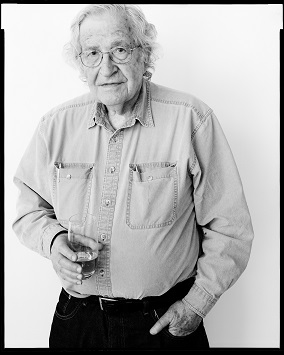
| Unfortunately, I can't see anybody out there but I assume there are
people there. I'm going to be talking--I'll be talking primarily
about West Asia, which overlaps pretty closely with what we call,
here, the Middle East or the Near East. Some of these remarks are
going to be highly critical of the practices of states in the region,
including the currently most powerful states, Israel and Turkey.
Supporters of their criminal practices often charge that these
criticisms are unfair, they overlook the conflicts and the threats
that the states face, the states and the societies face. And I think
those charges are, in part, correct. The criticism has an element of
unfairness, but for a different reason. The conflicts and the threats
are certainly real and serious, but they in no way justify the
continuing barbarous practices and actions that have gone on over many
years and are in large measure responsible for the threats that now
exist.
But these vicious practices are only to be expected. In a
situation of conflict and threat, the state authorities will resort to
any means that they can get away with; that includes serious war
crimes, crimes against humanity, and they will do so, as long as their
crimes are tolerated and supported and sometimes encouraged by the
overlord. If the master says that's enough, they stop. Therefore, it
follows that our criticisms should be directed primarily to
ourselves. Indignation about the crimes of others is easy and cheap
and not particularly attractive, sometimes even shameful. Looking in
the mirror is far more important, much more difficult. And in these,
and many other cases, our participation in crimes is quite real, and
it proceeds at several different levels.
In the first place, it's a matter of government policy, decisive
military, economic, diplomatic support for crimes, all with full
awareness, over many decades. At the second level, it goes on at the
level of doctrinal institutions--media, schools, universities,
intellectual journals, often scholarship. That includes evasion or
suppression of crucial facts, plenty of outright falsification,
sometimes even unconstrained enthusiasm for atrocities.
And at the third, and most important, level, it's a matter of our
own choices. None of this is graven in stone. There are many
examples rather similar to this, where things have been changed by
public action. We may remember that this month, March, 2002, happens
to be the 40th anniversary of the first public announcement of the
U.S. attack against South Vietnam. In March, 1962, the Kennedy
administration announced that the U.S. Air Force would be flying
missions against the South Vietnamese. Use of chemical warfare was
instituted to destroy food crops. Hundreds of thousands, ultimately
millions of people were driven into concentration camps, urban slums.
Napalm was authorized.
All of this proceeded with no protest. That's why there's no
commemoration, today, of the 40th anniversary. Nobody even
remembers. There was no protest, virtually none, here in Berkeley or
in anyplace, for a long time. It took years before substantial public
opposition developed. It did finally develop, as somebody, Barbara,
somebody pointed out, and it made a big differences.
One of the differences it made is that it contributed, along with
the civil rights movement and other activism of the time, to making
this a much more civilized country, in many ways. I'm not talking
about the leadership, I'm not talking about the intellectual classes,
but the general population has changed. No American president could
dream of anything remotely like that today. And the same is true in
many other areas. And it didn't happen by magic or "gifts from
angels" or anything like that. It came from committed, dedicated
public activism on the part of millions and millions of people. And
it did make a much better country. There's plenty wrong, but, as
compared with 40 years ago, the improvement is enormous.
And there are many specific cases just like this one. Again, I
couldn't hear clearly from the back, but somebody mentioned South
Africa, which is a rather similar case. We may remember that, as late
as 1988 the U.S. government condemned Nelson Mandela's African
National Congress as a terrorist organization-- in fact, in their
words, one of the world's "more notorious" terrorist organizations,
and supported, accepted South Africa, in its worst days of apartheid,
accepted it as a welcome ally. That was, after just during the
Reagan/Bush years alone, South Africa, with U.S. and British support,
had killed about a million and a half people in the surrounding
countries, forgetting what happened inside, and caused about $60
billion of damage in the surrounding countries. But it was a welcome
ally and its opponents that were struggling for liberation were one of
the more notorious terrorist organizations in the world.
Within a few years, Washington was compelled to abandon and reverse
that stance. It was compelled by an aroused and activist public, if
you trace the revision to its roots, and that's far from the only
case. In fact, there really are choices, in these and in other
cases. If we don't make the choices, we are participants in the
crimes, knowing participants.
Well, let me turn to West Asia with that in the background. Policy
makers want us to focus on what they call the "axis of evil", which I
think is worth doing, I think we should laugh at it, and I want to
return to that. But they understand that, to pursue their goals,
they're going to have to make some gestures, at least, about what's
called, here, the Israel-Palestine conflict, a phrase which suggests a
certain symmetry, although the actual coverage regards Israel as the
victims of mindless and insane Palestinian terrorism.
Well, since some gestures are necessary to pursue the other goals,
the U.S. government ordered the Israeli government to withdraw its
tanks and armed forces from Palestinian towns and refugee camps, and
they instantly obeyed, as always. Cut a few corners, but they
followed orders quickly. That demonstrates once again, not the first
time, where power lies and where responsibility lies. For the rest of
the world it underscored again what they already knew: that it's not
a symmetrical Israeli-Palestinian conflict, it's a military occupation
now in its 35th year--harsh, brutal and oppressive. Continues because
of the decisive unilateral support by the United States at all the
levels I described. It's in gross violation of international law and
has been from the outset.
And that much, at least, is fully recognized, even by the United
States, which has overwhelming and, as I said, unilateral
responsibility for these crimes. So George Bush No. 1, when he was
the U.N. ambassador, back in 1971, he officially reiterated
Washington's condemnation of Israel's actions in the occupied
territories. He happened to be referring specifically to occupied
Jerusalem. In his words, actions in violation of the provisions of
international law governing the obligations of an occupying power,
namely Israel. He criticized Israel's failure "to acknowledge its
obligations under the Fourth Geneva Convention as well as its actions
which are contrary to the letter and spirit of this Convention."
That Convention is no minor affair. It's one of the core
principles of international law. It was established in 1949, to
formally criminalize the actions, the practices, of the Nazis in
occupied Europe. Well, George Bush's condemnation of Israeli
practices in violation of international law, as the occupying power,
that expressed official US policy at that time. However, by that
time, late 1971, a divergence was developing, between official policy
and practice. The fact of the matter is that by then, by late 1971,
the United States was already providing the means to implement the
violations that Ambassador Bush deplored. It was backing what had
happened in that year.
To recall to you, those who may not know or have forgotten, in
February, 1971, Egypt offered a full peace treaty to Israel, exactly
in terms of official U.S. policy. It didn't even mention the
Palestinians, wasn't an issue at the time, didn't mention the West
Bank. It just mentioned Egyptian territory. Israel recognized it as
a genuine peace offer, considered accepting it, decided not
to--remember, this is the dovish labor party, this is Golda Meir's
government, not Ariel Sharon, although Sharon in fact was, under their
orders, implementing some of his worst atrocities at that time. These
were bipartisan programs.
So, no mention of the Palestinians, full peace treaty. Israel
decided not to accept the full peace treaty that was offered by its
major adversary, Egypt, on the assumption, openly discussed
internally, in Hebrew, that they thought if they held out they could
do better in gaining more territory. The United States had to make a
decision. Should it continue to support the official policy, the one
Bush reiterated at the U.N. a couple of months later, and go along
with Egypt, call for a full peace treaty? Or should it follow Henry
Kissinger's preference of what he called "stalemate," meaning no
negotiations, just delaying tactics, slow integration of the
territories within under Israeli control, of course funded and backed
and supported by the United States, while the U.S. continued to block
diplomatic settlement.
Well, Kissinger won the internal conflict, and from that point on
U.S. official policy and U.S. actual policy have diverged and continue
to diverge. It wasn't until Clinton that the official policy was
formally abandoned, including the concern for international law and
U.N. resolutions, which were effectively rescinded by Clinton. But
until that time, the policy officially remained as Bush had described
it, though the practice was as Kissinger had laid it out.
This program of blocking diplomatic settlement, a diplomatic
settlement that has almost universal international support, that
program has a name, it's called the peace process in standard
rhetoric. So you read about the U.S. implementing the peace process
and calls for the U.S. to intervene more directly to advance the peace
process. What the peace process is, not only in this case--this is
common--the peace process refers to anything the United States happens
to be doing, maybe blocking peace, as in this case.
That's one of the levels of participation in atrocities. Well,
during these, by now, over 30 years of extreme rejectionism and
obstruction of diplomacy, United States policy has continued a dual
track, up till Clinton. It's officially kept the position that Bush
had enunciated, in practice kept to Kissinger's preference for
stalemate, slow integration of the territories, delaying tactics,
consolidation within Israel, meaning U.S. and Israel.
What about the Palestinians. Well, the plans for the Palestinians
were enunciated at the same time. This happens to have been
internally, in secret cabinet meetings, but the records have been
released, in Israel. Moshe Dayan advised the cabinet, this is the
dovish cabinet, that, with regard to the Palestinians, we should tell
them that they will live like dogs and whoever will leave will leave,
and we'll see where that goes, while we quietly proceed to establish
what he called "permanent rule" over the territories. Notice, I'm not
quoting an extremist, except an extreme dove. Within the spectrum,
Moysha Dyan was one of the leaders who was most sympathetic to and
understanding of the position of the Palestinians and their needs and
what was happening to them.
Well, those policies continue. They go on right to today. They go
on through the Oslo phase of what's called the peace process.
Internally in Israel, in Hebrew again, which is a secret language,
trusting the Western commentators not to report it, at the dovish end
the official negotiator for Barak, Shlomo ben Ami who's sort of on the
dovish side of the spectrum, he, just as he entered the government, in
1998, he wrote a book in Hebrew in which he discussed the Oslo
process. And he pointed out that the goal of the Oslo process is to
establish what he called a permanent neo-colonial dependency for the
Palestinians in the occupied territories. Which is accurate, that was
the goal of the Oslo process. It was perfectly transparent, in the
original documents, the declaration of principles that was signed with
great fanfare in September, 1993. The Palestinians, unwisely, chose
to disregard the evident facts and to believe otherwise.
The perpetrators of crimes can choose to delude themselves, if they
like, but the victims would be well-advised to pay close attention,
not just in this case. What that meant is, and what ben Ami repeated
in 1998, is that the goal of the Oslo process, the long-term goal, was
to establish something like what South Africa established in 1962,
when Transkei, the first of the Bantustans, was formerly established,
I think that was the year, as a state, black state, run by black
people. In fact, more viable than what's intended for the
neo-colonial dependency in Palestine. They actually even put
resources into it, contrary to what the U.S. and Israel do, not
because they're nice guys but because they were hoping to get
international recognition.
If the "master of the world" had recognized it, we would be
celebrating the independence of Transkei today, if they could have
gotten away with it. Fortunately, they couldn't. Well, Ehud Barak,
while he and Clinton were being praised for their magnanimous offers
at Camp David in mid-2000, he was going ahead with the standard
project, establishing illegal settlements. In fact, the last year of
his term in office, the settlement program reached its highest level
since 1992, the year before the Oslo process began. The goal was to
ensure that whatever came out would be a permanent neo-colonial
dependency, exactly as they said. It's a secret only if we choose not
to hear what's being said.
At the time of the Camp David agreements, the Israeli
government--when I say Israel, I always mean U.S.-Israel. They can't
do it without U.S. support and encouragement. So the government had
established, according to Amnesty International, 227 Palestinian
enclaves in the West Bank, all separated from Jerusalem and from Gaza,
also, which was also cantonized -- a lot of them, most of them in
fact, a couple of square kilometers, little dungeons. And in fact,
the magnanimous offer at Camp David that we were all supposed to
applaud, was an improvement. It assembled these 227 enclaves into
four distinct, separate cantons in the West Bank, northern,central and
southern, separated by salients that broke the area, virtually
bisected it up, in the north and again in the south, all separated
from Jerusalem, small area of Jerusalem, which is traditionally the
center of Palestinian life.
With regard to Gaza it was kind or vague, but probably more or less
the same. If you recall the period of celebration of Clinton and Camp
David--well, you can check this yourself. I don't read the California
newspapers, but I looked pretty hard and I could not find, in the
United States, any maps. I mean, we're all applauding the settlement
that Clinton and Barak proposed, but it was impossible to find a map
describing them, in the United States. It was easy if you looked
anywhere else. So the Israeli press published the maps, the British
press published them, but, as far as I'm aware, no maps were published
in the United States, at least not in the national press.
And I think there's a reason for that. If you looked at the maps,
you immediately saw that you can't possibly be praising this as a
magnanimous and forthcoming offer. In fact, it didn't even approach
what South Africa had done, 40 years earlier. All of this continues
thanks to U.S. support and encouragement at all three of the levels
that I mentioned--at the level of policy, at the level of the press,
doctrinal institutions. In the press, I guess the most extreme
example of sort of fanaticism or whatever the right word is, is Thomas
Friedman of the New York Times. He wrote, at the time, that President
Clinton has spoken and now we know, as he said, what the outcome must
be. Of course, we have the words of the master. You have to go back
to the darkest days of Stalinism to find anything comparable to that.
When the Palestinians refused, that shows how terrible they are.
The third level of support for this is, of course, ourselves.
There were protests, but not enough. Well, let me come forward right
to the present moment. Just last week the two major human rights
groups in the world, Amnesty International and Human Rights Watch,
issued very eloquent pleas to allow international monitors to be sent
to the territories. Amnesty International, to save Palestinian and
Israeli lives, and, Human Rights Watch, once again, "to end Israel's
excessive and indiscriminate force" against civilians.
Amnesty International's appeal begins by saying that Palestinian
and Israeli children are slaughtered; ambulances carrying wounded
Palestinians are shot at; Palestinian homes are demolished, their
towns and villages sealed off. Remaining silent amounts to condoning
the escalation of killings, violence, and retaliation. Here, the
Jewish Voices against Israel's occupation of Palestinian territories,
which was mentioned earlier. They'll have an ad in the New York
Times, I think this Sunday, saying pretty much the same things. And
in fact, as you heard, calling for suspension of military aid to
Israel, which is used to maintain the occupation, until Israel
withdraws from the territories and reduction of economic aid, by the
amount that's spent on maintaining the illegal settlements.
And there are other such voices. These pleas, all of them, are
addressed to the United States, which has refused to allow
international monitors and is blocking them. And everyone knows that
that's the easiest short-term way to lessen and reduce the level of
violence. The most recent case, explicit case, was on December 14th,
the Security Council of the U.N. debated a resolution calling for
implementation of the U.S. Mitchell Plan, reduction of violence and
dispatch of international monitors to monitor, to observe, and
facilitate the reduction of violence. It was vetoed by the United
States. A U.S. veto means, of course, it's finished. It also means
silence here, so it's scarcely reported, and out of history, like the
February, 1971 affair that I mentioned earlier.
It went to the General Assembly immediately and there was the usual
outcome, an overwhelming vote in support of the resolution,
essentially unanimous. U.S. and Israel opposed, joined by Micronesia
and another Pacific island, one of the small Pacific islands, I forget
which one, Nauru, I think, so it wasn't universal. And that of course
wasn't reported, it's not the "right" story.
All of this was at a very important moment. It was in the midst of
a long, three-week cease fire. During that cease fire one Israeli
solider was killed, 21 Palestinians were killed, 11 children,
according to journalist Graham Usher. That's technically called a
period of quiet, which lasted for three weeks, broken a couple of
weeks later. This was right in the middle of it. Right before that,
on December 5th, there had been an important international conference,
called in Switzerland, on the 4th Geneva Convention. Switzerland is
the state that's responsible for monitoring and controlling the
implementation of them. The European Union all attended, even
Britain, which is virtually a U.S. attack dog these days. They
attended. A hundred and fourteen countries all together, the parties
to the Geneva Convention.
They had an official declaration, which condemned the settlements
in the occupied territories as illegal, urged Israel to end its
breaches of the Geneva Convention, some "grave breaches," including
willful killing, torture, unlawful deportation, unlawful depriving of
the rights of fair and regular trial, extensive destruction and
appropriation of property not justified by military necessity and
carried out unlawfully and wantonly. Grave breaches of the Geneva
Convention, that's a serious term, that means serious war crimes.
The United States is one of the high contracting parties to the
Geneva Convention, therefore it is obligated, by its domestic law and
highest commitments, to prosecute the perpetrators of grave breaches
of the conventions. That includes its own leaders. Until the United
States prosecutes its own leaders, it is guilty of grave breaches of
the Geneva Convention, that means war crimes.
And it's worth remembering the context. It is not any old
convention. These are the conventions established to criminalize the
practices of the Nazis, right after the Second World War. What was
the U.S. reaction to the meeting in Geneva? The U.S. boycotted the
meeting, along with Israel and Australia. Australia was a surprise.
According to the Australian press, that was done under very heavy U.S.
pressure. They were the three countries that boycotted, and that has
the usual consequence, it means the meeting is null and void, silence
in the media. As for ourselves, that's for each person to decide.
Even the Clinton administration, which broke all records in
supporting Israeli government policies, was unwilling to publicly
oppose the applicability of the Geneva Conventions, particularly in
the light of the circumstances in which they were established. On
October 7th, 2000, that's a week after the intifada broke out, the
Security Council adopted a resolution deploring Ariel Sharon's
provocation at the mosque, the Haram al-Sharif, on September 28th, and
the violence there the next day, which was under the command of Ehud
Barak and his minister of security, Shlomo ben Ami, when a massive
police presence was sent to the mosque, as people left the mosque
after Friday prayers, the presence of the police predictably led to
stone throwing and shooting into the crowd and elsewhere, with deaths
and many wounded. And that set off the current intifada.
The resolution condemned all that. It also called upon Israel, the
occupying power, to abide scrupulously by its legal obligations under
the 4th Geneva Convention. The vote was 14 to 0, one abstention. A
U.S. abstention means a veto, in effect. A veto, also, from
reporting, because it wasn't reported as far as I noticed, and it's
out of history. But it stands as international law, adopted without
dissent, and in fact it simply reiterates what George Bush said in
September, 1971.
Well, there were other events at the same time, in September of
2000. The intifada began right after the September 28th and 29th
provocations. On October 1st what are called Israeli
helicopters--when you hear Israeli helicopters, that means U.S.
helicopters flown by Israeli pilots. Israel doesn't produce
helicopters, it doesn't produce F-16s, so Israeli jets and helicopters
means our jets and helicopters. They, on October 1st, began attacking
civilian targets, apartment complexes and others, killing and wounding
dozens of people. That went on October 1st and October 2nd.
There was a U.S. reaction, at all the levels. At the level of
government, the Clinton administration reacted, on October 3rd, by
finalizing the biggest deal in a decade to send military helicopters
to Israel, Black Hawk helicopters, others, also spare parts for Apache
attack helicopters that had just been delivered. Biggest deal in a
decade. The press collaborated by refusing to publish it. A friend
of mine did a database search and found one reference in the country,
in a letter written to a Raleigh, North Carolina, newspaper. There
were efforts to persuade editors to at least allow publication of the
facts that they knew--this is no secret, it was perfectly public
information. They knew it, but they wouldn't report it. So it's not
failure to publish, it's refusal to publish.
There were efforts to reach the public in other ways. Limited
effects. To this day, it is scarcely known that the U.S. reaction to
what I just described, the dispatch of the biggest shipment in a
decade of helicopters, immediately after those helicopters had been
used to attack civilian targets and kill and wound dozens of people.
The reaction was what I described and the press, silence.
Shortly after, Israel began using U.S. helicopters for targeted
assassinations, began a few weeks later. By now there are about 50 of
them. These are just straight murder. I mean, there's no evidence
presented, and none is needed. Also about 25 cases of the famous
collateral damage--wives, children, bystanders, figures vary a little
but they're in that neighborhood.
A petition was brought to the High Court, essentially Supreme
Court, in Israel, to call on the High Court to ban the murder of
people by U.S. helicopters. The court denied the appeal, saying that
it saw no reason, were its words, to ban this. The U.S. reaction:
send more helicopters, and jets and armaments, a huge flow. All with
the goal, it's got to be the goal because it's conscious, of enhancing
terror, to borrow George Bush's words, referring to the official "bad
guys."
What about diplomacy. Well, it continues. Last week there was a
U.N. resolution, the first one the United States has proposed in 25
years. A lot of fanfare about that. Why did the United States
propose a Security Council resolution on Israel and Palestine? Well
the answer was given by the more serious part of the press, the Wall
Street Journal, which, actually, it often does do the best reporting.
The point was, they said, to block a resolution that called for an end
to violence--that was coming along--but also referred to Israel as an
occupying power, and was therefore, in their words, an anti-Israeli
resolution. And clearly the U.S. must block these anti-Semitic moves,
so the U.S. blocked the anti-Israeli resolution that referred to
Israel as an occupying power, by advancing its own resolution.
Out of history is the fact that Israel, of course, is the occupying
power. It's recognized as such, officially, by the United States,
going back to George Bush No. 1, and even Clinton, who, as I
mentioned, his support for the Israeli government was extreme, only
abstained when the Security Council unanimously reiterated the
position that Israel is the occupying power, bound by the requirements
of the Geneva Conventions, but, for the Wall Street Journal, that's an
anti-Israel position. It's not surprising that's the standard
rhetoric on the issue.
What about the U.S. resolution? Well, it's totally vacuous. What
it says is we have a vision, somewhere in the future, of two states.
Notice that that doesn't even approach South African racists, 40 years
ago. They didn't have a vision of black states, they established
them. But we don't go as far as South African racists in the deepest
days of apartheid, and we praise ourselves for this progressive
stance.
Well, again, the question is, do we tolerate it? I mean, you can
tolerate it, it continues. There's also much discussion of a Saudi
Arabian plan that was introduced by Thomas Friedman as a real
breakthrough, with a lot of self-congratulation. He's rather stuck on
himself, as those who subject themselves to reading his column are
aware, but he's very proud of having made a real breakthrough in the
peace process. The press reported that maybe the Arabs have at last,
I'm quoting, come to drop their "implausible notion" that Israel is
just somehow going to go away," and they will finally grant Israel the
simple gift for which it is always yearned, namely, recognition of its
right to exist-- Wall Street Journal and other national newspapers.
Again, more serious journals, like the Wall Street Journal,
recalled, I'm quoting, that the idea of the Saudi Arabian resolution
proposal is not new. Saudi Arabia first presented it in 1981, but the
"hard line Arab states" shot the plan down. But now, two decades
later, they seemed to have softened. The plan at that time was
blocked by Syria, Iraq, and Arafat's PLO. Although, possibly, Israel
wouldn't have accepted it anyway. We can't be sure. That's quoting
the Boston Globe.
Well, let's return to the real world. The PLO approved the
resolution, didn't shoot it down. It did officially approve it, with
qualifications however. The qualification was that the 1981 Saudi
plan did not mention the PLO. As for Syria, it objected to one thing,
namely, the fact that the Saudi Arabian proposal did not refer to the
conquered Syrian Golan Heights.
The other Arab states, their reaction was ambivalent. They didn't
reject it, but they awaited some sign that the United States and
Israel would show some interest.
What about Israel's reaction? It's not mentioned in the reporting
but it was there. Shimon Peres condemned the Saudi proposal, this is
'81, because it threatened Israel's very existence. The official
Labor Party newspaper, Davar, reported that the Israeli air force had
carried out military flights, with U.S. planes, over the Saudi Arabian
oil fields. This was, they interpreted, as a warning to the United
States not to take the proposal seriously, or else. If it did, Israel
would use its U.S. supplied military capacity to blow up the oil
fields. The Labor Party newspaper described this as so irrational as
to cause foreign intelligence services to be concerned over Israeli
bombing of the Saudi oil fields.
One of the leading Israeli intellectuals, well-known in the United
States, Amos Elon, described the Israeli reaction as shocking,
frightening, if not downright despair producing. Over toward the
center right, correspondent Yoel Marcus condemned what he called the
frightened, almost hysterical response to the Saudi plan, which he
regarded as a grave mistake.
The most interesting reaction was that of Israel's president, Haim
Herzog, also something of dove. He wrote that the real author, his
words, the "real author"of the Saudi plan was the PLO. And he went
onto say that the plan that the PLO had written was even more extreme
than the Security Council resolution of January, 1976, "prepared by"
the PLO, he claimed, proposed by the Arab confrontation states, Syria,
Egypt and Jordan. Supported literally by the entire world but
fortunately vetoed by the United States, as usual vetoing it from
history. That resolution called for full implementation of UN 242,
those of you who follow this know that that's the core resolution
guaranteeing the rights of all states in the region to live in peace
and security within recognized borders. It included all that
wording. But it added to it the Palestinian state in the occupied
territories.
So the U.S. vetoed it, as it continued to veto or block others in
subsequent years, up to the 1981 plan that caused such hysteria, and
in fact beyond and right up to the president. Herzog had been the
U.N. Ambassador of Israel, in 1976, when the terrible resolution came
up. He was actually wrong in what he said. The Saudi Arabian plan in
'81 was virtually the same as the Security Council resolution that the
U.S. had vetoed. And of course the idea that the PLO had prepared
either of them is absurd, but they did support them.
But it does reflect the hysteria, among Israeli doves, over the
Saudi peace proposals, backed by--the United States made it very
clear, in 1981, that it would not consider the Saudi plan. That's
what in fact happened. The coverage today is a little bit different.
Something else was happening at the time of the Saudi plan in
1981. Israel was at that time just beginning the preparations for the
invasion of Lebanon, which took place a couple of months later. At
that point, they began the provocations in Lebanon to try to elicit
some PLO action which could be used as a pretext for the invasion.
There were bombings, killings, sinking fishing boats, all sorts of
other things. They were unable to elicit a pretext, so they just
invaded anyway, with U.S. support, killing about 20,000 people. A
couple of U.S. vetoes of Security Council resolutions let it continue.
What was the point? Well, at last I can quote the New York Times
saying something accurate. The goal of the invasion, I'm quoting the
New York Times, this January--the Israeli government's goal in
invading Lebanon was to "install a friendly regime and destroy Mr.
Arafat's Palestinian Liberation Organization. That, the theory went,
would help persuade Palestinians to accept Israeli rule in the West
Bank and Gaza Strip." So that was the point of the invasion of
Lebanon.
That report is quite correct, and, as far as I'm aware, it's the
first time in the United States that any public, any media or often
even scholarship or anything else, has recognized what was completely
transparent, open and obvious all throughout the Israeli press and
commentary, 20 years earlier. That was announced right away. If you
read dissident literature, you knew it. But finally, on January 24th,
2002, the New York Times permitted itself to publish a line, hidden in
a column on something else, which told the truth, that they had all
known for 20 years, namely that the U.S.-Israeli attack on
Lebanon--not small, 20,000 killed, approximately--that that was a
textbook illustration of international terrorism, as defined in the
U.S. code and by U.S. army manuals, the use of extreme violence, in
this case, to obtain political ends, by intimidation, coercion and
imposing fear.
Maybe it's not international terrorism, maybe it's the more serious
war crime of aggression, in which case we should have Nuremberg trials
instead of just an international tribunal, but at least that. That's
what was going on in 1981 at the time of the Saudi Arabian peace plan.
However--and in fact, the person who was most influential in
preventing people here from knowing anything about this was good old
Thomas Friedman, the man who's now taking credit for the breakthrough
of reintroducing the Saudi plan of 20 years ago that the U.S. and
Israel shot down, contrary to reporting. So, right through the 1980s,
when he was the New York Times' correspondent in Jerusalem, he was
denying explicitly what he knew to be a fact. You could read a
headline in the mainstream Israeli press, which he reads, which would
say "PLO Arafat offers negotiations, Peres says no." A couple of days
later you read a column in the New York Times by Thomas Friedman
saying that Shimon Peres and Israeli doves lament the fact that
there's no Arab peace partner. All the Palestinians want to do is
kill. Arafat refuses to negotiate. That's within a few days.
This continued through the 1980s. Friedman's own position, which
he reported in interviews in the Israeli press in April, 1988, at the
time when he won the Pulitzer prize. His own advice to Israel was
that they should run the occupied territories the way they run
Southern Lebanon, that is, with a military occupation, a mercenary
terrorist army, to keep people under control, major torture chamber in
Khiam, in case anybody gets out of line--all common knowledge. And
that's what he advised for the occupied territories, but, being a
liberal he said, you should allow the Arabs to have something, I'm
quoting, because "if you give Ahmed a seat in the bus he may lessen
his demands."
Now you can imagine, back on the darkest days of apartheid, that
someone might have suggested that "if you give Sambo a seat in the bus
he may lessen his demands," but the chances that that person would
then get a Pulitzer prize and be appointed to chief diplomatic
corespondent on the New York Times are perhaps less than 100%
Anyhow, he's improved. You got to give credit where credit is due.
He's improved a lot since then. It might be helpful if he told us
what he was doing in the 1980s and the press told us what they were
doing, but you can't have everything. The U.S. stand at the time, the
official U.S. stand, in December, 1989, was the Bush-Baker plan. That
called for--here's the wording. It opposed the establishment of "an
additional Palestinian state" between Israel and Jordan. The word
"additional" means that there already is a Palestinian state, namely
Jordan, so there's no moral issues. And they didn't want that there
to be an additional Palestinian state, additional to Jordan.
Furthermore, the affairs of the occupied territories, the West Bank
and Gaza Strip, will be resolved in accord with the policies of the
government of Israel. The third position was that there would be a
free election in the occupied territories held under Israeli military
occupation, with most of the Palestinian intelligentsia in jail, under
administrative detention, under torture. That was, of all of that,
the only part that made it to the public was the forthcoming gesture
in support of a free election--no conditions mentioned. That's the
U.S. plan of December 1989. Shortly after that came the Gulf War.
The world backed off, knew the U.S. is going to run this region by
force. That's the end of international diplomacy. On the issue of
the pressures that the U.S. had resisted, the U.S. was at that point
able to institute its own unilateral rejectionist program, leading to
the permanent colonial dependency and the 227 "little dungeons" of
December 1999, to be united into four cantons in the West Bank under
Israeli control, while we all applaud Clinton's magnanimity.
Well, I'm going to skip the disgusting record of how the United
States and Israel have implemented Dayan's prescription for 35 years,
and let's turn to other parts of West Asia, the last couple of
minutes. Back to the axis of evil. Why an axis of evil? Well,
what's in the mind of George Bush's speech writers when they give him
that phrase to read? I mean, we don't have internal documents so I'm
speculating now. But a reasonable speculation, I think, is that all
of this stuff, it's really aimed at a domestic audience, primarily.
September 11th did have an effect around the world, same effect
everywhere, perfectly predicable. The effect was that harsh and
repressive elements around the world recognize that they have a window
of opportunity. They can pursue their own agenda relentlessly, while
the population is frightened, obedient, silenced by a one-sided appeal
to patriotism, meaning you shut up and I'll pursue my own plans even
more aggressively and more relentlessly than before. Exactly how
that's implemented, well, it varies country to country. In Russia,
China, Turkey, Israel, other countries, Algeria, it means increasing
the repression. We got our chance, we're going to increase violence
and repression.
In the more democratic countries, like the United States, it means
doing whatever you can to impose, to strength state power, subdue the
population, protect the powerful state from scrutiny, and here,
particularly, to escalate an attack against the domestic population
and future generations, which is quite severe and which I don't have
to review, you're familiar with it. That's what's been going on since
September 11th, and it's crucially important to keep people from
paying attention to it.
Well, how do you keep people silence and submissive? Everybody
understands this. The best way to control people is by fear, and the
easiest way to do it is to just pull a couple of lines out of standard
children's stories or ancient epics about how an evil monster is
coming to destroy you and the incarnation of --
It happened that while this stuff was going on, I was in India, and
to sort of try to get to sleep at night, I was reading Indian epics,
which are kind of fun. The main epic, the Ramayana, is about exactly
this. I think Bush's speech writers must have plagiarized it. The
incarnation of Vishnu comes down to earth, is the perfect man, he's
going to drive evil from the world. And it becomes the story of how
he does it. That had some literary value, as compared with the
plagiarism, but its picture is about the same. So that's where the
evil is, and the hero, and you huddle under the shadow of the hero,
and so on. Namely, don't look at what the hero's doing to you, which
is not pretty.
Why axis? Well, I doubt that Bush knows what the word refers to,
but the population is supposed to recognize the connotations. You're
supposed to think of the Nazis, and Italy, and Japan, so on. Well,
going back to the real world again, the three countries that are the
axis of evil, Iraq and Iran have been at war for the past 20 years.
North Korea has less to do with either of them than France does.
North Korea is tossed in presumably for two reasons. For one thing,
it's totally defenseless, therefore it's isolated, perfect target to
attack, easy, cheap, nobody will object. Of course, bringing it into
the axis of evil does severely increase threats in the region. South
Koreans don't like it at all, or the Japanese or others, but that's a
marginal issue.
Furthermore, North Korea's not Muslim, so therefore it may deflect
the belief that U.S. policies are targeting the Muslim world.
What about Iran? Well, Iran's plenty of evil, undoubtedly.
There's an internal conflict in Iran, between the reformist elements,
which have an overwhelming popular support and are trying to improve
the situation, and a reactionary and dangerous clerical element,
serious. And they got a real shot in the arm from this. For Iran to
be called part of the axis of evil is a tremendous boon to the most
dangerous and reactionary sectors of the society and very harmful to
the reformists.
The history of Iran, in the last 50 years, explains the notion evil
very clearly. Again, it takes kind of discipline for the press and
intellectual community not to point out what's pretty obvious. In
1953, Iran was evil. What had happened was that a conservative
nationalist government was elected and was making moves to try to take
control of Iran's own resources, which had been run by the British.
So that was evil, and it had to be overthrown by a U.S.-British
military coup, which installed the Shah, a brutal,harsh ruler, who
went on, for 26 years, to compile one of the worst human rights
records in the world. He was always ranked right at the top by
Amnesty International and others, serving U.S. interests, major
military power.
So Iran was good. If you look at the coverage in that period,
there's little discussion of Iranian crimes. Actually, some
interesting reviews of this. Then, in 1979 they became evil again,
namely, the overthrew the Shah and turned toward independence, and
since then they've been evil, meaning out of control. Actually,
exactly why they remain evil is an interesting question. Usually U.S.
policy in that region is influenced heavily by the energy
corporations. And they've been trying for some years to join the rest
of the world in supporting Iranian reformers and bring them back into
the international system. But the U.S. government is opposed to
that. It insists on isolating and attacking Iran and supporting the
harshest elements, and that leads us to ask why.
My suspicion is that it's once again a factor, which is indeed a
guiding factor in world affairs, it even has a name, in the
international affairs literature. It's called "establishing
credibility." That was the primary public reason given, official
reason given, by Britain and the United States for bombing Serbia. We
had to establish our credibility. What does that mean? Well, if you
want to know, then go to your favorite Mafia don and he'll explain it
to you. If some storekeeper doesn't pay protection money, you don't
go get the money, you make an example of him. You beat him to a
pulp. Then people get to understand that you do not defy the orders
of the master. That's called credibility. And if anyone gets out of
line, you have to make an example.
Iran did get out of line, and even if there would be economic
interests and so on in restoring them, there's an overriding need,
understandable, on the part of the "masters", to make sure that no one
else gets the wrong idea. I suspect that's the guiding reason, once
again, as it often is, even publicly announced to be.
What about Iraq? Well, Bush and Tony Blair, who the London
Financial Times recently described as the U.S. Ambassador to the
world. The other press describes him in a little less complimentary
terms--America's poodle and things like that. Bush and Blair have
recently, just a couple of days ago, have repeated the standard line,
of Clinton and others, that we've got to get rid of Saddam Hussein.
He's such a criminal that he has even used chemical weapons against
his own people. You heard that in Bush's presidential news conference
a couple of days ago. And that's perfectly true, he did use chemical
weapons against his own people, an ultimate crime. All that's missing
is that he did it with the full approval of Daddy Bush, who continued
to support him right through that period and beyond, as did Britain.
They thought it was just fine for him to use gas against his own
people, to develop weapons of mass destruction, which he was doing
with the support of the United States and Britain, which continued,
irrespective of his atrocities, because he was useful at that time.
Until those words are mentioned, we know that you can't even use
the term hypocrisy, it's unfair to the term hypocrisy to talk about
the coverage of this with the omission of the fact that the crimes are
very real and we supported them, and continue to support them
afterwards. Bush's support was particularly fulsome. In early 1990,
well after that, he actually sent a high level senatorial delegation
to Iraq, just a couple of months before the invasion of Kuwait. It
was headed by Bob Dole, soon to be presidential candidate. The
purpose of the delegation was to convey to Bush's friend Saddam his
greetings and good wishes, and to assure him that he shouldn't pay
attention to the occasional criticisms he hears in the United States.
It's just that some of the American reporters are kind of out of
control and we've got this free press thing and don't have a way to
shut him up. But in fact, we think you're a fine guy.
Until some of that is brought in, we know that all the talk about
those reasons are just--don't even rise to the level of nonsense. So
we put that aside. I mean, it's true that he's a monster. He was
much more of a monster then. It's probably true that he's developing
weapons of mass destruction. Then, he was certainly doing it with our
support, and he was far more dangerous, way more powerful and much
more dangerous. He's a threat to anybody within his reach, but the
reach is smaller now. He's evil, all right, but his crimes can't
possibly be the reason for the planned attack.
So what is the reason? Well, I don't think it's very obscure.
Iraq has the second largest oil reserves in the world, after Saudi
Arabia. It's been clear all along that the United States, one way or
another, will find a way to regain control over those enormous
resources, and it will certainly not permit privileged access to them
on the part of its adversaries. France and Russia have the inside
track now, and that's not tolerable. Maybe close behind them is Dick
Cheney, according to what I understand, who seems to be getting Iraqi
oil into the country, but I don't know about that.
Anyway, France and Russia can't have privileged access. The U.S.
has to take control over them. And, sooner or later, will do so, try
to do so. They may regard this as a window of opportunity. However,
it's not going to be easy. There's a lot of talk about the technical
difficulty, but there's a much more fundamental one. Any regime
change in Iraq has to be carried out in a way which ensures that it is
not even marginally democratic, and there's a good reason for that.
The majority of the population of Iraq is Shi'ite, and if they have
any voice in a new regime, they might draw Iraq closer to Iran, which
is the last thing the United States wants. The Kurds are going to
press for some kind of autonomy, so that can't be allowed. It will
drive Turkey berserk.
And therefore the new regime, whatever it is, has to be ruled by
Sunni generals, military force. That's why the C.I.A. and State
Department are now convening meetings of generals who are defectors
from the Iraqi army in the 1990s. Unfortunately, their favorite
according to the press, General Khazraji, can't come, he's being
detained in Denmark where he's under investigation for participation
in the Halabja massacre, the chemical attack on the Kurds, so he can't
come, even though he's the guy we really want.
But that's the kind of regime that they'll kind of somehow impose.
Again, none of this is secret, and we can thank Thomas Friedman once
again for having explained it all. You may recall, in March 1991,
right at the end of the Gulf War when the U.S., of course, had total
control over the whole area, there was a rebellion, in the south, a
major rebellion, a Shi'ite rebellion, which could well have overthrown
the monster, probably would have, except for the fact that the U.S.
authorized Saddam to use his air force helicopters, planes, military
helicopters to devastate the resistance. In fact, there were probably
more people killed then, more civilians, than during the war.
This is all while General Stormin' Norman Schwartzkopf was sitting
there, watching it. He later said that the Iraqis had fooled him,
when they asked him for authorization to use helicopters, he didn't
really understand that they were going to use them. As he put it, he
was "suckered by the Iraqis", these deceptive creatures, and therefore
he didn't realize, and they sort of destroyed the resistance while he
was looking the other way.
At that point, it was so obvious, you just couldn't refuse to
report it. And it was reported. Thomas Friedman who was chief
diplomatic correspondent for the New York Times, then. Chief
diplomatic correspondent means State Department spokesperson at the
New York Times. You have lunch with somebody in the State Department,
he tells you what to write, that sort of thing. He had a column, a
good column, in which he explained the US position. He said, we just
had to allow Saddam to smash the opposition, and then he explained,
and it still holds, that "the best of all worlds" for the United
States would be "an iron-fisted military junta" that would rule Iraq
the same way Saddam did, and with the support of Saudi Arabia and
Turkey and of course the United States. That's the best of all
worlds, and we'll try to achieve it somehow. It's best if the name of
the head is not Saddam Hussein, that's a little embarrassing, but some
clone will do. That's what we have to aim at. And that's not easy to
achieve.
So, quite apart from all the technical problems, that has to go
on. Well, the phrase axis of evil is pretty much in the eye of the
beholder. There are others who see an axis of evil but a different
one. I'll finish with that. The semi-official Egyptian newspaper,
al-Ahram, had a long column a couple of days ago, called The Axis of
Evil, in which they referred to the evil axis of the United States,
Turkey and Israel. That's a realistic axis. [applause]. For one
thing, there's a close alliance, and the alliance is not secret, it's
overt, it's strong. These are the three. The U.S., obviously world
rule, Israel and Turkey the two major military powers in the region,
both of them more or less U.S. offshore military bases. They have
been aligned, for a long time, as part of a system aimed at the Arab
world, at the oil-producing regions. It's what Nixon's administration
called "local cops on the beat", with headquarters in Washington, to
make sure that people don't get out of control in the oil-producing
regions.
At that time, the Shah, Iran at that time, remember, was still
good, it wasn't evil yet, so it was part of the system, too. There
was an alliance between Israel, Iran, Turkey, Saudi Arabia, U.S. in
the background, Britain helping out, as part of the way of controlling
the region. And that axis of evil, the membership has shifted
slightly with Iran having become evil again, like in 1953, but it's
still there. And that's the axis that they see. And it's active.
Just the last couple of days, again today, the United States is
trying to convince, and apparently has convinced, Turkey to become the
military force which will fight the war on terror in Afghanistan.
Well, maybe that passes here, but everyone in the region, including
Turkey--I just returned from there--including the regions most
devastated by Turkish atrocities in the last decade. Everyone knows
that Turkey's a leading terrorist state, maybe one of the worst in the
world. And again, when I say Turkey, I mean the U.S. and Turkey. In
the 1990s, in the area that I just visited, southeastern Turkey, the
Kurdish areas, this is the site of some of the worst atrocities and
"ethnic cleansing" of the 1990s. It was bad enough in the '80s, got
much worse under Clinton. The U.S. supplied 80% of the arms. They
peaked in 1997--1997 alone, more arms were sent to Turkey than the
whole cold war period put together, up to 1984, when the
counter-insurgency campaign began. A couple of million refugees,
country devastated, tens of thousands of people killed. Far worse
than anything attributed to Milosevic, in Kosovo before the NATO
bombing.
Right through the late nineties Turkey became the leading recipient
of U.S. arms in the world, after Israel and Egypt. And the atrocities
included every imaginable form of barbarity and torture and terror you
can think of. But none of it happened. None of it happened for the
usual reason: we did it. Therefore, silence, out of history, and in
this case, applause. So Turkey is lauded by the state department and
the New York Times, front page stories by their terrorism expert,
Judith Miller, and others, as providing a model for how to deal with
terrorism.
Here's one of the major, the perpetrator of some of the major
terrorist atrocities of the 1990s, and, remember, international
terrorism, because you and I are doing it, which is lauded as a model
for how to put down terror. Well, that's pretty normal, and again,
same three levels that I mentioned before are worth thinking about.
Well, West Asia is going to face very difficult days. The stakes
for the world are enormous. This is the location of the world's major
energy resources. There are a lot of factors involved in this.
However, the most important of them happen to be right here, which is
a good thing, at least for those who hope to stave off the worst
outcomes and to offer some hope to the victims. Thanks.
---
If I can add one notice, I can't give the details and it's from
memory, but one of the really important things going on in Israel, as
you heard, is the refusal of reserve officers, a couple of hundred of
them now, to serve in the occupied territory. It's having a big
impact, it's very brave and honorable thing to do. And there are
support groups from them, some here. I'm pretty sure that Tikkun
magazine, which is located here, is organizing a support program for
them, and I think you ought to pay careful attention to it.
What can young people do to begin rebuilding this world? Well, you
know, same thing young people have been doing for years. I mentioned
before that this country's a lot more civilized than it was 40 years
ago. A good part of the reason is what young people then were doing,
here in Berkeley and many other places, and it had an effect. I
mentioned one effect, namely, barriers against the use of state
violence. It's not insignificant for much of the world. But that's
not the only one. Forty years ago there was no feminist movement,
there was no environmental movement, there were no third world
solidarity movements, there was no significant mass-based anti-nuclear
movement, no anti-apartheid movement, and on and on.
These are all things that developed through the active--to a large
extent, through the active participation of people who were then young
people, continued when they became older people, more young people
came along in the 1990s. There's new initiatives, like, say, the
anti-sweatshop movement throughout the world is mostly people your
age. The movements opposed to what is ludicrously called
globalization, meaning what the Wall Street Journal, my favorite
paper, calls free investment agreement, called for us free trade
agreements. The people who are opposing that are mostly young people,
many of them here. Actually, the major movements against that are in
the south, in Brazil and India and places like that. But we've joined
in, the north has joined in, with plenty of initiative from young
people. There's no limit to the things that can be done. And there's
plenty of models, right in front of you, last few years.
Q: At your talk Tuesday at U.C. Berkeley, you were not very
enthusiastic about the movement to divest from --that says Palestine
but I think it means Israel. Could you explain why?
Well, I just expressed my reservations, the same ones I expressed
here already. I don't say it's the wrong thing to do. I never trust
my own judgment on issues of tactics, which is not very good, my
judgment. But there are some problems that I see. The problem is
that the protest should be directed here. It's easy to criticize
others, but when those others are doing it because we allow them to
and arm them to do it and support them to do it and encourage them to
do it, there are some questions about directing our actions to them.
And that would be true if it's Israel or Turkey or other agents of
U.S. atrocities. So that's my reservation. How you figure out a way
around that you have to think through yourselves.
Q: You've said that we as citizens should not speak truth to power
but, instead, to people. Shouldn't we do both, speak more on this
subject?
This is the reference to about the only thing on which I find I
disagree with my Quaker friends. On every practical activity I
usually agree with them, but I do disagree with them about their
slogan, speaking truth to power. First of all, power already knows
the truth. They don't have to hear it from us, so it's largely a
waste of time. Furthermore, it's the wrong audience. You have to
speak truth to the people who will dismantle and overthrow and
constrain power. Furthermore, I don't like the phrase "speak truth
to." We don't know the truth, at least I don't.
We should join with the kind of people who are willing to commit
themselves to overthrow power, and listen to them. They often know a
lot more than we do. And join with them to carry out the right kinds
of activities. Should you also speak truth to power? If you feel
like it, but I don't see a lot of point. I'm not interested in telling
the people around Bush what they already know.
Q: My friend is a young Afghan American woman who is still in
high-school and has chosen not to live her life her; instead she's
chosen to earn a degree in teaching and move to Afghanistan, to reach
and help Afghan children. What advice would you offer her?
Specifically, what can she do to be most effective and protect herself
as a woman?
I mean, she knows, without knowing her, she knows 100 times as much
about this topic as I do, so I wouldn't offer her any advice. I would
offer ourselves advice. We have a responsibility to Afghanistan. The
United States and Russia, those two countries, destroyed Afghanistan.
In the last 20 years the two countries have destroyed Afghanistan. We
shouldn't be giving them aid. We should be paying them reparations.
We should be honest enough to do that. And we certainly shouldn't be
bringing in a leading terrorist state, which we have turned into a
terrorist state, in order to help them overcome terrorism, which is
what we're doing now. Just as we shouldn't have done to them what we
did in the last couple of months.
But there's a lot that we could do. It's not the only country in
the world to which we owe reparations, but it's one. And the way we
could assist this young Afghan woman is by doing the kind of thing
that she and others like her would ask us to do. And we should follow
their lead. We don't have anything to tell them.
Q: What's your opinion on the U.S. government knowing about the
September 11th attack but letting it occur in order to have
justification for an already planned war in Afghanistan?
It's a common view, and I've read it, over the internet, many
times. I think it's extremely implausible. Unless some really
serious credible evidence is produced, personally I wouldn't take it
very seriously, and I haven't seen any such evidence. It's very
unlikely. It's not the kind of thing that happens. I can't think of
anything remotely like it in history--maybe the Reichstag fire. But
it would be an extremely rare and implausible event, and there'd have
been no reason to do it. It would have been crazy, in my opinion.
If you think it's worth investigating, go ahead and investigate it,
but personally, I don't think it's credible or even, in my view, at
least, even serious enough to investigate.
Q: Recently, there has been talk of assigning the peacekeeping role in
Afghanistan to the Turkish military. Please comment on this.
Well, I already have. Will the Turks closely adhere to U.S.
policy? Sure, they'll do whatever we tell them. You provide some
country with 80% of their arms, you support them in all their
atrocities and repression, yeah, they're going to listen to what you
say. Just like Israel will, just like they did last week. Not
entirely. So, like I said, I just was in Turkey a couple of weeks
ago, and one of the big issues there being discussed in the press and
among people interested in foreign policy and so on, is that they
claim--I can't confirm it--but they claim that the U.S. is putting a
lot of pressure on them to serve as a military force for the planned
attack against Iraq. I don't know for sure that it's true, but it
could be, and they certainly believe it.
They've been saying publicly that they don't like it. The Prime
Minister said, No, we don't want to do it. And you can see the
conflict there in Turkey. On the one hand there's kind of an up
side. If they do do it for the United States, they'll get the
benefits of serving as a client. Also, there's a specific thing
here. A good bit of the population--the Iraq-Turkey border is an
artificial border, like just about every border, including our
borders. It's established by conquest. In fact, it was drawn by the
British, to ensure that Britain would have the control over the oil
resources of Northern Iraq, not Turkey. And the Turks are not
particularly happy about that. In fact a lot of the population on the
Iraqi side of the border is basically Turkish. And if they could
somehow get their hands on the oil around Kirkuk and Mosul they would
not be at all unhappy about it, they sort of think of it as their own,
with some reason, I should say. So that's kind of like an upside.
The downside is that that's Kurdish, a lot of that area is
Kurdish. They have carried out a vicious repression of their own
Kurdish population every since the 1920s when the state was
established. It's gotten a lot worse in the last 15 years, thanks to
us. And they don't want a bigger Kurdish population on their hands.
And they're concerned that--first of all, if there is an invasion of
Iraq it could turn into a slaughterhouse for the Kurds. I mean, it's
hard to predict what will happen, but they're right in the path of
every possible atrocity that might come along. And there might be a
Kurdish uprising and there might be a blow-up in the Kurdish areas of
Turkey, even though they are under tight military control, you can
never predict how that's going to work. And they're not happy about
that.
So, would they follow U.S. policy? Well, you know, mostly, but
there's some limits, for anyone. Even England might not follow U.S.
policies, in some respects.
Q: How have your studies in linguistics contributed to your analysis
of world events.
That's easy. Zero.
Actually it's negative, because it's taken time away from thinking
about world events.
Q. I've considered not paying my taxes, to protest the use of our
tax dollars to fund our government's military actions. What do you
think of this?
Well, as I said before, I never trust my own tactical judgment.
Just to give my own experience, back in 1965, along with a couple of
friends, I did try to organize a national tax resistance movement. I
can't claim it was overwhelmingly successful, it wasn't, but quite a
fair number of us didn't pay taxes for quite a few years, in my case
about ten years. I don't know if it was effective or not, I just
can't judge. I mean, I know what happened to some--the government
responds, it looks kind of random, the way they respond.
In some cases, they can go after you. Like, I know cases where
they went after people, took their houses and cars, and so on. In my
personal case, it was mostly a matter of sending passionate letters to
the IRS which were read by some computer which returned to me a form
letter that said whatever it said. Since there's no way, in my case,
not to pay taxes, they can go right to the source, which they did, the
source of the salary and take the taxes, plus a penalty, so they got
the taxes. And they didn't do anything more. But in some cases they
did.
How much effect it had on policy and what it would be if there was
really a massive tax resistance movement, which we were unable to
develop, I just don't know. These are hard, tactical judgments, I
don't have any particular insight. I don't trust my own advice, and
there's no reason why you should. |