
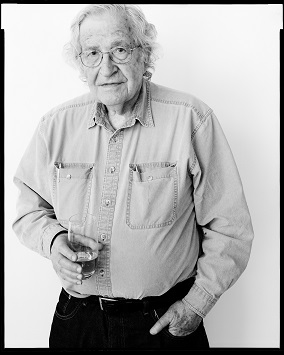
| He is the most frequently
quoted person on the planet. Noam Chomsky leads two separate,
influential lives: one as a linguist, the other as a human rights
activist. In both lives the responses he evokes are uncommonly
vehement – it seems he is either god or the devil. Yet Chomsky does
not seek followers. He wants everyone to see things for themselves, to
think and judge for themselves. On 7 December he turns 75.
His voice is never loud at the best of times, but today it is
particularly frail. The idea that Noam Chomsky is indefatigable turns
out to be part of the myth. This man who has been labelled so many
things – the Einstein of linguistics, the Darwin of our age, the
world’s leading intellectual, the anti-American extremist, the
charismatic leader of a sect – is all in. He’s just back from the
cornfields of Illinois, where a crowd of thousands gathered to hear
him speak on topics including the war in Iraq. Yet even today he has
one appointment after another. A Swiss camera team is still packing up
as I arrive, and the student after me is already waiting when
Chomsky’s assistant knocks on his office door to signal that my time
is up. The cheerful Bev Stohl keeps a strict watch on his schedule,
and no-one is allowed more than an hour.
That’s the way it is these days. “The past two years, ever since
September 11, have been terrible”, says Chomsky with a deep sigh.
“Every night it takes me an hour just to turn down invitations for
lectures and interviews.” Every day he spends six or seven hours
answering e-mails. He also has a seemingly endless stream of papers to
write, and new or revised books of his are constantly being published.
There must be more than a hundred by now – he has lost count – and
they reflect the double life he has led for more than forty years.
In one life he is the world-famous professor from MIT in Cambridge,
Massachusetts, who has totally changed the face of linguistics by
turning it into a quest for the human capacity for language. Many
thousands of researchers in dozens of countries are now part of that
quest, but Chomsky is still the pivotal, guiding force.
His second life, that of the activist, is harder to sum up. Perhaps
one could put it best by saying that Chomsky analyses, comments on and
above all criticizes the phenomenon of power – the power of government
(particularly in his own country, the United States), of commerce, of
the media. Drawing parallels with the past and keeping abreast of the
latest developments, he has spent decades explaining how he believes
these powers operate, and emphasizing their often disastrous impact on
entire populations, be it in Vietnam, Turkey, Palestine, East Timor,
Iraq, South, Central or North America or wherever. It is people that
matter to him. When asked what he himself would call the other,
non-linguistic Chomsky, he replies somewhat evasively: “Human. Things
that matter to people are what it’s all about. The fact that some are
concerned with these things is not surprising – what should be asked
is why everybody isn’t.”
Chomsky always emphasizes that there is nothing so special about the
things he knows and does. At most, he is prepared to admit to one
talent that not everyone possesses: “I can very easily switch from one
topic to another, whatever it is, and just carry on where I left off.
With friends who have the same ability, I can pick up the thread of a
discussion at exactly the same point even ten years later.” Yet this
combination of a cast-iron memory and an enviable ability to
concentrate surely does not suffice to explain Chomsky’s immense
influence on the thinking and actions of so many different people all
around the world. Nor can it account for the vehemence of their
responses to him. In both lives (when asked whether it feels like a
double life he replies: “Totally.”) he usually evokes either boundless
admiration or intense hatred. Chomsky is either god or the devil – few
people can see him any other way.
Not that there is anything particularly striking about his style or
appearance. What you see is a slight, rather shy man in a sweater. He
is now nearly 75. You can see it, and he can feel it, but it doesn’t
mean that much to him. When asked if he would like to be interviewed
to mark his birthday, he e-mailed back: “75? I guess so – hadn’t
thought about it.” Officially he retired five years ago, but you would
hardly know it. He still rests his feet on the open bottom drawer of
his crammed, battered desk, and as he talks his hands are constantly
playing with a scrap of paper or some other small object. His only
vanity is to have his hair cut by his wife Carol before being
photographed (he has known her almost all his life, and they were
married when he was 21). Yet as soon as he opens his mouth you start
to realize why he is so famous and notorious. Chomsky sounds rational,
cerebral and detached, but at the same time probing and deeply
committed to whatever his topic happens to be. He is utterly serious,
but will break into a smile at the most unexpected moments. His voice
is not only quiet but remarkably rapid, the voice of a highly
practised speaker.
During our three conversations only one question seems to stop him in
his tracks and make him think for more than half a second. I ask him
if he can remember how he first became interested in science. What
follows is a confession. “I have done things in my life that I am not
proud of,” he says. “There’s one thing I’ve never told anyone, except
probably my wife. In third grade we had to pick a topic for a project.
I don’t remember what I chose, astronomy or something, but anyway we
had to write an essay and I copied most of it out of the
Encyclopaedia Britannica. My first act of plagiarism. I guessed it
was wrong, but I didn’t tell the teacher, although I think she figured
it out.”
He didn’t get a bad grade for it, or even a good one. “We weren’t
given grades,” says Chomsky, who is still full of praise for the "free
school" he attended in Philadelphia (where he grew up). “It wasn’t
until high school that I realized I was a good student. The question
simply didn't come up. I knew I had skipped a grade, but what that
mostly meant was that I was the smallest kid in class and had to buy
the tickets when we used to sneak out and go downtown to the movies,
as I was the only one who could still pass for ten or whatever age it
was.”
Not only was Chomsky’s interest in science awakened (“As soon as I was
old enough to go on the subway, my best friend and I would spend whole
afternoons at the science museum, pressing buttons and looking at
weird and wonderful things”), but he had also learned that finding
things out for yourself was a whole lot more satisfying than being
taught them. He is quite convinced that a school system which
encourages pupils to pursue their own curiosity rather than pressuring
them to achieve would produce a totally different and far more
agreeable world, and people who are better informed than they are now.
To this day his only message is: see, think, judge and decide for
yourself. This is Chomsky’s own particular talent: he is very good at
stepping back and thinking about what it is he’s actually seeing.
That’s why he asks questions other people don’t ask. It's no accident
that Martians regularly crop up in everything he writes, whether the
topic is language or power. What would Martians see if they could
observe us from afar?
One thing they would see is that, all over the world, all children
start to speak. By the time they are six or seven all of them have
mastered whatever their language is. They don’t even have to go to
school – it just happens, whichever culture they live in. A Martian
would conclude that humans have an innate capacity for language, and a
more inquisitive Martian would want to know what that is, what all
those humans have in common – in other words, what their “universal
grammar” looks like.
It now seems almost inconceivable that this idea once roused people to
fury. For decades it was bitterly controversial. Language a biological
thing? Birds grow wings, people grow language, as Chomsky still likes
to put it? No way – it was all a matter of nurture and environment.
However, changes in our view of the world eventually put an end to
this controversy. It is now no longer taboo, as it was in the 1960s
and 1970s, to believe that many things are genetically determined, and
it is now generally accepted that the human brain has all kinds of
specialized functions.
There is a tendency to forget that Chomsky did a good deal to pioneer
the now flourishing “cognitive neurosciences”, which are revealing
more and more of our brain functions, most recently with the help of
ingenious equipment that enables us to look inside living, working
brains. That was unthinkable in the days when the American behavioural
psychologist B. F. Skinner ruled the roost. Among other things,
Skinner had become world-famous for his experiments with pigeons,
which he taught to do all kinds of quite complicated tricks by
consistently rewarding them when they got it right. In this way you
could “condition” behaviour to be just the way you wanted it. The
basic principle of behaviourism – which started with Pavlov’s dogs –
was that this was sufficient to explain all behaviour. Learning was
simply a matter of action and reaction, of stimulus and response. In
1957 Skinner published his book Verbal Behaviour
in which, as the title indicates, he explained language
as just one more form of behaviour. Children, he said, were
effectively trained in just the same way as pigeons. They learned
language by imitating their parents, who rewarded them when they got
it right – with encouragement and praise. Their mistakes were
systematically corrected until they eventually stopped making them.
Once they had learned language, they would live the rest of their
lives in a world full of “stimuli” that evoked “verbal responses”.
Chomsky’s devastating review of Skinner’s book in 1959 heralded the
end of behaviourism and Chomsky’s emergence on the world scientific
stage. The arguments he put forward then are still fundamental to his
work. One of the most special properties of language, he said, is that
its possibilities are quite literally endless. You could not list all
the sentences in a language even if you tried – for you can start a
new sentence in the middle of another sentence, and even then you can
always insert an extra word. There is no question of a particular
stimulus that produces a fixed, predictable response. For instance,
someone who sees a picture can say countless different things about it
– or nothing at all. Furthermore, anyone can start talking about
anything he likes whenever he likes, even something that does not
exist. The idea that all parents constantly correct, let alone praise
their children is clearly untrue, yet all children – unless they have
very severe disabilities – learn to speak. Nor can imitation account
for why all children make the same kinds of mistakes. For instance,
they say “sleeped” and “drinked” and “sheeps” and “tooths” – things
they cannot have heard from their parents, but which strongly suggest
that they understand the basic rules but have not yet grasped the
exceptions.
Scientific advances often begin with someone asking what turns out
with hindsight to be a fairly obvious question. “Not so very long ago,
no-one wondered why a ball falls downwards rather than upwards when
you let go of it,” says Chomsky. He started asking questions when
pursuing his study of Hebrew, which he had picked up from his parents
– Jewish immigrants from the Ukraine and Russia who had come to
America when they were still young and were both Hebrew scholars. “I
really had no background at all in linguistics,” recalls Chomsky. “I
only knew something about historical Semitic grammar because I had
read my father’s work on mediaeval Hebrew. I came across structuralist
analysis at university, and started applying it to modern Hebrew.”
Structuralism, which was the main linguistic current in America at the
time, yielded detailed phonological and morphological descriptions of
the most diverse languages.
But this was not what Chomsky was after. “What surprised me was that,
if you looked closely at the detailed material that was presented in
structural analysis, it was basically lists,” he says in a voice that
still betrays something of that initial surprise. “But if, for
example, you wanted to look at the formation of questions in a
particular language, there was almost nothing you could find. In that
respect it was all much the same as in traditional grammar – it
contains lots of information, but it presupposes the reader’s capacity
for language. He already knows the principles, simply because he is
human, so he has a fairly good idea of what is meant. Such grammars
thus serve a purpose, just like dictionaries. You think they tell you
what words mean – until you want to know what a word really
means, and then you discover that dictionaries merely give hints.
These are enough for everyday purposes, yet even something as simple
as a ‘cow’ is in fact an extremely complicated concept. It’s only when
you try to discover how we manage to use traditional grammars and
dictionaries that the really interesting questions arise.”
For instance, why do we say things this way rather than that way,
which sentences are acceptable and which are not, and if not why not?
Why can "John" and "him" not possibly be the same person in a sentence
such as “John can see him”, whereas they can in the sentence “John
hopes Peter can see him”? And why does no-one find this a problem? Why
can’t you say “John asked who Peter could see him”? Yet simple
questions do not automatically lead to simple answers. In fact, if
Chomskyan linguistics (better known by the technical term "generative
grammar") has taught us anything, it is that our capacity for language
is far more complex and ingenious than anyone ever suspected.
Even Chomsky took some time to grasp this. He kept trying to discover
rules and principles in Hebrew, but for a long time he thought this
was just some kind of hobby – until one day, while miserably seasick
on a ship in the middle of the Atlantic, he realized in a now famous
flash of inspiration that this private sideline of his was in fact the
real thing. He produced what he now calls a “rudimentary generative
grammar” of Hebrew, and eventually got other people interested in it.
With a knowing smile he says: “Contrary to a lot of mythology, much of
the early work done in generative grammar was on unfamiliar languages,
not on English. In fact, the first thesis was about Turkish, then came
Russian and French, followed by the Germanic languages and Japanese,
and after that it was impossible to keep track. The whole thing
exploded, and every answer produced at least five new questions. But
at least the questions were being asked!”
Chomsky himself never seems to have lost the enthusiasm and excitement
brought about by the start of the Chomskyan revolution. We have now
moved on several stages, for the new answers to the new questions led
to more new questions, and so on ad infinitum. Each time the
view of language was altered and hence the framework for new insights.
Those who know the story at all will have heard that “transformations”
made way for “principles and parameters”, which were in turn replaced
by “minimalism”. The accompanying methods and techniques are
complicated and difficult to grasp. This may be one reason why so many
people have the feeling that Chomsky keeps throwing his theories out
of the window, and have actually blamed him for this. This makes him
laugh: “How strange, the idea that you can never change your mind. But
it’s an ongoing process – that’s what science is all about.”
Yet much has remained unchanged, and Chomsky is the first to emphasize
this. “As soon as we started in the 1950s we knew that if we found a
principle it really had to hold for all languages,” he explains.
“There must be a general structural plan for language, and it can’t be
all that complicated, otherwise there is no possible way for children
to learn it. Yet if you look closely at language you see so infinitely
many puzzles, such a wealth of detail, such variety and complexity
that it’s hard to reconcile the two. It can’t just be that language is
much more complicated than we thought – there has to be something very
simple going on at the same time. This is a problem that linguistics
still has not solved.”
Yet there is hope – so much so that Chomsky now speculates about much
more far-reaching questions. “My colleagues think it’s a weird idea,”
he laughs, “but you find yourself wondering whether complex systems
may be based on generally applicable organizational principles which,
when applied to language, automatically generate many of the features
we see. Of course, language may just be pure coincidence – but, again,
it could be one example of a more general phenomenon.” What
Chomsky seems to be saying is that, if complicated systems are all
complicated in the same way, then the various properties of our
capacity for language are due to that, rather than to something
inherent in ‘language’.
“If that’s true, our descriptions of ‘universal grammar’ are hardly
less superficial than traditional descriptions of language,” he adds,
though it is clear from his tone that this wouldn’t bother him at all.
He then leaps spontaneously from this idea to a first, cautious
attempt to think about the evolution of language. Even though others
have come up with theory after theory on the subject, Chomsky has
always kept well away from it, and has often been blamed for this. Yet
his answer has always been the same: whatever you say about it can
never be more than speculation, a fairy tale. We simply weren’t around
when language first emerged, no recordings have survived and even the
latest insights into our capacity for language still offer no clues.
But now at last he believes he may have found the beginnings of a way
in. If fixed organizational principles are indeed a key feature of our
capacity for language, this greatly limits the possible ways in which
language can have emerged, and opens the door to more specific
questions. “Now I can tell a fairy tale of my own,” says Chomsky with
a sardonic grin. He is still rather cagey about it. “It seems clear
that something happened to hominids fifty or sixty thousand years
ago,” he says. “All kinds of archaeological findings point in that
direction. And it must have been a minor change, because that’s how
evolution works.” He believes that ideas about what it could have been
may emerge from our growing knowledge of the human brain and from
comparisons with other species such as apes: “What apes appear to lack
is our notion of ‘infinity’, not only in language, but also when
counting. They can count to three, four or five, and then it stops.
But we can carry on counting, saying ‘plus one’ over and over again.
This is known as a recursive operation. You start with one plus
one, then you ‘plus’ one more to the result, and so on. Language works
in much the same way, except you don’t use pluses. This recursive
ability may have been a minor evolutionary change, and it may also be
one of the general principles on which complex systems are based.”
Chomsky would love nothing more than to be able to keep on studying
such questions and simply lead a linguist’s life. “I wish the world
would go away”, he says with a deep sigh. But he feels he has no
choice. In his view it is simply a matter of decency, of basic
morality, to keep on drawing attention to human suffering in all its
forms. “Not to do so is pathological,” he even says. So we are living
in a pathological world? "Yes, and it’s designed to stay that way.
There is just one message that is constantly driven into people's
minds: the only thing there is to life is to passively consume.
Whatever you do, don’t think for yourself, don’t question your life
and the world in general, and don’t concern yourself with the fate of
others. I saw it happening to my grandchildren by the time they were
two years old. The motto is: eat, drink, buy, and otherwise devote
your time to sport, personal relationships and sex. And it works, it’s
all very effective. Teenagers actually spend their free time in
shopping malls, and obesity is a really serious disease. Of course,
it’s all aimed at exploiting instinctive behaviour. And the school
system is mostly designed to create obedience and conformity. Anyone
who fails to adapt for any reason is soon filtered out.”
It is no accident, Chomsky often says, that the public relations
industry first developed in America and Britain. In the free West,
propaganda is the only way business and politics can exert power – and
they are now doing so with unprecedented success. “There have been
some quite incredible examples during the Iraq war,” says Chomsky, who
still seems amazed by it all. “Just recently Bush repeated that Saddam
had links with Al-Qaeda. The fact that he can get away with this when
even the CIA says it isn’t true shows just how far things have gone.
And then there’s all this scaremongering! Everyone else just hates
Saddam, but Americans actually fear him.”
Chomsky has been a fierce critic of American foreign policy ever since
the start of the Vietnam war, for he believes the immense impact of
overt or covert intervention on local populations never receives the
attention it deserves. His comments are always based on publicly
available sources, on documented facts. Time and time again he refers
to CIA reports and official government papers. Anyone who is prepared
to look can see for themselves exactly how it all happened. For
example, he says, “today’s market system was imposed on us.” He likes
to point out how much trouble it took during nineteenth-century
American industrialization to get people to abandon their freedom and
become wage slaves. “Once that was achieved, people started talking
specifically in the 1920s about how to control things outside the
workplace,” he says. The phrase “manufacturing consent” dates from
this period: unanimity and consent were to be “manufactured”. This is
the title of one of Chomsky’s most famous books, which among other
things makes clear just how selective the media are in what they do or
do not report, and what they give broad or narrow coverage to – a
selectiveness directly related to the interests of America’s
industries and political leaders.
It usually isn’t even deliberate or malicious. Those who help to
“manufacture consent” are rarely conscious of the fact. That’s the way
it works. “Everyone thinks he has good reasons to do what he is
doing,” says Chomsky, “and no-one thinks he’s a bad guy. It’s very
hard to hold up a mirror to yourself. Herd behaviour has been
internalised. There is so much that prevents you from looking at the
structures you are embedded in, and anyone who drifts out of line is
taking a serious risk. Not that you’ll actually be shot in this
country, as you would be in many murderous societies, but there are
definitely penalties – in terms of your career, your status, your
income. And you can’t just have a quick protest and then go back to
your TV. It’s hard to face what’s really going on, and just how many
people are suffering. It takes an effort.”
Yet if PR works so well and Chomsky wants to change the world, why
doesn’t he wrap his message more effectively? For instance, why
doesn’t he use jokes and one-liners, as film-maker and writer Michael
Moore has done so successfully? “I have only one message,” says
Chomsky, “and it can’t be wrapped – you have to find it out for
yourself. Use your common sense. I don’t want to improve the world, I
want people to improve it. I don’t know much about Michael
Moore, but someone should take a good look at who his audience is. I
happened to see him once on Oprah, and I’ve seen the film
Bowling for Columbine. Both times the audience were clapping and
jeering and shouting. They were mocking themselves! So I really do
wonder if, for example, the list that was shown of deaths America has
been responsible for in so many countries has made any real
impression.”
Yet Chomsky remains an incorrigible optimist. Despite the horrors he
is constantly confronted with, nothing will convince him that people
are intrinsically evil – not even personal experiences such as seeing
a documentary on the atomic bomb in Hiroshima in (of all places) a
porno cinema where the audience cheered at the sight of the mutilated
victims, or living on a kibbutz, which he briefly enjoyed fifty years
ago even though the peer pressure nearly drove him crazy. Whatever
suggestions I make in that direction, Chomsky responds with an almost
imperceptible shrug, a grin or the formal tones of a researcher:
“Little is known about human nature. Anyone can be either a saint or a
torturer.” What is more, he can see some improvements. “Forty years
ago you only saw white men in suits in the corridors here at MIT – now
all that’s changed,” he says. “There’s only one thing that always
works. It has changed the world. Keep at it. Whether it’s slavery,
women’s rights, or the environment, slowly but surely you’ll get
there. The most difficult thing is always that people must become
aware of the things they have internalised, the things they consider
normal.”
Does he still call himself an anarchist? “Yes, in the same sense that
I always have. I think people should be able to take their lives into
their own hands. I consider it to be the human inclination to be
fundamentally sceptical about hierarchies and domination. These are
not just facts of life, they have to be justified – though I don’t
know to what extent a world without hierarchies, in which people
really run their own affairs, can be achieved.”
The anarchist in him must find it hard that so many people consider
him a guru, idolize him, want him to tell them what to do. Chomsky
does indeed dislike the very notion of a personality cult. But he also
plays down the hostility he arouses. He refuses to worry too much
about all the hate mail and death threats he receives, the fact that
he is regularly accompanied (“against my will”) by undercover agents
when he makes public appearances or that his mail sometimes has to be
intercepted and screened for a while because the police
have evidence that someone is planning an attack on him.
Chomsky is used to having enemies. His persistent criticism of
American intervention in other countries’ affairs got him labelled
anti-American long ago, and with the wave of patriotism that has swept
the country since 11 September 2001 his protests against the wars in
Afghanistan and Iraq have produced an unprecedentedly
aggressive response.
Yet he puts it all in perspective: “What people are doing in other
countries really is dangerous. I greatly admire them,” he says. “I’m
lucky to live in the freest country in the world, where freedom of
speech is protected right up to the point where we decide to rob a
store together and you point your gun at someone and I say ‘Shoot’.
Apart from that, you can say whatever you like. Elsewhere there are
always laws against ‘subversion’ or 'libel' or ‘contempt of the State’
or something. If you live in a country like that and you do something
the government doesn’t like, then you’re stuck.”
The New York Times once said – and many have repeated it – that
Chomsky is "arguably the most important intellectual alive". Yet the
rest of the quote (“Since that's the case, how can he write such
terrible things about American foreign policy?”) is usually only
repeated by Chomsky himself. Pieces by Chomsky seldom appear on the
opinion pages of the Times or other major American newspapers.
However, with his impressive flow of books, journal articles and
nowadays publications on the Internet, he is able to reach more and
more people. In many countries outside the United States he is a hero,
and tens of thousands come to hear him speak. For someone who used to
be happy if anyone at all outside the organization came to listen,
this is further proof that keeping at it really does work. |