
"The fact is that they are deceitful with no wish to deceive, not like
Machiavellians, but with no consciousness of their deceit, and usually
with the naiive assurance that they are doing something excellent and
elevated, a view in which they are persistently encouraged by the
sympathy and approval of all who surround them." (Tolstoy, On
Civil Disobedience and Non-Violence)
Rumble in the Media Jungle
According to the propaganda model, the mainstream press will consign
the propaganda model to oblivion. It will be met with ridicule, anger
and abuse where necessary; with silence where possible - the priority
being that all engagement with the idea itself be avoided.
As the model also suggests, however, the mainstream is not monolithic
and is not maintained by a conscious conspiracy. The very efficiency
of 'democratic' thought control is such that many individuals are
completely unaware of the realities of the system by which they are
controlled, and so perceive no danger in exposing that system to
radical examination. For this and other reasons, damaging rationality
and common sense do occasionally slip through the net.
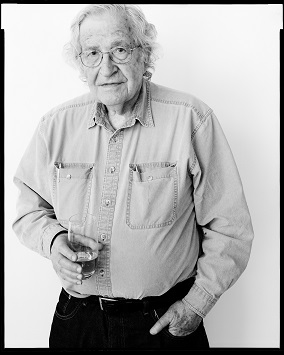
Such was the case when Noam Chomsky, Institute Professor of
Linguistics at the Massachusetts Institute of Technology, was
interviewed by Andrew Marr of the Independent. This encounter was
particularly significant, as Chomsky was facing a mainstream
journalist convinced that we have a basically free press. Chomsky was
very much preaching to the unconverted, and so we had a chance to see
how his radical critique held up against what to most people is simple
common sense.
The arena was BBC2's The Big Idea, on February 14, 1996, one of a
series of thirty-minute interviews. It had all the makings of a
classic brawl: Chomsky, the street-fighting linguist, who learned his
trade in and around New York's anarchist book stores and news-stands.
Marr, the Independent's much-vaunted Columnist of the Year and Chief
Political Correspondent (soon to become Editor).
Marr's preparation for the contest appears to have been relaxed to the
point of somnolent. Here, after all, was a respected journalist
squaring up to Chomsky, a notoriously tenacious intellectual
adversary. One prominent British intellectual warned a colleague
against getting into a dispute with Chomsky, describing him as "a
terrible and relentless opponent"; and a New York Times book reviewer
wrote: "Reading Chomsky... one repeatedly has the impression of
attending to one of the more powerful thinkers who ever lived." And
yet Marr, while knowing enough about Chomsky's arguments to debate
them, did not know enough to be aware of Chomsky's countless
refutations of the objections he planned to raise. Either he had not
read Chomsky's political works, or he had read them half-asleep, and,
as one reviewer wrote, "Not to have read [Chomsky]... is to court
genuine ignorance."
The result was a mismatch, with Marr offering arguments that were meat
and drink to his opponent - the sort of misunderstandings and
misinterpretations Chomsky regularly uses to illustrate the
intellectual bankruptcy of mainstream journalism. More often than not,
Marr managed to prove Chomsky's points for him. Older and wiser
journalists would surely have advised Marr that an ill-prepared TV
debate with Chomsky is to be avoided at all costs. As one reviewer
noted with regard to Chomsky: "Academe is crowded with critics who
have made twerps of themselves taking him on."
What happened to Marr helps explain why such confrontations happen so
rarely. The reality of his predicament appeared to gradually dawn on
Marr, whose standard response to Chomsky's counter-arguments was to
let the issue drop and quickly change the subject, only to be
subjected each time to a similarly relentless battering.
The interview centred around Herman and Chomsky's propaganda model.
The introduction to the programme was indicative of much that was to
come. An ominous clip of Big Brother from a film of Orwell's 1984 set
the ball rolling. "The idea that Orwell's warning [about thought
control and propaganda] is still relevant may seem bizarre", Marr's
voice-over intoned, immediately revealing his lack of understanding of
Chomsky's views. Marr asked his audience to consider whether it were
possible that the media is "designed to limit how you imagine the
world?"
Yet Chomsky's whole point-as is well-known to all who have read his
books-is that thought control in democratic societies does not happen
through totalitarian, Big Brother-style mechanisms but is the result
of a filtering process empowered by economic and political power
operating in a free market system - there is no design, no conspiracy.
Through a complex and subtle process, certain ideas and ways of
looking at the world are promoted and come to find their way into our
heads. This is a sort of negative thought control - we are controlled
as much by what is not there, as by what is. It is not that we are
prevented from choosing business-unfriendly facts and ideas, we just
never encounter them and so assume they do not exist. Children are not
forced to choose from a wide range of careers within the one corporate
system; they are not deliberately brainwashed into believing that this
is freedom. They are convinced that they are making a free choice
because society functions in such a way that they are unaware of
alternatives. Moreover, they are unaware that they are unaware, so
that the options confronting them seem to be 'just how life is'. As
Chomsky has pointed out many times, this is way beyond Orwell, who
wrote about crude, Soviet-style propaganda and whose understanding of
the possibilities of non-conspiratorial, democratic thought control
was limited in the extreme.
Continuing his introduction, Marr proceeded to cite the Indonesian
genocide in East Timor as an example of Chomsky's propaganda system in
action, claiming that Timor's fate was ignored "because we were
selling arms to the aggressors".
Unfortunately for Marr, this interpretation is itself a prime example
of the propaganda system in action. In reality, Chomsky (like Herman,
Pilger, Curtis and Zinn) argues that the slaughter in Timor has gone
unreported for two decades for far more deep-seated reasons. Firstly,
Indonesian dictator Suharto was a Western client originally installed
by the United States, which supplied arms, intelligence and other
assistance during the Indonesian massacre of some 600,000 'communists'
under Suharto, beginning in 1965. In return, Suharto consistently
maintained a 'good investment climate' for foreign companies operating
in Indonesia; meaning, as we have discussed, low-wage labour, forcible
suppression of unions, extra-judicial killings, torture, death squads,
minimal environmental protection and the general militaristic control
of the economy to suit the elite at home and abroad. East Timor had
gained independence from Portugal in 1975 and was looking to remain
independent. This, however, Chomsky argues, was not permissible - and
is still not - in the post-war world.
There were other reasons: Indonesia was a major Western ally that it
was deemed important to keep sweet, following the partial failure of
the war in Vietnam. Other motivations include vast reserves of oil and
gas in the Timor Gap (Timorese wealth which is currently being divided
up between Indonesia and Australia), and indeed the neat profit made
by US companies from supplying ninety per cent of the arms used for
the "annihilation of a simple mountain people" in East Timor.
The silence over the genocide in Timor was not just about pressure
from the arms lobby; it was part of a much deeper silence surrounding
the Western programme to install and support Third World dictators to
guarantee cheap access to local resources and so maintain the flow of
profits from South to North.
Cat Among the Cliches
Marr began his discussion with Chomsky by suggesting that we live in
"an age of relative media diversity, in the age of the Internet".
Relative to what?, one might ask. There was once far greater diversity
in the media than there is now. A good example is the radical press
which grew out of the vibrant working class culture of the thirties
and forties, which gave genuine expression to working class interests,
but which was quickly marginalized by the corporate press.
Marr moved on to suggest that opposition to the Vietnam War was an
example of radical ideas being accorded full coverage in the press.
What would we have heard, Marr asked, if there were no propaganda
system? Pretty much what we heard about the Soviet assault on
Afghanistan, Chomsky replied, namely that the United States was not
defending but attacking Vietnam, in support of a corrupt and murderous
South Vietnamese client dictatorship, by the massive bombing of
civilians and outright invasion. Of these realities, Chomsky
suggested, the media uttered barely a word.
"What I don't get," Marr continued, "is that all of this suggests -
I'm a journalist - people like me are self-censoring."
Chomsky argued that this is not so: journalists are a product of a
state- and corporate-run selection system that is operative throughout
politics, culture and education. Children are trained to defer to
experts, to repeat what they are told by learned authorities, and to
suppress their own doubts and independent conclusions. As children and
adults rise up the educational and career ladder they are selected for
obedience and subservience (such as the willingness, for example, to
put aside reservations and do as they are told for the sake of career
advancement). Winners are intelligent and free-thinking, but only
within certain parameters.
What Marr "doesn't get" is that the propaganda model does not depend
on self-censorship, but on a system of filtering maintained by the
ability of power to introduce bias by marginalizing alternatives,
providing incentives to conform and costs for failure to conform, and
by the innate human tendency to rationalize inconsistencies.
But, Marr insisted, "there are a lot of disputatious, stroppy,
difficult people in journalism, and I have to say I think I know some
of them." Chomsky replied that he also knows some of "the better"
journalists and they know it's all a sham and play the system "like a
violin", looking for occasional windows of opportunity to get things
through. Chomsky accepted that Marr was sincere in his beliefs but
then "If you believed something different you wouldn't be sitting
where you're sitting."
'Politics Funnier than Words can Express...'
Marr referred Chomsky to the Gulf War, pointing out that he was "very,
very well aware of the anti-gulf war dissidents - the 'no blood for
oil' campaign."
"That's not the dissident position," Chomsky interrupted.
"'No blood for oil' isn't the dissident [position]?!" Marr replied
incredulously.
As with East Timor, Marr had again unwittingly demonstrated how the
propaganda system operates: by presenting a false version of the
actual dissident view which is ignored, goes unreported and is thus
unknown.
Chomsky pointed out that the real dissident argument was that a
peaceful, negotiated settlement to the Gulf crisis was possible even
from August 1991, and increasingly so as allied forces threatened to
wreck havoc on Iraq. It is not simply that sanctions might eventually
have worked: they might already have done their job. The real problem
was that, far from seeking a peaceful resolution, the Bush
administration was fearful that Iraq might pull out before an attack
could be launched. Thus all peace initiatives were powerfully
suppressed, and simply did not appear in the mainstream US media. Some
high-ranking US officials, like Richard Helms, were unable to get
media coverage for possible peace initiatives. Even the US State
Department, Chomsky argued, considered the problem negotiable, but the
press would not cover it.
This is a sample of the real dissident position, not the 'No blood for
oil' argument. The media did inform us that many people objected to
killing for oil, but they never aired the idea that the war might have
been part of a plan to remove an obstacle to Western profits, or that
peaceful withdrawal was a genuine possibility, and a genuine fear on
the part of our leaders.
Marr chose not to respond, and instead moved on to Watergate,
generally assumed to be the classic example of how the free press can
humble the powers that be. After all, Marr said, "This brought down a
president." Chomsky, however, argues that Watergate is a perfect
example of just how servile the press is to power. Watergate is, he
has said elsewhere, "small potatoes" compared to what the state secret
police - the FBI - had long been doing to socialist, black and women's
movements under the COINTELPRO programme. "Sorry, you'll have to
explain that," Marr chipped in. "Exactly!" Chomsky replied. He had to
explain the meaning of COINTELPRO, whereas Marr knew all about
Watergate.
What Marr did not know about was a huge campaign of political
subversion that went all the way from bugging, theft and sabotage, to
political assassination organized by the FBI under four
administrations. By comparison, the Republican Watergate shenanigans
were a side-show. The reason the latter became headline news was, as
Chomsky explained, that one half of US political power started to mess
with the other half, and that is not allowed - hence the fall of Nixon
and widespread press coverage.
Watergate showed, not that the US has a free press, but that powerful
interests in the US are capable of defending themselves against
attack. By contrast, when minority movements without power are
attacked, there is no way through the propaganda system and the facts
go unreported. Thus, once again, in a way completely contrary to the
common understanding, Chomsky argued that:
"There couldn't be a more dramatic example of the subordination of
educated opinion to power in England, as well as in the United
States."
"It still seems to me," Marr proposed gamely, "that on a range of
pretty important issues for the establishment there is serious
dissent." Gingrich, for example, has "been pretty savagely lampooned".
Again, Marr missed the point. It is fine to lampoon Gingrich, just as
it is fine to lampoon Major and Blair. The point is that this type of
dissent is restricted within parameters so narrow that all serious
dissent is excluded and so real power is unthreatened. Henry Adams
explained how it works in a letter to a friend:
"We are here plunged in politics funnier than words can express. Very
great issues are involved... But the amusing thing is that no one
talks about real interests. By common consent they agree to let these
alone. We are afraid to discuss them. Instead of this the press is
engaged in a most amusing dispute whether Mr. Cleveland had an
illegitimate child and did or did not live with more than one
mistress."
It is the job of politicians to act as a buffer between populace and
power, to distract us from real issues, from real obstacles to
democracy. If necessary, a politician like Nixon can be sacrificed and
the myth promulgated that the one 'bad apple' has been purged from an
essentially good 'barrel'. Politicians, like journalists, are
representatives-not of the people, to be sure, but of corporate
interests. They are functionaries who have to abide by the basic rules
or leave.
But what about NAFTA (The North American Free Trade Agreement)?, Marr
countered. "We were well aware of the [counter] arguments" presented
by unions, environmentalists and so on.
"That's flatly false," Chomsky responded, pointing out that the
crucial dissident responses, the widespread and profound objections to
NAFTA, were suppressed and replaced by "Mexico bashing" and the
concern about losing jobs. The real issues: that the treaty was
organized and signed in secret in a way that largely circumvented
democratic procedures (whereby unions were supposed to be allowed to
comment on the treaty, and so on) were ignored. Instead, a barrage of
media publicity railed against union strong-arm tactics in pressuring
politicians, whilst the massive pressure exerted by corporate
lobbyists went unnoticed. The corporate solidarity in favour of NAFTA
was such that genuine discussion of the issues was nowhere to be found
in the mainstream.
But what about 'sleaze'? Marr asked. Apparently many of the
politicians he is acquainted with are "deeply irritated, ranging on
furious" about media intrusions into their private lives; and do we
not hear no end of tales about sexual misdemeanours and corruption?
Sure, Chomsky said, but that's of marginal importance. Corporate power
is in favour of 'law and order' (on its terms) and is certainly
opposed to corruption, which acts as a drain on profits and interferes
with the control of society. In India, fully one-third of the economy
is 'black', a fact that is not at all popular with transnationals.
Also, as Henry Adams hinted, sex scandals, corruption and sleaze all
serve the important function of diverting us from what really matters.
While we are focusing on royal love lives, or what politicians like to
wear in bed, we are assuredly not focusing on the real, systemic
issues which should be central to everyone concerned with
democracy-such as the fact that, regardless of the personalities and
behaviour of individual politicians, modern democracies are hopelessly
compromised by the immense influence of large corporations, which have
the power to manipulate governments and economies simply by threat of
capital flight and other measures.
By way of a strangely inappropriate concluding question-one which
supports Chomsky's contention that "within the mainstream it is barely
even possible to hear the arguments" - Marr asked: "What would a press
be like, do you think, without a propaganda model [sic]? What would we
be reading in the papers that we don't read now?" Chomsky reminded
Marr that he had just given dozens of examples; examples, moreover,
that had been chosen by Marr. Chomsky could have chosen different ones
which might have made his task easier.
Finally, how much hope is there in the Internet? As Chomsky suggested,
the struggle taking place for the independence of the Internet is
nothing new. First of all it is essentially an elite operation (most
of the people in the world have no access to a phone, let alone a
computer). More importantly, a similar battle already took place in
the 1920s over radio which, initially, was viewed as a public
resource. There were no limits on the number of stations, no reason
why the airwaves should belong to anyone in particular. Nevertheless,
radio fell under corporate control and, today, with the exception of a
few marginal voices, there is little dissent.
Deceived Deceivers
Barring a grin from Marr and a wry smile from Chomsky, the interview
was over. It was a rare and illuminating event. Chomsky was
interviewed by Peter Jay on TV in the '70s, and by Bill Moyers in the
'80s, but never have we seen Chomsky discuss the propaganda model in
such detail with a mainstream journalist. The public response to these
appearances is interesting. The Bill Moyers interview generated 1,000
letters from readers (more than the programme had received for almost
any other interview). When Chomsky appeared on TV Ontario in 1985, the
phone-in number registered 31,321 calls-a station record. John Pilger,
who regularly applies the propaganda model in his journalism, reports
that when his Timor documentary Death of a Nation was shown on Channel
Four, British Telecom registered 4,000 calls a minute to the number
displayed at the end of the programme. The producer of the
Marr-Chomsky interview reported that: "The audience reaction was
astonishing... I have never worked on a programme which elicited so
many letters and calls." His office was "inundated". The public
enthusiasm for this type of analysis is clear, but that of the
corporate media less so.
With Marr's The Big Idea, we had a chance to see ideas that have been
casually dismissed by the mainstream pitted against one of the media's
finest. The result was fascinating. We saw that journalists like Marr
are intelligent, lucid and rational, but only within parameters that
preclude a deeper understanding of what is really happening in the
world. We saw how the illusion of media diversity is maintained by
presenting superficial and trivialized versions of the true dissident
position. Above all, perhaps, we saw how journalists are intellectual
herd animals who instinctively seek safety among the tried but rarely
tested cliches of the mainstream: Watergate proves we have an
anti-establishment free press, media-coverage virtually ended the
Vietnam war, and so on. Normally this tactic succeeds in eliciting
eager nods of agreement, or a humble shrug of 'I suppose you're
right'. When confronted by a Chomsky, however, the facade of great
expertise and intellectuality that is the stock-in-trade of the
journalist, and which is normally so intimidating, quickly crumbles.
Interestingly, the reaction of the viewer to the spectacle of this
intellectual debagging is not surprise but relief: 'My God, I was
right all along, and I thought it was just me!'
To listen to, and believe, mainstream journalists like Marr - who is
undoubtedly an honest and sincere individual - is to be stifled and
bemused by a necessarily superficial, misleading and confusing version
of the world that cannot make sense because it cannot address the real
issues. Marr is not a liar and he is not a crude propagandist; he is
the unwitting product of a system that selects for the ability to talk
intelligently and convincingly about anything and everything, so long
as it is not genuinely costly to power. The crucial factor is that
individuals are able to do this sincerely and with the firm conviction
that what they are saying is the uncompromised, freely-expressed
truth. This, in the end, is the real genius of the modern system of
thought control-it is very subtle, invisible, and its greatest victims
are often not the deceived but the deceivers themselves. |