
| In his Foreword to Bakhtin and Otherness,
Michael Holquist described first the pleasures of elaborating projects
with friends, and then the degree to which the achievement was
mitigated by "the outbreak of war in the Middle East and the mounting
tensions in the Soviet Union." In my introduction to the same work, I
noted that it had been one year and a half since Holquist and I had
discussed the idea of collaborating on a volume concerning Bakhtin
studies, and that now, "amidst an escalating allied-forces led war in
the Middle East wherein so-called high technology equipment is used to
murder, massacre and maim civilian populations and soldiers at each
passing moment even as the enormous resources used to develop and
engage such equipment deprives human life of basic human needs, we are
on our way to delivering the issue to the printer." We had both
claimed some relevance of Bakhtin's work within such a context; my
suggestion was that "we should not misconstrue or falsify original
research intentions or findings in order to make them 'fit' into
useful political practice, we must find ways of researching and acting
which will provide the tools necessary to unveil coercive,
authoritarian, inhumane and anti-social actions of local, regional,
state, national and international political and economic policy
makers," and Holquist postulated the importance of Bakhtin in
addressing such issues: "the relevance of Bakhtin's work accomplished
in -- and speaking to -- a time darker even than this, cannot be
highlighted in a more lugubrious fashion. Let us hope that the
dialogue itself will have what Bakhtin calls a 'homecoming festival.'
Neither of us had foreseen that the carnage brought on by the many
types of weapons unleashed upon those Iraqi soldiers in the desert and
upon the large city of Baghdad would be joined by the carnage of
internationally-sustained post-war starvation and disease, hailed
under the banner of 'sanctions.' Five years later, the allies can
claim victory in their courageous fight against the newborn and the
young in a society now unable to afford basic medical treatments such
as vaccinations and anti-biotics. The 'homecoming festival' was
reserved for Wall Street, and the dialogue ostensibly limited to
individuals of murdering convictions. Nor could we have foreseen the
consequences of nationalist uprisings in the former Soviet Union,
glimmerings of which were at that time surfacing throughout the
Baltics and Eastern Bloc. The question, to recall Holquist's words, is
'Has Bakhtin's work spoken to this period?' Since there are very few
elaborate discussions of such questions available to us this regard
undertaken by Holquist or anybody else, I'd like to introduce a
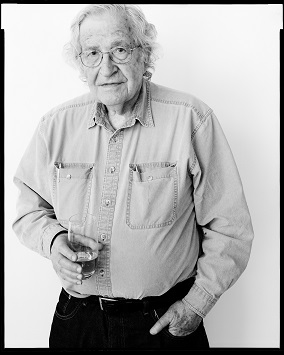
formidable challenger, Noam Chomsky. Although the examples will be
taken from Bakhtin, and in particular his approach to literature,
broader application could be foreseen across a spectrum of literary
research.
The easy answer to the question of how Bakhtin's work on the novel,
or any other literary criticism for that matter, can be applied to
contemporary political issues is: not at all. The issues for literary
theory, although various, are not generally taken to include the
analysis of aerial bombardment of civilian populations. Nevertheless,
from the vast array of practices encompassed by such a spectrum one
can reasonably draw out a number of apparently valuable textual
strategies such as discerning relations between particular discourses
and a broader social discourse, evaluating the impact of particular
texts within historical or institutional moments, or unearthing
properties of texts which shed some light upon issues of concern
within given societies. These approaches, and the analyses that follow
in their train, seem to provide some justification for the study of
literature and the application of tools employed for that purpose to
issues of social concern. And the huge industry of cultural and
literary studies that makes some claim to advancing our understanding
of social processes seems to testify to this fact.
There is another point here, being that Bakhtin's corpus is more
properly speaking an entire philosophy based upon the self's
relationship with the other; categories such as 'answerability,'
'dialogism,' 'polyphony' and even studies of the carnival testify to
Bakhtin's interest in the social domain more broadly conceived. But
the burning question cannot be avoided: Does (Bakhtinian-inspired)
theory go beyond literature and individual utterances, or indeed does
it even go beyond the uttering of truisms, in regard to our
understanding of (repressive) social phenomena? To answer such a
question in a general sense is to wade into the pools of epistemology
and to immerse ourselves in questions of what kinds of knowledge are
made available to us as readers when they have mastered to 'tools'
that theory offers. In a more particular sense, the question concerns
the relatively well-known (but nevertheless discipline-specific)
notions such as heteroglossia, dialogism, speech genres and polyphony,
and the applicability thereof to the detonation of multi-ton metallic
objects which send shrapnel which penetrates the skin of persons with
the objective of maiming or killing within a maximally large area upon
detonation. I will outline grounds for such a discussion, and then
propose at the end of this contribution that the work itself is not
applicable to the study of the disenfranchised, the oppressed or the
bombarded majority of the world except by extension, an extension that
goes beyond the work itself and into what it implies in terms of
possible worlds.
To evaluate the validity of Bakhtin's work to the
less-than-intriguing but nevertheless highly pertinent subject matter
known as corporate-backed profit-based decisionmaking leading to First
World expansionism is to make some claim about the nature of
knowledge, and the possibility of its advancement. Since nothing about
the theories in question suggests grounds for believing that the
physical processes of murdering or maiming are (for whatever ends) at
issue, then there could be some claim about the validity and
applicability of the theories to our understanding of human behaviour.
The sciences in question, therefore, are admittedly 'social,' in
contrast to the 'pure' sciences which have contributed to advancements
in the domain of matter and natural processes. To ensure that the
terms are well-defined, for an eventual assessment of Bakhtin's work,
we'll turn to relevant excerpts from personal correspondence from Noam
Chomsky (1991-1996).
What are Pure Sciences?
Despite his innumerable contributions to social sciences research,
generally in the form of political analysis, philosophy or historical
research, Chomsky adamantly declares that his only contributions to
the advancement of knowledge are made in the linguistic realm, deemed
'scientific.' The degree to which this linguistics research is
scientific according to his own criteria is of concern; but first the
grounds for said assessment need be clearly set forth.
According to Chomsky's rather rigid criteria, scientific research
exists principally in three disciplines; natural sciences, mathematics
and physics (and by extension some work in chemistry, biology,
astronomy and so forth). To work within these disciplines requires an
understanding of knowable physical processes, processes which can be
studied with the expectation or the hope of repeatable and predictable
results. Thus each veritable contribution to contemporary scientific
research (things were rather different in previous eras) generally
makes some reference to an existing body of knowledge (even if the
goal is to refute), which means that there is an important initiation
to the field that is generally assumed: 'Outside the hard sciences and
mathematics, there really isn't a lot that is beyond the reach of
people without special training.' The 'hard' sciences that Chomsky has
in mind here are moreover theoretically oriented, excluding therefore
most psychology, much in the way of medical treatments, and so forth.
Of the latter he says that 'as we move further from the domain of the
'exact sciences' (say, to medical practice, or automobile design), we
find that theoretical knowledge rapidly tails off and reliance on
intuition and experience correspondingly increases, and it's
correspondingly easier for error to perpetuate.' Notice here that
there is an important distinction between theoretical work and, say
technological advancement. So 'hard' sciences excludes, from Chomsky's
perspective, work that has some superficial resemblance to exact
sciences, for example machine translation or 'artificial
intelligence:' 'Machine translation is a very low level engineering
project, and artificial intelligence is largely fraud, dismissed by
most serious scientists and lacking any results, as its leading
exponents concede, after 45 years of endless hype.' Moving closer to
human concerns, of the type that might help explain the nature of
living beings, Chomsky also sees a certain explanatory potential: On
natural sciences, as compared to social sciences, Chomsky says that
social sciences 'don't have anything remotely like the explanatory
character that parts of the natural sciences have developed since the
17th century revolutions (principles remote from any superficial
generalizations, nontrivial deduction of surprising empirical
consequences from them, unification of what appear to be entirely
disparate aspects of the world, insight into hidden structure and
principles, etc.).' The fact remains, however, that no matter how far
we've come since the 17th century, we have but scratched the surface,
and there is little hope of making much progress on the vast array of
complex issues in this domain.
Even the small number of comments allows us to view a kind of
epistemological spectrum that moves from exact or pure sciences to
natural sciences (where relatively speaking far less is known or
perhaps even knowable), and towards what he most frequently refers to
as 'intuition.' On the borders lie the vast unknown, the properties of
the human mind or the universe which remain so far from our grasp that
we have rarely begun to even formulate appropriate questions to deal
with them. This is the 'mystery-for-humans' category, a precarious
region which just happens to contain the most significant issues
relating to human existence, questions about which have been posed in
similar ways since as far back as the Greek era (at least) and with
similarly unsatisfactory answers. This is often the area where social
sciences dwell, and where highly complex theories are formulated with
some debatable advancement. On the side of the debate that refuses
(most) knowledge claims in this domain stands Noam Chomsky, and his
powerful critique forces us to confront some very tough questions.
What are Social Sciences?
Social sciences according to Chomsky's criteria is therefore a
misnomer, an attempt to provide credibility to what could often be
characterized as a series of truisms, assumptions and observations
which, at our present level of understanding, could never be proven.
Chomsky has two overall categories (three, if one includes fraud)
according to which he divides up most work in the social sciences. The
first is the simple 'exposing of facts,' which in the domain of
political sciences for example involves 'giving an analysis of the
background within which it naturally fits and arises, the factors that
lead it to be suppressed or distorted as it passes through the
doctrinal system, the role of obedient intellectuals, etc.' When one
moves from the observation or setting out of the facts to the deeper
truths that these (political) observations reveal, then one is in the
domain of 'analysis.' The critical point here is that Chomsky, in his
own words, 'is not aware of the existence of any theories, in any
serious sense of the term, that yield insight in the analysis case,
including work on the nature of totalitarianism, internal filtering,
and all the rest.' What most social scientists call 'analysis' is, in
his sense, 'pretty obvious,' and indeed he 'gets irritated when
intellectuals dress it up as something more than that.' Political
science, which is one of the areas to which Chomsky contributes in a
major way, comes under particular fire. 'As for political science
theory, it is mostly trivialities or nonsense, as far as I know,
dressed up in big words for careerist purposes.' In the hierarchy of
useful social sciences research, Chomsky suggests that 'political
theory seems to me much less illuminating than history,
anthropological theory than sensitive descriptive anthropology,
etc.).' And even in areas that one might have thought important to
Chomsky, like 'radical' theory, is often 'so obvious that few people
would even bother saying them, except maybe in the opening lecture of
a course, after which you get down to business.' Taking the side of
the exact sciences, Chomsky happily abhors the suggestion that he
engages in this political work in 'social theory:' 'I think you are
quite right to separate me from the others you mention and say I'm not
a social theorist. The only question I would raise is whether that
honorific term applies to anyone. I've never found social theory,
where plausible, to be much more than common sense.' This kind of
dressing-down of social scientists has sometimes raised fury; a recent
TLS exchange between Chomsky and a political scientist from
Berkeley gave space to such discussion, turning around the question of
whether or not Chomsky has a 'theory' for his social science work.
Chomsky's conclusion? 'In a large measure I write without a theory.
Then he [the political scientist] presented the theory that animates
his work, which turns out to be precisely what I do (like anyone),
except that I don't call it a theory, rather a collection of truisms.'
Moving along the social sciences spectrum, one encounters other fields
that have important impact for the society, such as philosophy.
Despite the fact that Chomsky has done significant philosophical
inquiry, he nevertheless applies similar criteria to its evaluation.
Commenting upon the marked lack of philosophical references in his
work, he says: 'It's true that I don't appeal to philosophical texts,
in this connection, because I don't find them terribly revealing.
Sometimes they are suggestive, but usually I find that when I've
cleared away the usually unnecessary rhetoric and complexity, what
remains is pretty straightforward. I feel the same about the areas of
philosophy where I have done a fair amount of writing and research
(philosophy of mind, philosophy of language).'
So from Chomsky's perspective, the social sciences are for the most
part the region where notions obvious to any highschool student are
batted around, couched in the kind of terminology and approaches that
make it look serious, and sound like 'exact sciences.' The highschool
student example is in no way derogatory for Chomsky; indeed if
something sounds sensible to a child or an adolescent, it is from
Chomsky's perspective more likely to be more truthful than the wisdom
espoused by a 'public intellectual.' None of this is to say that
Chomsky would limit social sciences research, indeed the very thought
would reek of the kind of Stalinism that he has spent his life
condemning. Nevertheless, one must in his sense evaluate the
utilisation and pretensions of social scientists as a measure of their
value for things beyond say academic careerism or, worse still, the
legitimation of (say) the explosion of devices upon helpless residents
of Baghdad. 'To the extent that the social sciences have any
intellectual content and are more than either ideological claptrap or
descriptive taxonomy (a limited extent, in my opinion), they are no
different from other areas of science, as far as I can see.' The
measure of this intellectual content is, as previously demonstrated,
highly problematic. Indeed it is upon grounds of evaluation
that the social sciences versus exact sciences research becomes clear:
'[T]here is a noticeable general difference between the sciences and
mathematics on the one hand, and the humanities and social sciences on
the other. It's a first approximation, but one that is real. In the
former, the factors of integrity tend to dominate more over the
factors of ideology. It's not that scientists are more honest people.
It's just that nature is a harsh taskmaster. You can lie or distort
the story of the French revolution as long as you like, and nothing
will happen. Propose a false theory in chemistry, and it'll be refuted
tomorrow. Fakery in scientific experiment is a very marginal
phenomenon, contrary to what you read in the press, and is quickly
discovered, for a very simple reason: people replicate, and its their
professional task to check results and the thinking that leads to
them. There's no comparable discipline outside of a few areas of human
thought.'
Social sciences do have a role to play, as long as practitioners
steer clear of simple careerism, whereby academics multiply complex
treatment of simple subjects for personal gain. Worse, is the danger
that the academic justify, with his or her position or complicated
prose, authoritarian efforts undertaken in the name of some dubious
programme (Skinner's brand of behaviourism comes to mind in this
regard). But the problem is not just with the individuals and their
careerist agendas; it is also that 'theoretical understanding is, in
my opinion, very thin outside of a few areas, something I've written
about a lot.' This is not to say that serious speculation is without
interest, but moreover that healthy scepticism, exhibited on many
occasions by bewildered students, might be a healthy response to
convoluted theories. And this kind of common sense approach may yield
important results in pursuits which, although challenging, are
certainly worth pursuing. Chomsky himself encourages this kind of
endeavour: 'If someone can come up with a nontrivial theory that has
some bearing on matters of human concern, with conclusion of any
credibility that would alter the ways in which I or others view these
matters without access to the 'theory,' I'd be the first to immerse
myself in it, with delight. What I find, however, is intellectuals
posturing before one another.'
The final issue here, before turning to specific examples, is the
relationship between social and exact sciences. It is a widely-held
view amongst social scientists and humanities researchers that
somebody should regulate scientific research to ensure that it doesn't
pursue unacceptable ideological aims. The notion, for example, that
the sciences are part and parcel of dominant ideology has been at the
basis of many studies of contemporary society. Once again, with a
characteristic refusal of regulating agencies, Chomsky takes on the
issue of whether scientific research or findings reflect something in
the social compendium within which they emerge. 'It is possible that
the exact sciences would look somewhat different in a more egalitarian
society, because the distribution of effort would change so that the
topics under study would receive different emphasis. Perhaps some
aspects of human biology would, say, receive more attention than they
do now, and some aspects of particle physics less (thought that is far
from obvious). However, it is highly unlikely, contrary to
contemporary fashion, that sciences themselves would look much
different.' In Chomsky's sense, science builds upon existing knowledge
which in most areas is highly restricted. The natural sciences, for
instance, 'are largely driven by internal considerations, by what can
be studied next, what is on the fringes of understanding.
This is true, I think, to a far greater extent than is believed by
people who have not paid much attention to them. To take a
contemporary example, Congress may decide to spend a ton of money on
cancer research, but those who work on the topic will explore the
properties of cells in the only ways they know, hoping that something
will lead to insight into cancer.'
It should also be clear that the inverse relationship, which
manifests itself for example in the application of scientific research
to social sciences, is more often than not an application of one
barely-understood scientific theory to a completely unrelated area of
humanities or social sciences. Literary theory is dogged by
hare-brained efforts to apply tiny fragments of scientific work taken
wholly out of context to literary or social phenomena. A contemporary
example is chaos theory, understood by neophytes thanks to the handful
of one-liners about the 'butterfly effect' that were included in the
film Jurassic Park. Intriguing and provocative, but far from
the theory itself and even further from a claim to knowledge. So these
are the two broadly-defined areas of study to which specific examples
can be compared. First, some reflection upon a scientific project in
linguistics, and then some discussion of Bakhtin's work with the same
unit of measure.
Is Linguistics a Pure Science?
Linguistics is generally classified in the humanities or social
sciences; but with Chomsky's work over the last 40 years there has
been considerable progress in the field and he indeed claims a place
for it in the more exact sciences domain. The issues are complex, but
worth setting out briefly. His most recent book (cited from the
original manuscript), The Minimalist Programme, is a
significant advance in the field and a notable deviation from previous
work. It is motivated by two related questions: (1) what are the
general conditions that the human language faculty should be expected
to satisfy? (2) to what extent is the language faculty determined by
these conditions, without special structure that lies beyond them? The
shift in what could probably be considered social sciences questions
occurs very rapidly, because Chomsky postulates that 'to the extent
that the answer to question (2) is positive, language is something
like a 'perfect system,' meeting external constraints as well as can
be done, in one of the reasonable ways. The 'minimalist' program for
linguistic theory seeks to explore these possibility.' It does so
through a series of assumptions, most notably that 'there is a
component of the human mind/brain dedicated to language -- the
language faculty -- interacting with other systems.'
Chomsky's vision of the language faculty also presumes the
existence of at least two components: 'a cognitive system that stores
information, and performance systems that access that information and
use it in various ways.' For present work, Chomsky is particularly
concerned with the 'cognitive system,' and he uses some of the
theories elaborated earlier on, notably the Principles and Parameters
approach, to address issues raised by the model and by the data for
which it hopes to account. Details concerning the programme are
complex and they presume significant prior knowledge. But the theory
is speculative and bold, and to the extent that it could ever be
proven, would go a long way towards explaining the most fundamental
issues concerning typology, language variation, language acquisition
and by extension one (important) aspect concerning the nature of the
human mind. For example, an upshot of this approach would be to
suggest that 'the apparent richness and diversity of linguistic
phenomena is illusory and epiphenomenal, the result of interaction of
fixed principles under slightly varying conditions.'
So, returning to the initial question, how 'perfect' is the
language? 'One expects 'imperfections' in morphological-formal
features of the lexicon. The essential question is whether, or to what
extent, this component of the language faculty is the repository of
departures from virtual conceptual necessity, so that the
computational system is not only unique but in some interesting sense
optimal.' Learning to ask the right questions about this computational
system and resolving them with the (by now massive amount of
available) data could lead to important advancements in the study of
language and the mind. Initial indications suggest some promise for
the programme, however huge amounts of work remain to be done before
any verdict can be drawn. Chomsky concludes the introductory chapter
of The Minimalist Programme with cautious optimism, and with
plans for continued study: 'Whether these steps are on the right track
or not, of course, only time will tell.'
The proposed model is still in the state of 'bold speculation,' and
it differs quite considerably from previous overall models that
Chomsky and others have developed to explain various linguistic
phenomena. Is the description provided on track with the pure sciences
model as previously described? To the degree that it can be confirmed
by empirical data, yes. However there is some possibility that the
entire project still fits more closely with the 'mystery-for-humans'
category than with 'exact sciences.'
Is the Study of Literature a Social Science?
Two areas of research outside of pure sciences offer in Chomsky's
sense particularly valuable analyses, but for the most part these
areas touch on the mysteries of human existence. The first is history:
'Historical studies are another matter. One can learn a lot from
history, as from life, as long as it avoids the pretentious tomfoolery
required by intellectuals for career and power reasons.' Examples of
pretentious tomfoolery are important for this discussion, since
they'll help guide an analysis of Bakhtin's pertinence, at least from
Chomsky's perspective. One term that Chomsky mentions is Foucault's 'épistemé':
'When Foucault says I'm working within a particular 'épistemé' because
of time-culture limitations, he could be right, and I would even agree
to listen to him if he or anyone could offer as much of a hint of a
rational, credible argument. He couldn't, and no one else can either,
so I'm afraid I have no choice but to dismiss this as more of the
games that intellectuals play when they have nothing in their heads
but must try to seem important to themselves and to one another.'
Pierre Bourdieu, another theoretician whose work has been applied to
literature, doesn't suffer any less. 'Doubtless there is a power
structure in every speech situation; again, that is a truism that only
an intellectual could find surprising, and seek to dress up in
appropriate polysyllables.' And Lyotard? 'As for Lyotard and the
post-modern age, I await some indication that there is something here
beyond trivialities or self-serving nonsense. I can perceive certain
grains of truth hidden in the vast structure of verbiage, but those
are simple indeed.'
The 'grains of truth' to which Chomsky refers are indeed perceived,
and then evaluated with our 'intuition,' which basically means that we
don't know how it is evaluated. What we do know is that we have
intuition and that it seems to be one component of a broader mystery
that has come to be known as 'human nature.' This nature has been
postulated fundamentally by Chomsky in his work since early on, for
simple reasons: 'My belief in human nature doesn't guide me in
anything, because it is a truism. The question is: what is human
nature? The answers to that, if we could find them, would not be
truisms. We have some insight, in some areas; typically, those remote
from the areas in which important questions of human and social life
arise. Beyond that, we rely on intuition, experience, and hopes.' Some
of the insights are scientific, and Chomsky does presume that, barring
knowledge that we simply seem intrinsically unable to discover, we
shall some day know important things about this category. For the
moment, we rely upon things like intuition and domains such as the
arts. This is where literature become significant: 'I have, I'm sure,
been powerfully influenced by fiction, including what I used to really
immerse myself in when I had more time -- Tolstoy and Dostoevsky,
Turgenev, Eliot, Dickens, etc.' 'Powerfully influenced' is strong
language for Chomsky when discussions of formative mediums or
individuals arise. This makes it particularly significant in terms of
its knowledge claims: 'Literature is an entirely different matter. We
learn from literature as we learn from life; no one knows how, but it
surely happens. In fact, most of what we know about things that matter
comes from such sources, surely not from considered rational inquiry
(science), which sometimes reaches unparalleled depths of profundity,
but has a rather narrow scope -- a product, I assume, of special
properties of human cognitive structure.' So there is something
outside of the social sciences-exact sciences spectrum, and sitting as
it does on the margins of our understanding, and describing as it does
the central element of our nature (creativity), it could in fact be
deemed critically important. Indeed, if the minimalist programme
postulations are true, then creative uses of language may be at the
centre of our own humanity. So 'literature is not a social science. If
literature is illuminating, that doesn't tell us anything about the
power and value of social science.' Okay, but what about literary
theory? And how should one characterize Bakhtin's work within these
categories? Could his work have anything to say about human behaviour,
as deviant as bombardment or as invigorating as dialogue?
What is Bakhtinian Scholarship?
The work of M.M. Bakhtin is particularly intriguing with regards
this discussion. The time during which he wrote the bulk of his work
was one of the darker moments in human history. Although he did not
address the pertinent political issues of Stalinism, Bolshevism,
totalitarianism or any other general descriptions of the period, his
work is generally taken to be a powerful (though couched) criticism of
discursive practices that reigned therein. Furthermore, he (and
persons in his 'circle) also made bold speculative statements
pertaining to a wide number of fields, including linguistics,
psychanalysis, theology, social theory, historical poetics, axiology,
philosophy of the person, vitalism, formalism, and the works of
Dostoevsky, Freud, Goethe and Rabelais. Some of his speculations, for
example his work on speech genres (written in 1952-53), have
subsequently received qualified recognition following large scale
projects concerning the effects that learning foreign languages might
have upon linguistic development (none; it appears that genres of
discourse are organized in similar ways as languages). So there are
inklings of a 'model' in his work which, though not on the same scale
as (say) the minimalist programme, nevertheless with some explanatory
power for general language performance. There are also some inklings
of a 'model' of discursive practice in his description of polyphony or
heteroglossia, notions which alert us to the extreme diversity of
language practices contained within a given national language. The
upshots of this proposition, including the idea that local speech
situations contain chronotopically-specific lingo ('shop-talk'), that
utterances reflect the situatedness of the speaker and the context to
which s/he is speaking, the ways by which speech acts are built upon
interaction rather than monologic transference of information, and so
forth. These approaches, especially when compared to the models
against which it was thought through (in a dialogic fashion), such as
formalism, seem to be more valid. Without wanting to push the argument
towards the absurd, it is nonetheless clear that even if this model
were more valid than a formal one, that there is no direct implication
concerning corporate expansionism or the bombing of a particular group
right back to the middle ages.
There are in my opinion a number of interesting upshots, to such
theories which may make them politically valuable. The first emerges
from the statement that Bakhtin's theories, even in the absence of
scientific proof of the type described by Chomsky, do 'seem to be more
valid.' We are, in other words, back to the domain of intuition,
common sense. Much of Bakhtin's work reflects insights glossed from
literary texts, and what he seems to be saying in many cases has the
feeling of being 'correct' in ways that are similar to the 'feeling'
of vitality that we have when reading a novel by Dostoevsky. In other
words, if we take Chomsky's adage that we learn from history as we
learn from life, or his sense that literature seems to influence us
and talk about truly important issues without us really knowing how,
and we apply it to Bakhtin's work, then there could emerge the sense
that his work has that mysterious power of explanation that is not
direct or verifiable but nevertheless present. This is, in other
words, an argument based upon nothing other than a sentiment that
'mystery-for-humans' issues are addressed usefully by Bakhtin because
he is offering up a 'mystery-for-humans' series of intuitions as
possible explanations. This doesn't get us very far, but it probably
gets us further than the other possibility, which is that Bakhtin's
work is applicable to speech situations because his insights are pure
common sense. Everybody knows that we speak differently to lovers than
to policeman, priests than to co-workers. Everybody knows that
particular working environments generate certain kinds of linguistic
relations amongst participants, including coined terms for oft-used
tools or manoeuvres. Everybody knows that we use snippets of ideas or
expressions when speaking with people, particularly when discussing a
topic that we know about from a very small number of sources.
Everybody knows that the person with whom one is speaking helps direct
the conversation, and that different people make us articulate things
in different ways, some of which actually making us feel like
different people depending upon the speech performance in question.
Bakhtin's work from this perspective is good only because it makes
intuitive sense, because it says things that, to use Chomsky's adage
once again, any child or highschool student could understand.
There may be something else going on, particularly in the
application of Bakhtin's work to issues in the realm of politics or
cultural studies. What Bakhtin seems to imply in most of his writings
is that societies ought to be open and diverse; there is the
clear suggestion in many of his texts that when societies close down
upon themselves that there is little hope for injecting new ideas,
methods of speaking, diverse perspectives and so forth. These
societies die a monologic death at this point, while other places,
more cosmopolitan and open to the world, celebrate dialogic diversity.
This is an obvious argument to employ if one seeks to encourage
immigration, to discourage nationalism, to encourage toleration, and
so forth. So his work in this sense becomes 'politically correct,'
what we want to hear. In order for it to become acceptable, however,
certain undesirable elements must be evacuated, notably the dangers
presented to ruling classes or status quo politics by such openness.
The carnivalesque is not simple toleration, it is a boiling cauldron
of potential creativity which may either scald or nourish, but it will
certainly never congeal. So here is a political implication of
Bakhtin's work; if he is right that vitality is a good thing, and that
maximal openness creates such vitality, if only in a linguistic sense,
then his corpus could be put to work for us good guys. The challenge,
of course, is that the argument suggests that undesirable theories
must be similarly entertained, that we the good guys ought not look
for theory simply on the basis of whether or not it confirms what we
already believe to be good, or true, or useful.
There is one final option, which would be to examine Bakhtin's
entire corpus in terms of its overriding political assumptions. Here,
perhaps, is the point at which it could truly be applied to Gulf War
analysis, or times darker even than this one. Every important notion
in Bakhtin's work speaks to Chomsky's sense of inherent human creative
potential. When he postulates dialogism as a desirable state, and
envisions the carnival or the public square or the multi-voiced novel
as utopic spaces of possible dialogism, then he is giving an overall
vision of what speaking situations must look like if they are
to be of any interest. He doesn't write about propaganda or
totalitarianism or (in more literary examples) poetry because they
don't meet his criteria for acceptable or interesting space. In this
respect, the carnivalesque is not a strange abberation in his work but
a central notion, confirmed and reconfirmed by studies of dialogism or
answerability. He offers grounds for questioning oppressive political
practices by pointing out ideal speech situations, thereby coupling
commonsensical ideas (we ought to be free and unfettered) with a
series of literary observations about how interesting free and
unfettered utterances are for the reader. So he ends up talking Gulf
War politics without ever mentioning politics, because he shows the
absurdity of cheering for one side or the other in such an activity
because the activity itself comes out of fundamentally deviant kinds
of human organization. Bakhtin's work, in other words, cannot in any
way be applied to status quo politics except to question them in a
totally radical way. There is no hope for the vitality of human
creativity in present day hierarchical structures, or in any kind of
fashioned political doctrine. People must be free to exchange and
converse and migrate and explore in an unfettered way, whatever the
consequences, for Bakhtin's vision of human vitality to flourish. His
work may indeed be valuable for a political vision; but one must be
willing to view the project for what it really suggests and not what
we want to hear, for careerist or politically expedient reasons.
Bibliography
Barsky, Robert F. Noam Chomsky: A Life of Dissent.
Toronto: ECW Press, 1996 (in press).
Barsky, Robert F. and Michael Holquist, Bakhtin and Otherness,
eds. Discours social / Social Discourse 3.1-2 (1990).
Chomsky, Noam. The Minimalist Programme. Cambridge, MA: MIT
Press, 1996 (in press). |