
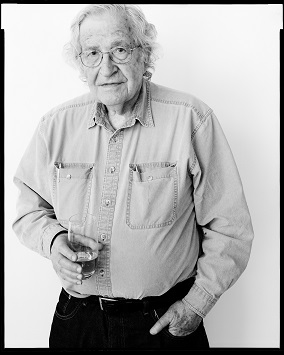
| In the space of 24 hours last week, Noam Chomsky,
the world-renowned linguist and controversial critic of American
foreign policy, spoke at UCLA on U.S. policies in the Middle East,
held informal exchanges on linguistics and language, and addressed a
small, select group of influential Westsiders at a mansion, complete
with moat, in Pacific Palisades.
And although UCLA campus police, riot helmets in hand, stood by at
Royce Hall as the turn-away crowd of 1,800 passed through a security
check one by one, it was in the Palisades where the most volatile
scene occurred.
The professor from Massachusetts Institute of Technology, whose
radical impact on linguistics is known as "the Chomskyan revolution,"
is often said to be without peer in his field. While he has not had an
equal impact on foreign policy, he is considered no less radical in
his criticism of the United States, particularly its policies in the
Middle East, Central America and other parts of the Third World. And
as a Jew, he has offended some members of the American Jewish
community for his support of Palestinian self-determination and his
criticism of Israel.
Provocative Speaker
"He's a very provocative person. We wanted to put him with some
people in the community who have access to resources and can impact
change," said Mary Brent Wehrli, executive director of the Southern
California Ecumenical Council's task force on Central America,
explaining the invitation to the heated discussion of U.S. Central
America policies at businessman Leo Wyler's mansion. "We hope that he
will provoke them."
The task force got its wish.
Chomsky's charges that U.S. government policies were connected to
interests of the corporate elite so infuriated some of the 40 mostly
wealthy guests seated around Wyler's massive fireplace that at one
point the discussion deteriorated into shouted accusations and
interruptions.
One man yelled out that he'd bet $100 that one of Chomsky's claims
about National Security Council policy would turn out to be "a lie."
("I'll take that bet," actor Ed Asner called out.)
"You do yourself a great disservice," Harold Willens told Chomsky
in the middle of it all. A longtime peace activist and frequent critic
of government policy himself, Willens, the host along with Wyler, Fred
Nicholas and UC Regent Stanley Sheinbaum, did not directly question
Chomsky's allegations. Instead, he took on the great linguistic
theorist for his language.
"You don't say it very well. Your language isn't precise enough or
fair enough," Willens said.
Reporting Called One-Sided
The eruption came during an exchange over Chomsky's view that the
U.S. media was reporting Nicaragua's abuses and deficiencies in
democracy and not reporting in any depth its social reforms --
particularly as compared with Honduras, El Salvador and Guatemala. The
media, he said, were part of an elite consensus regarding the U.S.
right to contain Nicaragua and a debate only over how it should be
contained.
His charges came as no surprise to some in the room who tended to
agree with him. Others seemed reluctant to believe him or genuinely
confused about his implications.
Several angrily took him on for implying they had let themselves be
"hoodwinked" and were "sitting back and being led" by such a group.
They accused him of "unbridled bias," overstatement, dogmatism and of
having "a shockingly closed mind for an intellectual." One woman
started a hurt and angry reproach by calling out, "Why do you live
here?"
"This is my country. I'd like to improve it," he replied.
Pushed Too Far
Later, when they broke for coffee and dessert, some flocked to him
for more discussion, others kept their distance.
Privately, Willens expressed disappointment that Chomsky had talked
down to the group and said that someone with such an iconoclastic
point of view should become a better communicator.
Had Chomsky only talked of specific Central American issues such as
the Arias peace accords and aid to the Contras, Wyler's daughter
Barbara said afterwards, the guests would have left agreeing with him
and his denunciation of U.S. policy.
"But he was pushing people farther than that," she said. A
supporter of the task force and a grass-roots organizer on peace and
justice issues, Barbara Wyler had hoped Chomsky would shake them up.
Instead, she said of those he had offended, "it was as if they had
been told there was no Santa Claus."
Doesn't Seek to Offend
Noam Chomsky -- take him or leave him. He does not seek to offend
people, he says, but he will neither apologize nor accommodate.
"I'm no diplomat," he said with a shrug and a small smile the
following morning over a bowl of granola at the UCLA Guest House.
It is one of the more non-controversial and undisputed statements
he makes.
At 59, Chomsky is a slightly built man who has the facade of a
mild-mannered professor -- glasses, sandy, slightly unruly hair, a
fleeting grin -- right down to the rumpled cords, rolled up shirt
sleeves and tweed jacket.
He has been called everything from "the most important intellectual
alive today" to a "pariah" who has been "banished from the margins of
political debate."
But he simply says what his own research and thinking lead him to
conclude. There seem to be no exceptions.
At Royce Hall, after he had spoken on U.S. policies in Iran and
Israel, policies he attributed to a desire to control the oil in the
region and thus protect U. S. economic interests, an Arab admirer of
his work stepped to the mike and took him to task for not using Arab
sources.
It was a shortcoming to which Chomsky immediately agreed. He does
not read Arabic well, he said. And tactically, "it's more credible if
I quote from Hebrew sources.
"Arab sources are not reliable," he added. "They exaggerate.
They're careless...."
Next question.
"Wanting to ask Noam Chomsky a question is like wanting to walk
into a buzz saw," one man chuckled to his colleagues after Chomsky's
presentation on language and interpretation at a philosophy colloquium
that drew 300 to Rolphe Hall one afternoon.
His delivery during his week-long stay did not vary. Regardless the
subject, occasion or audience, he methodically developed his argument
point by point, often taking a chronological approach, referencing
everything, inundating his listeners with detailed facts pulled from
memory: He has read the footnotes, waded through newspapers and
periodicals, compared and quantified accounts, closely examined the
documents, including declassified government material. Not a point or
fact has been overlooked or forgotten.
Not grandiloquent, he proceeds dispassionately, at times tediously,
at times humorously, an offhand but trenchant sarcasm that seems to
take the place of any emotional range.
He does not seek to offend, he said, and he does not get offended.
He seems driven not out of a competitive streak but through an
impatience to get the truth out.
Being called a liar the other night seemed to slide right off him.
Just a momentary, barely visible ruffling of the feathers and a testy
offer to send the man the National Security Council document in
dispute.
"I don't care. Considering the hysteria, at least it removes the
matter to a factual issue," he said after the Wyler house debate.
"After all, why should he believe me?
"I rarely talk to groups with that background, at that social and
economic level," he added, then went on to describe the gathering as
split three ways: Those "extremely admirable" people who were already
committed, those "who want to do something and are hurting" and those
who were "naive, with no concept of what goes on in the world and
their role in it. They're very insulated from reality. Talk to a group
of welfare mothers and they know much more about the world than
someone living in a stockade in Beverly Hills."
Asked about his credentials by a student at the philosophy
colloquium, Chomsky responded : "I have no credentials in any subject,
which is why I'm teaching linguistics. And it's exactly why I teach at
MIT."
The university, he added to everyone's amusement, had no tradition
in the humanities, so there was nothing to stop them from hiring him.
He was not joking, he explained the next day. He has degrees, but
no credentials.
He has a BA, MA and Ph.D. in linguistics (1955) from the University
of Pennsylvania, he said, but he calls them technicalities, saying he
doubts if anyone opened his dissertation.
"Nobody was interested in what I was doing," he explained, adding
that he had the same reception at Harvard where he was a junior
fellow.
The Chomskyan revolution "redefined the study of language and mind"
his colleague, Carlos Otero at UCLA, has written, describing its main
feature as "his hypothesis that human beings are born with an innate
knowledge of universal principles underlying the structure of human
language and other cognitive structures."
Chomsky could not get anything published and could not get hired.
It did not bother him. Instead, he and his wife, Carol, also a
linguist, went to Israel in 1953 and joined a kibbutz. He had been
raised an ardent Zionist, he said, attributing his lifelong political
activism to those roots. He grew up during the Depression in a lower
middle-class neighborhood in Philadelphia. His father was a Hebrew
teacher who studied medieval Hebrew grammar; his mother a Hebrew
teacher. He first learned language from his father, he said,
proofreading 14th-Century Hebrew grammar when he was 10. The family
members were observant Jews, more cultural than religious.
"I'm Jewish," he said. "It's my background. I don't ask myself
about it."
While on the kibbutz, he said, he was concerned about the direction
the young country was taking in dealing with the Arabs. He believed
the Arabs were being deliberately isolated and repressed under a
military administration.
His outspoken criticism of Israel has drawn denunciation both here
and there, yet he has not cut his ties with the country.
"In fact, I'm going there in April," he said, "for a linguistics
conference. It's on my work... I'll give political talks while I'm
there."
From the kibbutz, he went to MIT in 1961 for a job in the
electronics department and has made the university his base ever
since. He and his wife have three children, now grown.
Lecturer in Demand
He lectures at universities all over the world and has published
dozens of books and hundreds of articles. The book he couldn't get
published for lack of interest in the '50s, "Logical Structure of
Linguistic Theory," was published in 1975 when the publishers came to
him.
"The only thing that matters to me," he said, "is if I read stupid
things about (my work). Then I think I've got to do something to
correct it.
"I read all the time," he added. "I'm so busy I literally do not
have time to go to the library. So what happens is, I subscribe to
just about everything. I order every book and then usually give them
away."
He has no research assistant, he said, but plenty of people come
into the office and offer to help. In addition, he has contacts around
the world, he said, "dissidents in their own societies, people who are
marginalized."
"They clip for me and I clip for them. In fact I ended up buying
two Xerox machines. I'm copying stuff all the time."
He is continuing his research in philosophy and linguistics,
including researching technical problems in the latter, he said, in an
effort to find underlying principles of grammar that will help explain
individual languages.
He has just finished a book on U.S. political culture as reflected
in the Iran-Contra hearings [The Culture of Terrorism]; he is
about to come out with another, co-authored with Edward S. Herman, on
political economy and the mass media [Manufacturing Consent],
and he has a series of television lectures coming up for Canadian
Broadcasting Company on U. S. policies and the media that he'll turn
into a book [Necessary
Illusions].
Sometimes, he said, he has to justify to himself all the time he
spends on work in his field, work that he does "because I find the
questions intriguing and exciting."
The question to him is never why he does so much else.
"That's the wrong question," he said. "I think 'Why do you do so
little?' Take a look at the world." |