
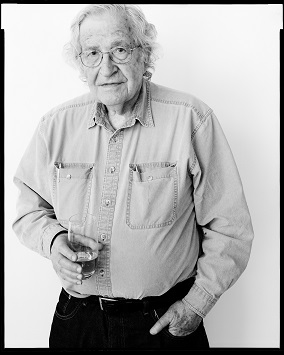
| Noam Chomsky teaches linguistics at M.I.T. and
is a well known political dissident. He has written such books as
"Deterring Democracy," and "Manufacturing Consent." The Editor of Diet
Soap recently contacted Mr. Chomsky to ask him a few questions and
perhaps entice him into adding some respectablity to this fringe zine.
This second effort was futile, however, the professor did have some
comments (although none which he "trusted enough to convey," whatever
that means) on pranks, surrealism, psychedelics and the "deeply
personal."
Dear Mr. Lain,
Interested to hear about your journal. About your questions, I
don't really have any opinions that I trust enough even to convey.
Surrealism, pranks, and sabotage may have their place. Some of the
Dutch provo "pranks" were quite imaginative, humorous, and effective I
thought. Surrealism had its place as a movement in the arts, with many
achievements, but little in the way of undermining indoctrination, as
far as I can tell. Incidentally, immersion in the "deeply personal" is
not counter to capitalist oppression; rather, it is a central
component of it. Huge capitalist PR efforts are precisely designed to
immerse people in the deeply personal, removing them from the arena of
decision-making in the social, economic, and political spheres.
As for drugs, my impression is that their effect was almost
completely negative, simply removing people from meaningful struggle
and engagement. Just the other day I was sitting in a radio studio
waiting for a satellite arrangement abroad to be set up. The engineers
were putting together interviews with Bob Dylan from about 1966-7 or
so (judging by the references), and I was listening (I'd never heard
him talk before -- if you can call that talking). He sounded as though
he was so drugged he was barely coherent, but the message got through
clearly enough through the haze. He said over and over that he'd been
through all of this protest thing, realized it was nonsense, and that
the only thing that was important was to live his own life happily and
freely, not to "mess around with other people's lives" by working for
civil and human rights, ending war and poverty, etc. He was asked what
he thought about the Berkeley "free speech movement" and said that he
didn't understand it. He said something like: "I have free speech, I
can do what I want, so it has nothing to do with me. Period." If the
capitalist PR machine wanted to invent someone for their purposes,
they couldn't have made a better choice.
Admittedly, that's one case -- though not a trivial one. It
corresponds to what I saw over the years, though I admit I didn't see
a lot. I did have a great deal of contact with young people in the
resistance, the civil rights movement, and other popular efforts, and
still do. But simply don't know much about the influences you mention,
which were quite remote from any form of struggle that I knew anything
about or had any contact with.
Sincerely,
Noam Chomsky |