
If George Bush were to be judged
by the standards of the Nuremberg Tribunals, he'd be hanged. So too,
mind you, would every single American President since the end of the
second world war, including Jimmy Carter.
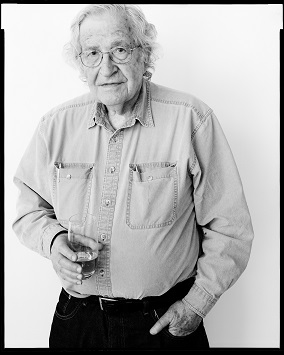
The suggestion comes from perhaps the most feted liberal
intellectual in the world - the American linguist Noam Chomsky. His
latest attack on the way his country behaves in the world is called
Hegemony or Survival: America's Quest for Global Dominance.
Jeremy Paxman met him at the British Museum, where they talked in
the Assyrian Galleries. He asked him whether he was suggesting there
was nothing new in the so-called Bush Doctrine.
NOAM CHOMSKY:
Well, it depends. It is recognised to be revolutionary. Henry
Kissinger for example described it as a revolutionary new doctrine
which tears to shreds the Westphalian System, the 17th century system
of International Order and of course the UN Charter. But nevertheless,
and has been very widely criticised within the foreign policy elite.
But on narrow ground the doctrine is not really new, it's extreme.
JEREMY PAXMAN:
What was the United States supposed to do after 9/11? It had been the
victim of a grotesque, intentional attack, what was it supposed to do
but try...?
NOAM CHOMSKY:
Why pick 9/11? Why not pick 1993. Actually the fact that the terrorist
act succeeded in September 11th did not alter the risk analysis. In
1993, similar groups, US trained Jihadi's came very close to blowing
up the World Trade Center, with better planning, they probably would
have killed tens of thousands of people. Since then it was known that
this is very likely. In fact right through the 90's there was
technical literature predicting it, and we know what to do. What you
do is police work. Police work is the way to stop terrorist acts and
it has succeeded.
JEREMY PAXMAN:
But you are suggesting the United States in that sense is the author
of Its own Nemesis.
NOAM CHOMSKY:
Well, first of all this is not my opinion. It's the opinion of just
about every specialist on terrorism. Take a look, say at Jason Burke's
recent book on Al-Qaeda which is just the best book there is. What he
points out is, he runs through the record of how each act of violence
has increased recruitment financing mobilisation, what he says is, I'm
quoting him, "that each act of violence is a small victory for Bin
Laden."
JEREMY PAXMAN:
But why do you imagine George Bush behaves like this?
NOAM CHOMSKY:
Because I don't think they care that much about terror, in fact we
know that. Take say the invasion of Iraq, it was predicted by just
about every specialist by intelligence agencies that the invasion of
Iraq would increase the threat of Al-Qaeda-style terror which is
exactly what happened. The point is that...
JEREMY PAXMAN:
Then why would he do it?
NOAM CHOMSKY:
Because invading Iraq has value in Itself, I mean establishing...
JEREMY PAXMAN:
Well what value?
NOAM CHOMSKY:
What value? Establishing the first secure military base in a dependant
client state at the heart of the energy producing region of the world.
JEREMY PAXMAN:
Don't you even think that the people of Iraq are better off having got
rid of a dictator?
NOAM CHOMSKY:
That, they got rid of two brutal regimes, one that we are supposed to
talk about, the other one we are not suppose to talk about. The two
brutal regimes were Saddam Hussein's and the US-British sanctions,
which were devastating society, had killed hundreds of thousands of
people, were forcing people to be reliant on Saddam Hussein. Now the
sanctions could obviously have been turned to weapons rather than
destroying society without an invasion. If that had happened it is not
at all impossible that the people of Iraq would have sent Saddam
Hussein the same way, to the same fate, as other monsters supported by
the US and Britain. Ceausescu, Suharto, Duvalier, Marcos, there's a
long list of them. In fact the people, the westerners who know Iraq
best were predicting this all along.
JEREMY PAXMAN:
You seem to be suggesting or implying, perhaps I'm being unfair to
you, but you seem to be implying there is some moral equivalence between
democratically elected heads of state like George Bush or Prime
Ministers like Tony Blair and regimes in places like Iraq.
NOAM CHOMSKY:
The term moral equivalence is an interesting one, it was invented I
think by Jeane Kirkpatrick as a method of trying to prevent criticism
of foreign policy and state decisions. It has a meaningless notion,
there is no moral equivalence whatsoever.
JEREMY PAXMAN:
Is it a good thing if it is preferable for an individual to live in a
liberal democracy, is there benefit to be gained by spreading the
values of that democracy however you can?
NOAM CHOMSKY:
That reminds me of the question that Ghandi was once asked about
western civilisation, what did he think of it. He said 'Yeah, it would
be a good idea.' In fact it would be a good idea to spread the values
of liberal democracy. But that's not what the US and Britain
are trying to do, it's not what they've done in the past. I mean take
a look at the regions under their domination. They don't spread
liberal democracy. What they spread is dependence and subordination.
Furthermore its well-known that there is a large part of the reason for
the great opposition to the US policy within the Middle
East. In fact this was known in the 1950's.
JEREMY PAXMAN:
But there is a whole slur of countries in eastern Europe right now
that would say we are better off now than we were when we were living
under the Soviet Empire. As a consequence of how the west behaved.
NOAM CHOMSKY:
Well, and there is a lot of countries in US domains, like Central
America, the Caribbean who wish that they could be free of American
domination. We don't pay much attention to what happens there but they
do. Look, in the 1980s when the current incumbents were in their Reganite
phase, hundreds of thousands of people were slaughtered in Central
America. The US carried out a massive terrorist attack against
Nicaragua, mainly a war on the church. They assassinated an
Archbishop and murdered six leading Jesuit intellectuals. This is in
El Salvador. It was a monstrous period. What did they impose? Was it
liberal democracies? No.
JEREMY PAXMAN:
You've mentioned on two or three occasions this relationship between
the United States and Britain. Do you understand why Tony Blair
behaved as he did over Afghanistan and Iraq?
NOAM CHOMSKY:
Well, if you look at the British diplomatic history, back in the
1940s, Britain had to make a decision. Britain had been the major
world power, the United States though by far the richest country in
the world, was not a major actor in the global scene, except
regionally. By the Second World War it was obvious the US was going to
be the dominant power, everyone knew that. Britain had to make a
choice. Was it going to be part of what would ultimately be a Europe
that might move towards independence, or would it be what the Foreign
Office called a junior partner to the United States? Well it
essentially made that choice, to be a junior partner to the United
States. US, the leaders have no illusions about this. So during the
Cuban missile crisis, for example, you look at the declassified record,
they treated Britain with total contempt. Harold McMillan wasn't even
informed of what was going on and Britain's existence was at stake. It
was dangerous. One high official, probably Dean Atchers --he's not
identified--, described Britain as in his words "Our lieutenant, the
fashionable word is partner". Well the British would like to hear the
fashionable word, but the masters use the actual word. Those are
choices Britain has to make. I mean why Blair decided, I couldn't say.
JEREMY PAXMAN:
Noam Chomsky, thank you.