
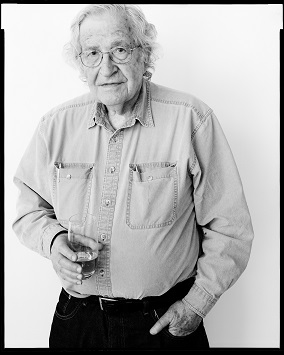
[Bernie Dwyer]: It’s really
a pleasure to welcome you to Cuba on your first visit here. Our
telephone interview last August swept rapidly across the Internet
which is indicative of the interest people have in what you have to
say even after so many years of critical political commentary. What
motivates you to continue keeping in touch with what is going on in
the world and offer analysis, commentary and possible solutions to
world problems?
[Noam Chomsky]: It seems to me the opposite question is the
one that ought to be asked. There is a moral truism about this that is
as elementary as anything can be: privilege confers responsibility and
the people who are called intellectuals, for no particularly good
reason, happen to be privileged.
We have education, training, resources, opportunities and in a country
like the United States, virtually no repression, it’s an unusually
free country by comparative standards, so we just have that much more
responsibility than people who lack those opportunities, like most
people in other countries including those under the boot of the United
States, and most people in our own country. After that it’s just a
matter of choice. Do you observe moral truisms or don’t you?
If you do, these are the kind of things that you naturally and
automatically do and it doesn’t merit any credit or applause or
anything else, it’s just being a human being and using the
opportunities that you have.
[Bernie Dwyer]: The slogan from the World Social Forum which
you attended at Porto Alegre in Brazil earlier this year was that a
better world is possible. Is that part of what motivates you? Do you
honestly think that a better world is possible?
[Noam Chomsky]: Possible, certainly. Attainable, that’s
another question. And that goes back to the first question: if people
are willing to undertake their responsibilities seriously, then a
better world is very possible. Unfortunately, there is probably an
almost inverse correlation between opportunity and dedication and
commitment.
So rather typically, it’s the people that live under repression and
deprivation and face serious penalties and lack privilege who are
working hard to build a better world. Those who have the opportunity
and every opportunity in front of them, every kind of privilege, quite
typically throughout history tend to be subordinate to power.
Actually, it’s not a particular observation of mine. The founder and
leading figure in modern international relations theory, Hans
Morganthau - a much respected scholar - once harshly condemned what he
called our conformist subservience to those in power. He was referring
to the intellectual classes in the United States and the West
generally. And it’s a comment that is reasonably accurate and goes
back through recorded history: the respected intellectuals in
virtually every society are those who are distinguished by their
conformist subservience to those in power. Others who take elementary
human responsibilities seriously tend to suffer overwhelmingly in one
form of repression or another.
So if you were in Czechoslovakia under the Soviet Union, you might end
up in jail. If you were in El Salvador in the same years, you would
get your brains blown out. Well, those are just the different kinds of
repression that appear in different kinds of societies. And in a
country like the United States, or Western industrial societies, the
punishment - such as it is - is marginalization or vitriolic attacks
or something like that, but nothing that even merits comment when
compared with most of the rest of the world.
And this is pretty close to a cultural universal. There are some
exceptions but it’s commonly true.
In fact one of the reasons that we believe that a better world is
possible is because we have a better world. The world is a lot better
than it was not very long ago. Maybe not in every respect - there is
more aggression - but in many respects. We know how it got better. It
didn’t get better by some gift from the gods or the powerful or some
benevolent dictator, it got better because people struggled to make it
better and typically, those who were suffering most.
[Bernie Dwyer]: So would you go along with the axiom that
power corrupts? For instance, when one is listening to election
campaigns or leaders of struggles, it’s very seldom that they maintain
their altruistic attitude once they attain the power position.
[Noam Chomsky]: People who are really sincere about the
belief that a better world is possible will refuse to take power. In
fact, they will try to undermine institutions that even grant power.
Maybe to some extent, certain kinds of authority are required to
delegate responsibility and that sort of thing, but one who is really
interested in a decent world would want to reduce that to the absolute
minimum, in fact to constantly be challenging authoritarian
relationships and institutions and require them to justify themselves.
Sometimes they can be justified, but the burden of justification is
always on authority and domination. It is never legitimate in itself.
That’s true even if it’s a family or an international society.
So take Brazil today. It should be a lesson in humility to the
industrial world. Elections were carried out in Brazil of the kind
that are almost unimaginable in the United States and other industrial
societies. Brazil, of course, has an extremely high concentration of
capital and wealth - unusually so. It is a pretty brutal and
repressive society. You have to be afraid of the police if you live in
a favela or not even there. Nevertheless, under very harsh conditions,
popular movements developed from poor people, landless workers and
steel and peasant workers. The popular forces reached the point where
they could actually challenge and even overcome a tremendously high
concentration of capital and the media power of authority and
repression and elect their own government.
You cannot imagine that happening in the United States. There is no
candidate who can even participate unless he manages to gain a large
component of concentrated wealth and power behind him. Otherwise he is
not in the political system. Well, now we should be humiliated
literally by the fact that under much harsher conditions, poor and
repressed people can do what we are afraid to do and that runs
throughout the industrial world.
There are many things happening like that around the world. That
takes in the so-called anti-globalization movements around the world,
(a very bad name: they are global justice movements), that want a
different kind of international integration. People think about them
as having started in Seattle, but that’s because when something
happens in the North, you have to pay attention to it. You know, if a
hundred thousand peasants are storming the Indian parliament: who
cares about that?
At the Summit of the Americas, which attempted to ram through the Free
Trade Area Agreement, there were big protests that were reported, but
that’s because they were in Canada. If the same thing had happened in
Argentina or somewhere, they probably wouldn’t have been reported.
It’s interesting that, in fact, when these events are reported, they
are radically distorted. Just coming down here on the plane from the
United States, I was reading the latest issue of one of the foreign
policy journals and there was an article which opened by talking about
the World Social Forum, which is extremely rare because it is almost
never mentioned in the United States.
I happened to be in a very good position to see most of the hundred
thousand marchers that were taking part. Anyway, this article opens by
saying “The slogan of the World Social Forum was ‘A Better World is
Possible’ but its slogan should have been: ‘Let’s go back to the Old
World’ - a world of anti-Semitism, of Fascism, of Nazism and so on -
and it says, the marchers, 20,000 of them (there were actually
100,000), were carrying swastikas and calling for killing the Jews and
so on and so forth. Maybe if you look at a 100,000 people and you
look hard, maybe you will find three people who are doing that.
But that’s the picture of the World Social Forum that you are allowed
to present to a kind of liberal intellectual and well-educated
audience in the United States. When it’s in Seattle, they show people
breaking windows and all that, but when it’s in the North, you cannot
ignore it. When it’s in the South you can lie about it as much as you
like.
[Bernie Dwyer]: Do you see these popular movements taking the
place of the organized Left political parties in the major task of
building a new society as was mentioned several times during the
conference, which commented that the Left is in disarray?
[Noam Chomsky]: Well, I have never really thought that the
Left was much in “array” as far as political purposes were concerned.
These are usually various power systems, maybe good things, maybe bad
things. I don’t think that these new popular movements are taking the
place of anything, they’re really new. There never was anything like
the World Social Forum before.
The goal of the Left from its modern origins has been to create a real
International. The Left has never been anti-globalization, that’s why
every union is called an International. You want to have international
solidarity and support and so on. It never succeeded. Now the
Internationals were very limited in their outreach and they fell
apart, actually under internal authoritarian reasons in each case.
Now this is different. This is really international and it has
participation from a vast range of components from society: peasant,
working people, environmentalists, intellectuals, poets, all sorts of
people. How far this will go, who knows. There are a lot of disruptive
forces inside and a lot of pressures outside, a lot of difficulties,
maybe this one will fail, but even if it fails, it succeeds. It lays
the basis for something that can come next. You don’t expect anything
important to happen in a day - whether it’s the elimination of slavery
or women’s rights or whatever it may be. These are things that take
time.
One of the problems of organizing in the North, in the rich countries,
is that people tend to think - even the activists - that instant
gratification is required. You constantly hear: “Look I went to a
demonstration and we didn’t stop the war so what’s the use of doing it
again?” But people who live real lives know that that is not the way
things work. If you want to achieve something, you build the basis
for it.
If you want to achieve something like, say, an electoral victory that
means something, you have to spend decades organizing the basis of the
groups so all local communities can take part and so on and so forth.
It’s a lot easier in countries where there are more opportunities and
wealth and less repression. It’s still not going to happen in a few
minutes, so the World Social Forum is not really replacing left
parties. Its place is maybe establishing more authentic ones and I’m
not even sure whether political parties are what we are looking for.
Maybe what we are looking for are cooperatives and communities which
interact and federate and just build a new society.
[Bernie Dwyer]: During these times of US domination of the
world, what role do you see Cuba playing?
[Noam Chomsky]: Well, Cuba has become a symbol of courageous
resistance to attack. Since1959 Cuba has been under attack from the
hemispheric superpower. It has been invaded, subjected to more terror
than maybe the rest of the world combined - certainly any other
country that I can think of – and it’s under an economic stranglehold
that has been ruled completely illegal by every relevant international
body, It has been at the receiving end of terrorism, repression and
denunciation, but it survives.
If you look back at the declassified record and the problems that Cuba
was posing and therefore had to be overthrown, one intelligence
analyst said that “the very existence of the Castro regime is
successful defiance of US policies that go back a hundred and fifty
years”. He’s not talking about the Russians. He is talking about the
Monroe Doctrine, which says we are the masters of the hemisphere. It
goes on to say that this really dangerous as it offers a model that
others might want to follow. That’s what is called “communist
aggression”. You have a model that somebody wants to follow. So you
have to destroy the virus.
Kissinger, for example, during the other 9/11 - the one that happened
in 1973 - was concerned that Allende, with his democratic victory and
social programs would spread contagion not only in Latin America, but
even in Italy where the United States at the very same time was
carrying out large scale subversive operations to try to undermine
Italian democracy and even supported fascist parties in Italy.
Yes, Cuba is the symbol of successful defiance that accounts for the
venomous hostility. The very existence of the regime, independent of
what it does, by not subordinating itself to power is just an
unacceptable defiance for the rest of the world. It’s a symbol of what
can be done without using harsh conditions. It’s once again a case of
those under the most severe conditions are doing things that others
can’t do.
So, for example, let’s take Cuba’s role in the liberation of Africa.
It’s an astonishing achievement that has almost been totally
suppressed. Now you can read about it in scholarship, but the
contribution that Cuba made to the self-liberation of Africa is
fantastic. And that was against the entire concentrated power of the
world. All the imperialist powers were trying to block it. It finally
worked and Cuba’s contribution was unique. That’s another reason why
Cuba is hated. Just the plain fact that black soldiers from Cuba were
able to beat back a South African invasion of Angola sent shock waves
throughout the continent. The black movements were inspired by it. The
white South Africans were psychologically crushed by the fact that
South African forces could be defeated by a black army. The United
States were infuriated. If you look at the next couple of years, the
terrorist attacks on Cuba got much worse.
But yes, it’s a symbol of successful defiance. One can have arguments
about what society is like and what it does, but that’s for Cubans to
decide. But for the world its symbolic significance is not slight.
[Bernie Dwyer]: You are aware of the plight of the five Cuban
political prisoners in the United States. You are also very aware of
flagrant abuses, not only judicial but also of human and prisoner
rights regarding the visits of two of the prisoners’ wives and the
five year old child, Ivette. Why do you think that the EU, the UN, and
the other international bodies that are supposed to be keeping an eye
on democracy are allowing this very repressive attitude to continue?
[Noam Chomsky]: The reason is embarrassingly simple. You don’t
challenge the chief Mafia Don. It’s dangerous. Everyone knows that.
There’s no higher authority, there’s just the Mafia. If the Don is
doing something you don’t like, you can only object quietly. That’s
the main reason.
The secondary reason is that the European elite share the interests of
American power. They may not like the US throwing its weight around
that much - especially when it interferes with them - but
fundamentally they don’t disagree. They want to support the same
programs of economic integration, so-called neoliberal programs. They
are not unhappy to see the US power in reserve to crush people who
stand up and get in the way.
The thing with the Cuban Five is such a scandal, its hard to talk
about it. Cuba was providing the FBI with information about the
terrorist actions taking place in the United States, based in the
United States - completely criminal. So instead of arresting the
terrorists, they arrested the people that provided the information,
which is so ridiculous I find it difficult to talk about it. They put
them under very hard conditions and it’s not recorded. You can’t read
about it. So one of the reasons it goes on is because nobody knows
about it. There were a few brief mentions, but all it said was that
these people were informing Cuba that an unarmed plane was going .to
fly over Havana. That’s about the only story that was reported. The
actual facts of the matter are not secret but no one knows.
Take the embargo, which has been challenged by everyone. The European
Union did bring a challenge to it at the World Trade Organization and
the US just told them to get lost. In fact, what the Clinton
administration said was that Europe was challenging a policy, at that
time, of thirty years. These were US policies aimed at overthrowing
the government in Cuba without announcing that yes, “we are
international criminals and you are interfering with us and therefore
you have no right to say anything” and then the US just pulled out of
the negotiations and what’s anybody going to do about that?
I mean, the US is a huge debtor. It owes an enormous debt to the
world. What happens if it decides at some point that we are not going
to repay the debt? It’s not like Argentina. The International Monetary
Fund is not going to say anything. In fact, it’s a branch of the US
Treasury Department and even if it did say anything, it would tell
them to get lost too.
Look at the record and the serious issues in which the US is involved.
Let’s take the Vietnam War. The world was overwhelmingly opposed to
it. It almost never came up at the United Nations because one of the
high officials that I have talked to understood that if they brought
up the Vietnam War at the United Nations, the UN would simply be
destroyed. During the bombing of Serbia, there was a brief moment -
about five seconds - when it looked as though the International
Tribunal might take a look at NATO crimes. During that moment, an
American congressman was interviewed by the right-wing Canadian press,
The National Post, and they asked him what would happen if the
tribunal took this up and he said that we would take the United
Nations buildings in New York apart brick by brick, throw them in the
Atlantic Ocean - metaphorically speaking, of course.
If you take the record of vetoes: the US ran the United Nations in the
early days, because of the distribution of power. By the 1960s it was
beginning to reflect some sort of world opinion. Decolonization had
taken place and there were a lot of participants. However, since the
mid 1960s, the US is far in the lead on vetoing resolutions and
Britain is second.
No one else is even close and this can’t be discussed. They haven’t
discussed the fact that the UN is paralyzed by the US refusal to obey
international positions. There was all this fuss in the last year
about Iraq only partially fulfilling UN resolutions. Right, maybe they
should fulfill them all. If Iraq had the veto they wouldn’t have had
to fail to fulfill UN resolutions. I mean the veto is the strongest
and most extreme method of violating UN resolutions. So if you want to
be serious about even wanting to discuss the topic, you bring up the
veto. I don’t know one article in the entire US press in terms of
opinion that brought up the point.
These are not trivial resolutions. The US has vetoed resolutions
calling on all states to observe international law. It vetoed the
Security Council resolution affirming the World Court judgment which
condemned the US for pronounced international terrorism. No one
mentions this, nobody knows it, it’s not part of anyone’s
consciousness. You go into the faculty club or the editorial offices
and people will never have heard about it. That’s what it means to
have extreme power and a very subservient intellectual class. Exactly
as Morgenthau pointed out – it’s out of history, it didn’t happen.
A week or two ago a poll was taken in Baghdad by the right wing
American Enterprise Institute which had Gallup Poll do the poll. It
was reported in the mainstream press with the New York Times headline
“People in Baghdad Glad to See Saddam Go”. Well, you didn’t need a
poll to tell that, but if you read down the article to see the actual
results at the bottom which, in answer to the question “Which Foreign
Leader Do You Have the Most Favorable Impression Of?”. Jacques Chirac.
What does that tell you? A couple of weeks later, the same reporter
mentioned it with the comment “go figure” in that what kind of crazy
people are these that after we go and liberate them and they say the
most popular foreign figure is the one who was against the war? So
they’re crazy Arabs – there can be no other possible interpretation
like that they may be opposed to being invaded or some such thing.
Those things are there, in a sense - they’re not blacked out by the
state censors but this just as well might have been censored unless
you think for a few minutes to realize what it means. This happens all
the time.
[Bernie Dwyer]: You had serious problems obtaining permission
from the United States to come to Cuba to participate in this
conference. Do you foresee any further problems upon your return?
[Noam Chomsky]: In a country like the United States people who
have some degree of privilege - which is a lot of people in a country
like the US, and I’m part of it - are free by comparative standards,
from government repression. I was on Nixon’s enemies list, but nothing
ever happened and I never expected anything to happen. Actually, I was
up for a long jail sentence but that was because of openly organizing
tax resistance and supporting other forms of resistance, and I was
very public in this so I don’t call that repression.
But what intimidates people is not the police, but the defamation. Any
serious departure from the conformist subservience to those in power
is dealt with tantrums, lies, and endless vilification. Lies repeated
long enough become truths and you become a holocaust denier and other
things. It’s unpleasant but compared to what other people face around
the world that kind of unpleasantness isn’t worth talking about. |