
|
Through the framework of cause and effect, you can see the obstacles
posed by the War on Terrorism. Militarization, globalization, and
racism have accelerated; their intersections compounded. Chris Spannos
discussed these intersections and prospects for social change after
Sept. 11 with Noam Chomsky on May 24, 2002.
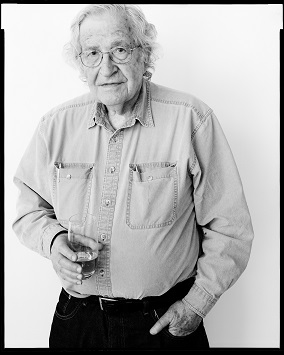
Noam
Chomsky is one of America's most prominent political dissidents and a
renowned professor of linguistics at the Massachusetts Institute of
Technology. He has authored over thirty political books, dissecting
issues such as U.S. intervention in the developing world, political
economy of human rights, and the propaganda role of corporate media.
Redeye: Hi Noam and welcome to Redeye.
Chomsky: Hi, how are you?
Redeye: I'm good, thanks.
There seems to be a general understanding that the events of Sept. 11
have caused a consolidation of power. Can you begin by elaborating on
it's characteristics?
Chomsky: The events of Sept. 11, first of all, were historic.
There is no doubt about that. It was a terrible terrorist atrocity,
but that, unfortunately, is not the reason it was an historic event.
Unfortunately, it is not unique in scale, by any means. What's unique
about it, is the victims. This is the first time in hundreds of years
that what we call the west - Europe and its offshoots - have been
subjected to the kinds of atrocities that they carry out all the time
in other countries and that is unique. The guns are pointed in the
other direction for the first time.
It doesn't lessen the nature of the atrocity. It is an atrocity. But,
outside Europe and the west, it is well understood that there is
nothing new, unfortunately, going on right now.
Just last week I was in Colombia where state terror carried out
through paramilitaries, crop destruction and other means is
extraordinary, at an extraordinary level and it all traces back to
Washington. So, it is international state terror happening right
before our eyes and it is not the only case.
But Sept. 11 was unique in that respect and it, as you say, lead to
the strengthening forces, not only in the west, but throughout the
world that want to exploit the opportunity exploit the atrocity as an
opportunity to expand projects that are already under way, many of
them quite brutal and repressive. For example, Russia eagerly joined
the War on Terror and Bush and Putin are drinking vodka about it right
now, I suppose. They are very happy to fight the War on Terror because
it gains them authorization from the United States for their own
horrendous terrorist atrocities in Chechnya, which they have stepped
up. Same is true in China, Algeria, Colombia and Turkey, where I was
just before, and Israel and Egypt, just about everywhere.
The western countries themselves have - mostly the governments - have
tried to push through what they sometimes call prevention of terrorism
ordinances or something like that. [They] have nothing to do with
terrorism but are a further way to try to discipline the population
and impose obedience, to prepare the terrain for pushing through a
program that they know the public is opposed to but will benefit
wealth and power, and be implemented during this period in the guise
of patriotism.
Patriotism is down to meaning you shut up and I'll relentlessly pursue
my own goals. That is happening everywhere and it takes different form
in different places. If it's a kind of consolidation, one doesn't
know, but it sure is an intensification of repressive harsh efforts
ranging from trying to discipline the populations to really serious
atrocities.
Redeye: The War on Terrorism has opened doors: a door for further
militarization, a further gap between rich and poor, and for
escalating racism. How do these things intersect?
Chomsky: Pretty clearly there has been increasing racism that
hasn't been as bad as some had anticipated. How bad it will get I do
not know.
In the case of increased militarization, it is not even a question.
The U.S. military which is already greater than most of the of the
world combined, certainly far beyond any potential adversary, was
sharply increased again and has very little to do with terrorism and
has plenty to do with global domination. They are tendencies that
already existed, they have simply been intensified.
Anti-immigrant feelings in Europe which have shown up in pretty ugly
ways in the last couple months. They were there before and there are
reasons for them, which are quite real. They have clearly intensified
and have taken on an anti-Islamic cast in the last months, but it is
an intensification of earlier problems.
The same is probably true in India and Pakistan, an extremely
dangerous situation. Both countries have extremely dangerous
fundamentalist movements, Hindu fundamentalism and Muslim
fundamentalist, and they are pretty brutal. In India, the massacres in
the Gujarat last month were almost certainly state-orchestrated and
connected to the Hindu nationalist extremism that is reviving that
Pakistan is familiar with. Now they are close to a war that could be
nuclear.
The framework of Sept. 11 has offered opportunities for conditions
under which these dangerous developments can persist and intensify.
Redeye: As you said the intersections were already there. Before
Sept. 11, modern resistance movements seemed to be gaining momentum.
Anti-globalization and peace movements, movements for community and
participatory democracy, were challenging institutions. What do you
see are the deciding forces for their progress?
Chomsky: Well I think they have developed even more effectively
after Sept. 11. There was a lull for a couple of weeks; people
acquiesced It wasn't a time for activism, but a time for reflection,
regret, thinking things through and so on. But after that it just
picked up more.
Just for a point of terminology: I wouldn't call them the
anti-globalization movement. That is a term of propaganda. Nobody is
against globalization. The question is what form would it take. Those
who want what the business press honestly call investor rights
agreements call what they are doing globalization and what everyone
else is doing anti-globalization, but that's nonsense. Everyone is for
globalization. The question is, Shall it be an investor rights base
form of globalization or a people's rights based form? Those are quite
different things.
A good indication of the expansion of the popular movements after
Sept. 11 is the meeting in Porto Allegre, the social forum a few
months ago. The number of people were maybe three or four times that
of the preceding year, from all around the world. [It was] a very
exciting meeting, I was there for part of it myself. It was pretty
impressive and it reflects things happening all over the world,
including here.
These are very often in the north called the Seattle movement, but
that just reflects their failure to pay attention to what happens
anywhere except the rich countries. The meetings are in Porto Allegre
and not in New York, because that is where these movements have
developed: in Brazil, India, South Africa and throughout most of the
south, that has been going on for decades. It is just that when it is
a couple thousand Indian peasants no one pays attention. But when
something comes to a northern city you have to pay attention. So the
wealthy countries are late comers for the most part, but they have
joined and that is important.
I think the possibilities for extending these popular movements are
greater than they were before. In the United States, after Sept. 11
there has been a notable increase among the general population in the
openness and concern and the willingness to think of all sorts of
issues that were previously not on the agenda. Sept. 11 was really
kind of a wake up call.
The United States and other rich countries tend to be very insular.
They mention how much to what they are doing in the world. The United
States is really pretty extreme in this respect. Sept. 11 made it
clear that that is not a tenable position. We have to pay much more
attention to our role in the world the way we are perceived, the
reasons for it. The actual consequences of our actions and that has
led to lots of reactions, but many of them are very healthy.
You can see it in any measure you like. For example, sales of books by
the small presses have skyrocketed, including books that were printed
twenty years. Public meetings, there are more of them and are larger
in scale. Commitment and engagement to the people and it is pretty
diverse its all very different kinds of groups and constituencies all
over the country and some similar situations are happening all around
the world. That opens opportunities. It doesn't mean that they have to
be used but they are there.
Redeye: You mentioned Porto Allegre and a huge amount of public
interest in current affairs and you also mentioned opportunity. How
important is discussion on popular goals and vision?
Chomsky: It's the first thing. You can't carry out any
organizational activities or any direct activism unless you have some
conception of what you are doing. That includes some kind of
overarching vision and some very practical proposes commitments to
immediate issues which they interact, of course. It's the groundwork
of anything further, begins with public discussion. |