
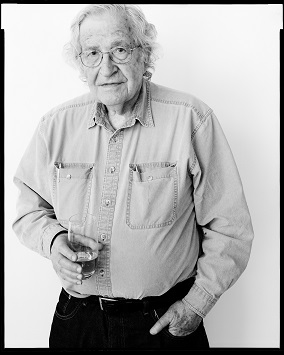
| Noam
Chomsky is a linguist, philosopher, and political activist. He has
long been an indefatigable human rights campaigner and has written
more than 30 books and countless articles attacking and exposing
United States foreign policy.
PACITTI:
Billionaire media magnate Silvio Berlusconi was elected premier at
Italian general elections last May, despite serious criminal
accusations and conflicts of business and political interests. It
would appear that Italian voters are less interested in moral issues
and more interested in what they thought he could do for them.
CHOMSKY: Well, why
do you think that’s different from Britain and the United States?
That’s what I was
hoping you would explain.
Well, the answer is
that it isn’t different.
Can you
elaborate?
There is a project
at Harvard called The Vanishing Voter Project. It does extensive
polling analysis to try to determine why the voters have been losing
interest in elections over the past 20 years. One of the things they
measure is the sense of helplessness; that is, that you feel you
cannot do anything that will affect the political process. It hit a
new high last year, far beyond anything before. Right before the
election about 75 percent of the population felt that there was no
election at all, that it was just some kind of game being played by
rich contributors, party bosses, and the media. The whole public
relations, or advertising, industry was crafting candidates, training
them to use certain gestures and produce certain words that the
research industry showed might increase the number of votes. But they
didn’t mean what they said and you weren’t supposed to be able to
understand what they said and it was all meaningless, just some kind
of public relations game.
Do you feel then
that what is happening in Italy is similar?
As far as I can tell
it is very similar, but I don’t know Italy as well. This is a tendency
that was led by the United States and Britain and goes back to the
early part of the century. The British Conservative Party (we have
their internal records) realized by the First World War that there was
no longer any way to keep the general population out of the electoral
system. They realized they were part of a union that was going to be
broadening the franchise and therefore they had to turn to what they
call political warfare. It’s called public relations, meaning
propaganda, to try to control people’s attitudes and thoughts and
direct them to other concerns and keep them out of the political
arena, since you could no longer control them by force. The same was
done in the United States. There was a huge growth of the public
relations industry right around that same time for the same reasons.
In the most advanced, more democratic societies, there is good reason
to believe that, as a society gains more freedom, propaganda takes the
place of violence as a means to control people.
In 1990, Berlusconi
was found guilty of perjury for denying his membership of the P2
Masonic lodge, an anti-Communist organization that used Italy’s
security services for political ends. His conviction was one of many
later annulled by a general amnesty. Alleged U.S. backing of P2 would
appear to confirm what you’re saying.
Exactly. Italy, as far
as we know, has been the main target of U.S. efforts to undermine
democracy since the Second World War. In 1948 particularly, there was
concern that the Left, which had a lot of prestige—it supported the
resistance against fascism and it had backed labor unions—was going to
win the elections, and the U.S. had plans. The National Security
Council’s first planning body, NSC1 was concerned with how to
undermine democracy in Italy. That was considered to be the problem at
the time. They concluded that they could undermine democracy by
withholding food, reinstating fascist police, which they did,
undermining unions, and a whole variety of techniques of that sort
were used. Then it was concluded that if this doesn’t work, if Italy
nevertheless has a Left political victory, the U.S. will call a
national mobilization and begin to support paramilitary activities in
Italy against the government. The National Security Council won and
that continued until the 1970s and maybe beyond. We only know until
the 1970s because that’s where the documents stop. That includes
supporting P2.
There’s more than a
suspicion here in Italy that Berlusconi obtained heavy backing from
the Sicilian Mafia at national elections.
Yes, but where did the
Sicilian Mafia come from? The Mafia was, as you know, destroyed by
Mussolini. The Mafia got reconstituted as the American and British
armies moved first through Sicily, then southern Italy and southern
France, and it was reconstituted as an agency to undermine the
resistance and undermine the Left. Not just in Italy. It was a
worldwide phenomenon. It affected Japan when the United States
reinstated Emperor Hirohito after the Second World War as part of the
effort to support fascism and undermine the Left.
So traditional
Italian forms of corruption are far less serious than the U.S.
variety?
In France, there was a
powerful anti-fascist resistance and a strong labor movement. The
south was immediately hit with one of the first activities, second
only to Italy, to try to undermine the unions and undermine the Left.
To do that they restored the Corsican Mafia, in southern France and
that is the source of the heroin traffic in the world. In order to pay
them off, they gave them the monopoly on heroin production. That’s the
same thing as the French Connection, right? That’s where the post-war
drug problem originated.
I know you’ve placed
the problem within a wider, global context, but is there something
else we could and should be doing over here that we’re not doing and
that goes beyond an Italian context?
In the case of Italy,
it’s certainly worthwhile bringing out the criminality, the Mafia
connections, and so on—people should understand the facts. But the big
problem in Italy, as far as I can see, is that people more or less
know, but they don’t care about it. They don’t care because they are
under tremendous pressure—this is not Italy but the world—to try to
remove the population from the political arena. What happened in the
1960s was extremely frightening to international elites. You see this
very strikingly, and perhaps most strikingly, in The Crisis
of Democracy.
It was the first
major study by the Trilateral Commission founded by David Rockefeller.
The Commission was a
mostly liberal internationalist elite, from Europe, the United States,
and Japan. It was mostly people like the Carter administration,
liberal in the American sense of social democrats and
internationalists. What they were deeply concerned about was an
increase in democracy, that is, through the 1960s parts of the public
that had usually been apathetic and passive began to get organized and
to enter the political arena and press their demands and so on. That
included women, working people, minorities, the elderly —in general
the large part of the population that was usually passive. The way
it’s supposed to work is that the political system is supposed to be
in the hands of private tyrannies, private power, and that was
beginning to erode. What they said is that there’s too much democracy
and that’s no good, it’s a crisis, that we have to have more
moderation in democracy, and we have to restore people to passive
apathy.
They said that they
had to prove that they were worried about what they called the
institutions responsible for the indoctrination of the young—their
words, not mine. That means the schools, the officials, media, the
churches—they were not indoctrinating people, they were becoming too
independent and thoughtful, too active, and something had to be done
to reverse this. Since then there have been major efforts to restore
people to their marginal existence and this takes many forms. One form
is what’s called minimizing the state within the neoliberal framework.
So remove decisions from the public arena and back into private hands,
one or another form of privatization.
Another form is the
centralization of financial authorities. So the European central bank
has enormous authority and it’s not accountable to parliament. Still
more important is the liberalization of finance since the 1970s,
dismantling the Bretton Woods system. That creates what economists
call a virtual parliament and you have to pay attention to what
investors say or else they can destroy the economy, and that restricts
enormously what governments can do. Right now there are extremely
important meetings on the general agreement for trade in services. The
idea is to privatize services, services meaning anything the
government can do—education, health, etc.
This is exactly
what Berlusconi has in mind.
Let’s remember that
this is a small part of something going on internationally. It’s
showing up all over the place in an effort to undermine the Left. You
can’t just throw them into a torture chamber. You have to find other
means. One means is propaganda. Another means is rabid consumerism, to
drive people into massive consumption. In the United States the
economy has suffered under the neoliberal policies, as has been the
case worldwide, and is maintained to an extent by consumer spending.
Household debt is now higher than disposable funds. That’s good
because it traps people, and trapped into debt you can’t do much.
You’ve got to just work harder and try not to think about it. So from
infancy children are deluged by propaganda telling them, buy, buy,
buy. The same is done with countries. The Third World is trapped by
debt, which was imposed by immense propaganda from the IMF and the
World Banking Organization. These are devices to try to control the
populations and ensure that the private tyrannies endure.
Do you think the
only thing we can do here in Italy is to try to make these things
clear?
Try to help people
see what’s going on. It’s not a matter of a little corruption here and
there. I mean, that’s true. It’s a marginal part of it. People are
correct not to be very upset about it. This guy’s corrupt, that guy’s
corrupt. So what? What’s much more important are the deeper systematic
properties, which are concerned as always to try to control the
population.
Do you think we
should do this by continuing to write books and articles?
We have to organize
people. There’s no point in books if they are just read by some
academics. It’s a different matter if they reach the general public
and are part of organizing efforts, for example; the kinds that have
led finally to international actions. That comes out of massive
organization. That’s the way to stop it. |