
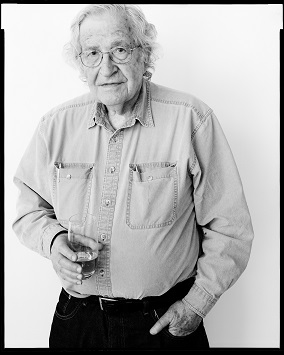
| QUESTION: The journal has approached this
particular publication on Shadow Economies in an effort to explore the
socioeconomic aspects of the subject. General themes have emerged that
reveal instances of economic imbalances stemming from political,
legislative and commercial action that enriches some and impoverishes
others. These implications of shadow economies, which is in many cases
a marginalization of the masses, relate to much of your work on the
politics of power and justice among nations and people.
CHOMSKY: In everything I have read about it, there are properties
that are rather common in discussing this topic. Whether we are
discussing terrorism or crime or anything else, there is a strong
tendency in the literature to focus on what you might call the retail
rather than the wholesale aspects. In the case of criminal activities,
for example, on terrorist activities of the weak rather than terrorist
activities of the strong. And I think that the same is true in
discussion of the shadow economy.
There are overwhelming elements of non-informal economies that are
not discussed much. Tax havens for example, are probably a substantial
element of the international economy. But these elements of "informal
economies" are part of the world of the strong and privileged, so not
very much is known about them. They are not the focus of a great deal
of attention and investigation, like drugs. In fact there are major
factors in the drug system that are much too little discussed, such as
the reasons why peasant farmers turn to coca production. They are
being driven to it by the very politics that the powerful states
advocate. For example, if you try to drive peasants to agro-export and
you undercut the conditions for production for local markets by
massive imports, and also establish conditions under which export of
major commodities undergoes sharp price fluctuations, then peasants
will not have many choices. They are likely to turn to production of
commodities for which there is always demand. And that has happened.
Colombia is a good case. Colombia had, and has, possibilities for
non-drug agricultural production, but they have very substantially
been undercut by external intervention. One of the more important
cases involves efforts to stabilize commodity prices. For large-scale
agribusiness it is not all that important if prices oscillate. But if
you are a small peasant farmer, you cannot say, "I am not going to
feed my children next year because the price is too low." Prices have
to be stable if you want to be a small coffee producer.
There were Third World efforts to introduce commodity
stabilization, but they were simply undercut by the rich countries.
The United Nations Conference on Trade and Development (UNCTAD), in a
core part of what was called "the new international economic order"
back in the early 1970s, tried in one of its first major efforts to
introduce measures to stabilize commodity prices. This would be
analogous on an international scale to the ways every rich country
stabilizes agricultural prices internally -- by market interventions.
The rich countries would not allow it -- primarily the United States.
That drives peasants away from coffee production.
Take Food for Peace Aid. In Colombia back in the 1950s, it sounded
like a nice idea, except that it undercut domestic wheat production.
So that eliminates another possibility. Once various possibilities are
cut away and massive state terror is introduced -- which happened, in
no small measure from US initiatives to prevent efforts to ameliorate
deplorable socioeconomic conditions -- you end up with the drug
culture. Those are massive factors in drug production, but they are
not the ones that are being addressed in policy or much discussed,
outside of specialist literature. The current drug war is not aimed at
stabilizing commodity prices for coffee production, just to take one
example of many. In fact even support for alternative crops is a very
marginal aspect. Judging by the programs that are not on the agenda,
the real motives can hardly be the professed ones, for many reasons.
QUESTION: How does the consumer and corporate power of wealthy
nations contribute to shadow economies around the globe?
CHOMSKY: What I just mentioned was a case in point. That is not
consumer power, it is corporate power. When the United States and
other rich countries undermine the efforts by the G77 group of
countries to work through UNCTAD to develop commodity stabilization
programs, which would allow small peasant production, that is
corporate power having a huge effect on shadow economies. But it is
also much bigger than that. Take tax havens again. Nobody knows the
scale of their use because it has not been studied much, but chances
are that tax havens are a major factor in the international economy;
probably well beyond drug money laundering, as pointed out by
political economist Susan Strange in her most recent book.
In fact, even the gross statistics, which as far as I know have not
been much investigated, reveal what appear to be significant effects
of these devices. The Commerce Department publishes detailed quarterly
reports on Foreign Direct Investment (FDI). Out of curiosity, I was
reading them regularly during the recent period of enthusiasm about
"new emerging markets" in Latin America. For the Western Hemisphere
(excluding Canada), roughly 25 percent of FDI was regularly going to
Bermuda, maybe 10 or 15 percent to the British Caribbean Islands and
roughly 10 percent to Panama. This reflects one aspect of corporate
power: about half of FDI was going to what a benign view might
consider as tax havens. The less benign view would be that the
category of FDI covers methods for laundering criminal money -- drug
money or something else. But it is certainly not building steel mills.
They do not do that in Bermuda or the Cayman Islands.
Fifty percent is not a small number. That is a big part of the
economy. During this period of enthusiasm about emerging Latin
American markets and the importance of FDI, I did not find a single
paper in the professional literature that even talked about these
points (although they were discussed by Doug Henwood in his invaluable
journal, Left Business Observer). Perhaps there were papers -- I do
not know the technical literature that well -- but I could not find
them. Certainly there must be specialists who know a lot about it, but
compared with the problems of the shadow economy that are discussed,
this one seems substantial. So, that appears to be a case in which
corporate activities are having a significant effect on the
international economy, within "shadow economies" -- violating the
rules. Of course, wherever this money is, it is redistributing wealth,
income and power upward, toward the richest sectors, apart from the
effects it has everywhere else. The World Trade Organization recently
ruled against the United States for permitting corporate use of what
amount to tax havens as a technique of export subsidy. That apparently
is a small fraction of this behavior on a global scale.
QUESTION: Is the shadow economy today the same as it has always
been? Or, is it taking on new characteristics and evolving with
globalization?
CHOMSKY: Globalization is a phenomenon that is new in some respects
but quite old in others. As many have pointed out, by gross measures
the global economy is not much different from what it was before: the
First World War. Upon closer look, however, there are important
differences. For example, the scale of speculative financial flows and
short-term financial flows, is astronomically beyond anything it has
ever been before. The distribution of production around the world,
mostly administered by international enterprises, is also sharply
different.
I think Barry Eichengreen pointed out one of the most striking
differences. He was not really talking about this, but there are
implications about it in his history of modern financial systems. He
pointed out that in the late 19th century, economic decision-making
had not yet been "politicized" by the rise of parliamentary labor
parties, unions and universal male suffrage. The general public could
be more or less excluded from decision-making. As a result, the costs
of financial rectitude -- keeping currencies stable and so on -- could
be simply imposed on the population. It was possible to have a
situation where there would be no special constraints on capital flow
and yet, still have a relatively stable economy.
By the 1940s, things had changed. There were unions, parliamentary
labor parties and, in principle, large-scale suffrage. In order to
compensate for this politicization of decision-making -- meaning the
public has a voice -- it was necessary to institute capital controls
and relatively fixed exchange rates. The luxury of imposing the costs
on a defenseless public was no longer available, as it still is in the
Third World through structural adjustment programs and other devices.
The Bretton Woods system instituted regulated currencies and the
option of capital controls to compensate for the inability to impose
the costs on the population, as before.
There is a corollary relating to what is now called
"globalization." Since the mid 1970s, we have seen a system in which
exchange rates float and limitations on capital flow have eroded.
Following the same reasoning as before, we would expect a significant
impact on popular sovereignty, on the ability of people to participate
in economic decision-making through government economic management and
social policies. These are options that erode under the threat of
capital flight and attacks on currencies -- under the "veto power" of
the "virtual parliament," as the process is sometimes called. That has
happened, noticeably. There also has been a slow-down in growth and
deterioration of other macroeconomic indicators. This is called
"globalization," but it is a particular form of integration of
international society.
The particular form of globalization that has been imposed has
specific consequences. It is not a matter of simply increasing
interactions among countries; rather, of doing so in a particular
fashion that happens to be geared to rights of investors and lenders,
and concentrated private power generally, supported by the most
powerful states and the international bureaucracies they have
established. These are particular modes of "globalization" that are,
in basic respects, incompatible with popular sovereignty in
socioeconomic decision-making and with social programs concerned for
the welfare of the general population; not maximization of profit and
market control. Popular sovereignty is undercut by the focus on
maximization of profit and control and financial liberalization that
is a core element of contemporary "globalization."
The same is true of the distribution of production, which enables a
lot of so-called trade really to be interactions that are internally
or centrally managed within a basically totalitarian structure. We
call it trade, but certainly a large proportion of it is centrally
managed. It is not trade in any serious sense. I think economist
Jeffrey Sachs is on target in calling these facts about cross-border
flows "stunning."
A common estimate -- it is really a guess, since there is little
careful investigation -- is that roughly 40 percent of cross-border
transfers are intra-firm, and that leaves out a significant amount.
Outsourcing, for example, is in essence centrally managed. And if we
were to count in the effects of strategic alliances we would find
that, according to some estimates, 70 percent of world trade is in
substantial degree centrally managed. That is a particular form of
administration of markets by highly centralized systems that have
various strategic alliances with one another and rely very heavily on
powerful states to socialize cost and risk. It is one kind of
globalization, with specific effects. But you cannot call that in
itself "globalization;" it is one particular form of the design of
international integration in the interests of corporate power. It
tends to marginalize large numbers of people, which tends to lead to
what are called shadow or informal economies. These terms are used for
people bartering without paying taxes, but not for the massive use of
tax havens to shift the burden to the general population and away from
the rich, along with all of the other effects that it has on
economies. I think that one has to be careful about these terms.
QUESTION: Frequently, terms having negative connotations are used
in reference to informal economic activity -- words such as shadow,
gray, underground and black market. Do you feel that these are
appropriate for understanding the dynamics of informal economies?
CHOMSKY: Yes, if you want to understand them, sure. Every social
system, whether it is a family or an international economy, has some
kind of norms. If it is an organized system, like states, the norms
turn out to be enforceable rules. Sometimes they are backed by state
force, or other forms such as Mafia force. If we consider the rules
that are more or less codified in the state and interstate systems,
economic behavior that does not conform to those rules could be called
a "shadow economy." The major component of that is activities such as
tax evasion on the part of major corporations or money laundering, and
so on. But since these are the prerogative of the powerful, they are
not what are usually meant in discussion of "shadow economy."
There are other aspects of interactions that violate rules and
norms, which are carried out by the poor. That is what is commonly
called the "shadow economy." But if we are to be clear about it, they
are all violations of the norms and rules, and those norms and rules
themselves are designed in the interests of the powerful.
I think it is a good analytic tool, but we should use it without
bias; that is, without a bias that leans away from the rich and
powerful and towards the poor and defenseless. Which is not only true
here; as I mentioned, it is true in other domains too. Take crime.
Every criminologist knows that corporate crime -- white-collar crime
-- is enormous in scale, and well beyond street crime in scale and
effects. Since nobody really studies it in close detail, we do not
have reliable numbers, but probably in orders of magnitude the numbers
that are given in in any criminology texts are more or less accurate.
According to some estimates, property crime carried out by
corporations is maybe on the order of five hundred times as high as
street property crimes. It is hard to count killings because we do not
know how many of the worker-related deaths to attribute to willful
negligence or violations of Occupational Safety and Health
Administration (OSHA) regulations, but the numbers are surely high. It
probably overwhelms the number of street killings.
The US is roughly similar to other industrial societies in level of
crime, but it is quite different in terms of fear of crime and
punishment of crime. That has been dramatically so since the onset of
"globalization." The US is, by now, off the spectrum in both of those
respects. If we look at punishment, we find that it is not directed at
those who are involved in major crime, but at those who carry out
retail crime. In fact by now many of them are not involved in crime at
all, except by newly-devised standards that criminalize certain
victimless activities -- typically those carried out by the poor, the
"dangerous classes" as they have been called. The whole culture, the
political and social culture of fear of crime, and harsh punishment of
crime -- both unusually high by comparative standards during the
"globalization" era --focuses on the weak and defenseless, not on the
rich and powerful, who are responsible for most of it.
I think we see a similar phenomenon when we talk about the shadow
economy. It is not that the topics discussed are not important, they
are. If we take a country like India, rough estimates are that the
black economy may be one-and-a-half times the size of the formal
economy, maybe more, so it is not small. On the other hand, what is
called the black economy very often is not considering the fact that a
multinational corporation has its corporate base in the Caribbean
islands or Mauritius.
QUESTION: The shadow economy is generally viewed as a problem in
that informal economic activities compete with legal entities, and
often deprive the state of funds that could be used to strengthen the
structure of society. Hernando De Soto, in The Other Path,
asserts that for Peru this kind of thinking is erroneous, that the
state itself marginalizes people toward informal economic endeavors.
How do you see the dynamics between the informal and formal economy
depriving the state of funds?
CHOMSKY: Tax evasion by major corporations is a major phenomenon. I
do not think it has really been studied to the point that one can put
numbers on it. But, for example Susan Strange concludes that it is one
of the dominant forces in the international economy. That is only one
component of wholesale "shadow economy" that escapes the rules. If we
look at money laundering, that is also huge, including the drug
business. The "shadow" arms trade, the illegal immigrant trade, the
trade in coerced sex -- these are undoubtedly very large parts of the
international economy. De Soto is talking about a real problem. In a
state like Peru, it is true that people are marginalized and driven to
other kinds of activity in order to survive and function. You do not
have to look very far to find it. We can find it right here. On the
other hand, if you look at the rules themselves, they also are
designed to marginalize people. Again, you don't have to go very far.
Take the building where we are right now. I have been working here at
MIT for 45 years and I think this is a great place, which is why I
have never thought of leaving. But we should not overlook the fact
that the institution is part of a larger system, by which the public
is compelled to bear the costs and risks of economic development so
that the profits can be privatized. So, a good part of the economy
relies on devices to ensure that cost and risk are socialized, and
profit is privatized. And this institution is just one part of the
funnel through which that happens.
Is the public marginalized in this system? Hopelessly marginalized.
Consider the Internet. Is the public aware that for 30 years they were
paying for the cost of developing it, bearing the risks of failure and
that the government decided in 1995 to give it as a gift to some big
corporations? I do not think that much of the public is aware of that.
Even to find out how the decision was made to transfer this enormous
public creation into private pockets is no small task. According to
the technical literature, the matter is still quite obscure. Does all
of this mean the American public was marginalized? Sure, very much so.
And you can say the same about just about every other dynamic aspect
of the economy.
So yes, there is tremendous marginalization, but that is within the
rules, not outside the rules.
QUESTION: It has been alleged that in India, the shadow economy is
roughly one-and-a-half-times the size of the formal economy. If the
economic activity that is taking place within that shadow economy
could be brought into state structures, do you think that it would be
used to strengthen Indian society?
CHOMSKY: Well, that depends on how Indian society is organized. I
mean the reason for the black economy is because opportunities are
lacking within the formal rule-governed structures. If people could
participate constructively within the organized economy they would do
so. The kind of shadow economy you are talking about -- where people
engage in barter interactions or whatever it may be -- those are
activities that people are driven to because they do not have
opportunities.
QUESTION: In some developed countries it is thought that the size
of the shadow economy is between 18 to 25 percent of economic
activity. In Scandinavia, where most people are able to participate,
perhaps this could be described as a thriving shadow economy.
CHOMSKY: Well you have to disaggregate and determine what types of
activities they are undertaking. I suspect that if you looked at the
informal economy in, say, Sweden, you would find much larger numbers
than that. You would have to ask questions (to which I do not know the
answers) such as how Ericsson evades their tax responsibilities. I
would guess that they do, if they are like other -- corporations, and
if they do then that is part of the black economy. I do not know much
about Sweden but I suspect that those numbers would be quite large.
There are other numbers that you could look at within the rules.
Ericsson, which is a big multinational, makes large profits on things
like mobile phone technology, which is an offshoot of the Swedish
military system, much like a good part of the economy here. They have
a military system that is highly advanced for a small country with
high-tech aircraft, for example -- and that is, of course, publicly
funded. One domestic function of high-tech military systems is to
provide a cover for high technology development, at public cost and
risk, culminating with Ericsson deriving substantial profits on mobile
phones. That is a cost that the public did not decide to bear any more
than people here decided to use their money to develop computers. They
did not decide it. They did not know about it, and most still do not
know about it. Furthermore, they not know that their taxes are now
being used for nanotechnology tomorrow either. These are operations
within the rules, forms of socialization of risk and cost. Maybe they
are good decisions in terms of long-run welfare benefits, maybe not.
But the public is marginalized. It is not involved in these decisions,
and knows little about them. If people did know, and had substantive
democratic modes of participation, they might well decide to use the
wealth that they produce in quite different ways.
And if Ericsson proceeds, as it well may, to shift production to
low-cost areas, and away from Sweden, where the people paid for the
wealth of this company, that is another way of marginalizing the
public. If it uses tax havens, or tax write-offs, or if it forces the
government into granting it subsidies in order to stay there, these
are other ways in which a private power system can marginalize the
public.
Suppose you added up all these numbers, which nobody does. I
suspect you would find that this covers a substantial proportion of
the global economy. Consider the state of Massachusetts, where we are.
The major services corporation in Massachusetts is Fidelity, and the
major industrial producer is Raytheon. These are called private
enterprises, although I think that use of the term "private" is a bit
of a word-game. A couple of years ago they both demanded that the
state provide them with what amounts to a subsidy in tax reductions or
they would move. Fidelity would move to Rhode Island, and Raytheon
would move to Tennessee, for example. The state therefore granted them
big subsidies through tax changes. Should they have the right to
demand that? Why should a system of private power -- unaccountable
private power -- have the right to compel the population that
essentially created them to grant them further subsidies? Raytheon
made a deal, understanding that they would keep some of their work
force local. They later reneged on the deal (so it is reported). But
the very existence of those relations is a way of marginalizing the
public; that is, subordinating it to unaccountable private power. And
that is again within the rules, not outside the rules.
It seems to me that if we want to study this topic seriously we
should look at it from a different perspective. To what extent does
the formation of the rules and the observance of the rules relate to
actual participation of people in determining their own fate? Under
what we should call democracy and freedom? It is certainly true that
the shadow economy in Sweden is drawing funds away from the public,
but it is presumably a small portion of the total picture, if we shift
to (what seems to me) a more realistic perspective.
QUESTION: In terms of governance, then, what types of appropriate
policy options would be in the best interest of both developing and
developed nations?
CHOMSKY: That ranges from technical questions to very broad
questions. For example, returning to the earlier example of
G77/UNCTAD, measures for stabilization of commodity prices might well
have been of significant benefit to small farmers in much of the
world, and also to global society -- for example, by undercutting a
lot of the basis for the drug trade, which encompasses many criminal
activities and leads to the destruction of lives (among other things).
Something as simple as stabilizing commodity prices would have had an
effect, probably a major effect, for many people. These are things
that are possible, and they are not outlandish. Every major society
like the US or the EU does it internally, but they would not allow it
to be done in the interest of the poor in the South.
That raises other questions: What right does a private company have
to make decisions on its own? On what grounds does a state-chartered
corporation have the right to demand not only personal rights, but
rights that are way beyond any person? If we go back a century, we can
find that various "organic structures," as they were sometimes called,
were being developed and accorded rights over and above people.
Something like that had been true under feudal systems, but now we had
new ones. There were basically three kinds gaining prominence in the
early 20th century: one was Fascism, a second was Bolshevism, and a
third was private corporations -- corporatism. They were similar, in
that they demanded and received -- more or less by force -- rights
that are independent of the rights of people. They had their own
rights, as entities. In the United States it was done mostly by
radical judicial activism. Two of the systems have collapsed. The
third remains, more powerful than ever.
We should, however, question the justification for what amounts to
unaccountable private tyranny. It is a real question, though one that
is far-reaching, as distinct from stabilizing commodity prices, or
imposing some kind of constraints on free capital flow, which is
probably very harmful to the economy, as well as to substantive
democracy.
QUESTION: Do you see how commercial interests might also influence
solutions to the problems that exist in shadow economies?
CHOMSKY: Can the problems of shadow economies be dealt with within
commercial institutions, like firms for example? Yes, a firm can
decide not to use tax loopholes. Or Microsoft, for example, could
decide not to take the public gift of the Internet. I do not expect
any of these things to happen, but yes, it could happen. It will most
likely not happen because the institutional structure of firms does
not allow it. Here, I think that [right-wing economist] Milton
Friedman is correct. There is an obligation on the part of the board
of directors to act in a way that is highly anti-social, namely to
maximize profit and market share. That is their legal obligation. The
rules are designed so that these anti-social activities are required
on the part of major institutions. That is a problem with the rules.
And in order to move towards a more free and just society, the rules
should be changed.
QUESTION: It could be said that the reality of informal economic
activities is, in a sense, Capitalism in its purest form: the
maximization of profits and risk-taking without regulation. Which
would you say is the anomaly? The formal or the informal economy?
CHOMSKY: I think the informal economies are more like the model of
capitalism than the formal economies. The informal economies are more
like what Adam Smith would have called a market. In contrast, the
formal economy -- the international economy -- is a kind of
mercantilism, or corporate mercantilism, with administered markets and
administered interactions, much of it involving interactions among
alleged competitors. For example, IBM, Toshiba and Siemens might work
together on some development project, while they are all supported (in
not such complicated ways) by socialization of risk and cost. That has
little resemblance to anything an advocate of free markets would
support. And these are not small proportions. The numbers we are
mentioning, such as the percentage of central administration of
cross-border interactions -- which we call "trade" -- these are
undoubtedly large numbers. Similarly, techniques of tax evasion and
laundering -- what probably lies behind the FDI figures I mentioned
before -- have not been very closely investigated, as far as I know.
In contrast, an informal economy in some country in Africa, where
one finds many people living in an informal economy that has trading
occurring in a local market, that probably looks more like a
capitalist society.
QUESTION: One aspect that has consistently emerged during the
Journal's research for this issue is that the informal economy is
poorly understood, or practically invisible. Why do you think that is
so? Is it because a lot of this activity is considered illicit,
nefarious activity? Is it because of pressure by vested interests? Or,
is it attributable to the difficulty of accurately measuring the size
of the informal economy?
CHOMSKY: Well, it certainly is technically difficult. It is harder
to measure things that are not registered and listed in the
bookkeeping. That is going to be harder to measure. On the other hand
-- again, I always come back to the same point -- the major elements
of the non-rule based economy, of the informal economy, are not
studied because they involve interests that are simply too powerful.
We do not find investigation of such substantial matters as the scale
of resort to tax havens. Even that proportion of international trade
that is intra-firm -- that is something that could be identified, but
if one were to try, it would be extremely difficult. As mentioned
earlier, there was an international monitoring system at the UN, but
that was undercut because the rich societies did not want it.
What proportion of cross-border transactions are really centrally
managed? That is something that one could conceivably ascertain
bringing into account intra-firm trade, outsourcing, strategic
alliances and other devices. But, powerful interests would prefer that
not to happen, and the analyses that exist are substantially based on
guesses. I have sometimes tried to check some of them through
footnotes, only to find that they trace back to what are really
guesses.
Many important matters are not studied carefully. Consider
something as fundamental as social indicators: child abuse, health,
hunger, illiteracy and so on. Most countries, and just about every
industrial country, at least take a stab at it. Even the government of
Turkey, publishes reports on social indicators. The United States does
not. If you want to figure out the relation between class and
mortality or something like that, or what the shifts are in social
indicators over the years, you have to go to private investigators.
Fordham University has an institute that has tried to monitor social
indicators. It is not a government project. In fact, at least as of a
few years ago, probably still today, the Census Bureau did not even
give data on class-related factors. You can find out about race and
mortality, but when Johns Hopkins University public health specialist
Vicente Navarro wanted to find out something about class and
mortality, he had to do complicated computations based on other
correlations that are given.
These are not topics that are intended to be studied, and for
strong reasons. If you look, for example, at the efforts of the
Fordham University project to monitor social health, they are not on
the scale of a major government project, so one has to take the
numbers with a grain of salt, though the tendencies are probably
correct.
One of the basic things that they have discovered -- and it shows
up in a lot of other parts of the social and economic system as well
-- is that through the early post-war period (which some people call
the golden age of state capitalism, roughly 1950 to the mid 1970s)
social indicators tended to rise along with GDP. Later, the measures
diverged: GDP continues to increase, although not as fast as
previously and social indicators actually decline. It is difficult to
overlook the fact that this was the period of the breakdown of the
Bretton Woods system, that is, of capital controls and regulated
currencies, the period of "globalization" in the contemporary sense.
The Bretton Woods system was instituted in part because it was
expected that free capital flow and fluctuating currencies would
undercut the possibilities for national socioeconomic management or
democratic participation in deciding socioeconomic planning. That was
why Keynes, White and others instituted those conditions, quite
explicitly. With the breakdown of conditions you get the expected
effects. That is not a major topic in the mainstream. It is well
studied, but it does not really enter the public arena. Many things
are not studied, or remain out of general view, because they cut too
close to the center of power.
QUESTION: As a final comment, would you be able to give us some
thoughts on how civil society might find solutions to the problems of
the shadow economy?
CHOMSKY: Civil society ought to aim at empowerment, and
democratization, that is, expanding to the limits the capacity of the
people to participate in making the decisions that affect their own
lives, their communities and the world. That is the task for civil
society. For the last 200 years there have been popular struggles
aiming at that and achieving quite a lot. And that is an ongoing task.
I do not know how many problems can really be solved -- life is a
complicated affair -- but whatever problems can be constructively
solved should, and can be, dealt with in that fashion. That requires
dismantling unaccountable private power systems and unaccountable
state power systems. It would require destroying totalitarian states
and their counterpart in the socioeconomic system. That is the task
for civil society -- for societies and their members. |