
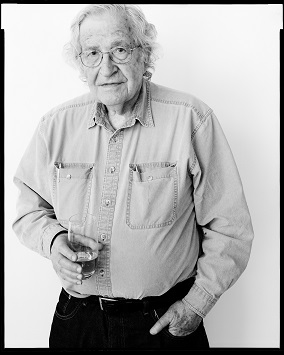
| QUESTION: Mr. Chomsky, the attention of world
leaders and the media seems to be once again focused on East Timor
following the independence vote there and all of the ensuing violence
that we've seen flow from that. Are you at all surprised at what has
happened since that vote in East Timor?
CHOMSKY: It's hard to be surprised. The violence, after all, was
going on since April. Very extensively in fact. The Australian press,
at least, which has by far given the most extensive coverage, was
reporting in July that the paramilitaries and so-called militias were
organized by the Indonesian army and were stockpiling arms to carry
out and initiate extreme violence if they didn't succeed in
intimidating the population enough to win the vote. It was anticipated
I'm sure.
QUESTION: Should there have been an international force available
to East Timor at the time of that vote to ensure that the will of the
referendum was carried through and not the acts that we're now seeing.
CHOMSKY: I think that there's very little doubt of that. For
example Bishop Belo who is as much of a spokesman for East Timor as
there is ... the bishop of East Timor who won the Nobel Prize a couple
of years ago. He was calling for an international force months earlier
and in fact every sensible observer could see that that was necessary.
The Indonesian army was organizing terror and destruction on quite a
remarkable scale. Bishop Belo and others estimated deaths in the range
of three to five thousand before the referendum.
QUESTION: How much influence does the West, in particular the
United States, have over Indonesia? Could all of this have been
prevented or has the Indonesian government simply lost control over
the military?
CHOMSKY: We just saw this weekend how much influence the United
States has. As soon as the United States finally was pressed to take
at least a kind of a tepid position Indonesia immediately backed down.
If the United States had, before, called on Indonesia to terminate the
violence there is very little doubt that they would do so. I should
say that this issue still remains. The Clinton administration is not
giving Indonesia strong indications that it wants the violence ended.
People are dying up in the mountains; they are starving to death; they
are being murdered in West Timor in camps that are under Indonesian
army control. We don't know what's going on in the countryside where
nobody's observing and the United States is doing nothing about it.
Indonesian generals can understand that. There would be nothing to
stop the United States from flying in humanitarian aid to the people
who have been driven into the mountains and are starving to death.
Indonesia is not going to shoot down U.S. relief planes.
QUESTION: Do you think that the financial concerns of Indonesia
have always outweighed the humanitarian concerns?
CHOMSKY: For the United States and other Western powers there is no
doubt. In fact they say so quite openly. The New York Times had
a cynical but good article a few days ago through their Asian
specialists, who simply described what they called the calculations of
the Clinton administration. The calculations are that Indonesia is a
country with rich resources and big markets with lots of investment
opportunities and are strategically important and East Timor is a poor
impoverished country of 800,000 people so therefore why bother.
QUESTION: Lots of talk now about accountability for the situation
... for what has happened in East Timor we've also heard those same
calls following the situation in Kosovo. Do you think accountability
will ever be brought forward here?
CHOMSKY: I think that the analogy to Kosovo is very misleading. The
question of accountability is very straightforward even though Canada
is not as big a player. Since the invasion in 1975 the West has
supported it throughout ... participated in it. The invasion was
carried out with decisive U.S. diplomatic support. We know that from
the memoirs of the U.S. diplomatic ambassador at the time, Patrick
Moynihan. It was carried out with U.S. arms.... Illegally, because
they were sent only for self defense. The U.S. immediately expanded
the flow of arms, secretly. The arms increased again in 1977 and 1978
with the Carter administration as the atrocities really peaked ... the
figure of 200,000 dead that you now hear that was from 1977-78. Jet
plane attacks with napalm up in the mountains creating a huge
disaster. We are actually in a hideous way reliving that disaster now.
In 1979 Indonesia finally allowed foreign visitors ... they allowed in
Western ambassadors including the U.S. ambassador. Carter's
ambassador, (Ed) Masters. They were horrified by what they saw. They
compared it to Biafra and Cambodia, a total disaster. However
Ambassador Masters intervened to prevent humanitarian aid from flowing
for about nine months. This was reported in congressional testimony by
one of the leading Indonesian scholars of the West in 1979. He pointed
out that Masters intervened for nine months to delay humanitarian aid
while I don't know how many tens of thousands of people died until
they got a green light from the Indonesian generals who said they had
the situation under control and therefore they would allow
humanitarian aid in. So that's exactly what's happening now.
QUESTION: Now that we see the UN actually saying that they will
send in a military force ... and we don't exactly know when that's
going to happen. Is that any indication to you that things are going
to change in terms of the West's relationship with Indonesia?
CHOMSKY: If the United States waits until they get a green light
from the Indonesian generals as they did in 1979 there will just be
more destruction and murder. They can move in right away. There is
nothing to stop them from bringing in humanitarian aid this minute to
prevent the people from starving to death in the mountains. Just this
morning The New York Times reported that 300 children starved
to death. Bishop Belo who is now abroad reported of 10,000 killed
since September. This is going on. There is no reason to let it go on
unless Britain and the U.S, who are the major powers, decide to let it
continue.
QUESTION: So do you not think then that the attitude has changed
towards Indonesia from the West?
CHOMSKY: There is a lot of pressure from the public in many
countries including the United States and Canada to do something. As a
result, a few days ago Clinton finally made some moves. They were
small moves but they were enough to get Indonesia in principle to
agree to an international force. If they made more moves they would
back off, almost certainly. It's simply a question of whether there is
going to be enough domestic pressure and turmoil in many countries to
compel the leadership to take the steps that they know perfectly well
that they can take. Incidentally, this has nothing to do with
intervening in Indonesia. East Timor is not part of Indonesia. It's
kind of like asking Indonesia to invite in the peacekeepers. Would be
like asking Saddam Hussein to invite in peacekeepers to Kuwait.
QUESTION: Yet at the same time that did seem to be the position of
many Western countries. That they didn't want to move into Indonesia
with a peacekeeping force until invited to do so.
CHOMSKY: Nobody asked them to invite peacekeepers into Kuwait.
Nobody asked Nazi Germany to invite peacekeepers into occupied France.
QUESTION: What about the domino effect? If independence does go
ahead in East Timor will there be other Indonesian provinces that will
want to follow leading to the disintegration of Indonesia?
CHOMSKY: First, remember that East Timor is not part of Indonesia.
Independence for East Timor which has been called for by the Security
Council of the United Nations 25 years ago and endorsed by the World
Court ... This will probably stimulate the already existing, real
separatist movements within what is formerly Indonesia. It's possible.
On the other hand, we should bear in mind that the United States which
is the main player has no principle objection to it. We know that
because the Eisenhower administration in 1958 carried out what are
probably the major post-World War Two clandestine operations to try to
break up Indonesia. They forced a rebellion in the outer islands where
most of the resources are to try to strip them away.
QUESTION: What are your thoughts on what lies ahead for the people
of East Timor? We are talking about a UN force moving in there
sometime in the future. What lies ahead there?
CHOMSKY: It is not a matter for prediction -- it is a matter for
action. I don't know what lies ahead. It will depend on what we do. If
people in the United States and Canada and Britain and elsewhere
pressure their governments to act, then there is some hope. It's been
a huge disaster already. Maybe it can't be reconstructed. But maybe if
they act now at least they will stop a worse catastrophe. If they
don't, it will continue to run along as it did in 1979 where
everything was put on hold until an Indonesian general said okay. What
the West ought to do, particularly the United States and others, is to
pay enormous reparations ... They are responsible for the catastrophe.
QUESTION: Mr. Chomsky thanks very much for this interview today. We
appreciate your time.
CHOMSKY: Okay. |