
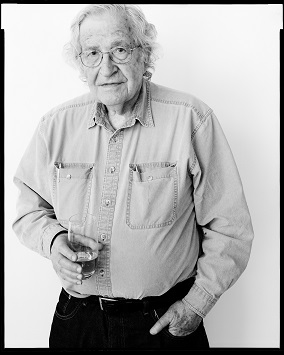
| QUESTION: Let's define some of the language we are
hearing around this war. Can you comment on the use of the terms
'humanitarian crisis', 'genocide', and 'ethnic cleansing' as they are
being applied to Kosovo?
CHOMSKY: Well, for starters, the concept called 'humanitarian
crisis' has a technical meaning, which does not have much to do with
what might reasonably be assumed to be the defining criteria of the
term. The technical meaning of humanitarian crisis is a problem
somewhere that threatens the interests of rich and powerful people.
That is the essence of what makes it a crisis. Now, any disturbance in
the Balkans does threaten the interests of rich and powerful people,
namely, the elites of Europe and the US. So when there are
humanitarian issues in the Balkans, they become a 'humanitarian
crisis'. On the other hand, if people slaughter each other in Sierra
Leone or the Congo, it's not a humanitarian crisis. As a matter of
fact, Clinton just refused to provide the relatively puny sum of
$100,000 for a peace-making force in the Republic of the Congo, which
might well have averted a huge massacre. But those deaths do not
constitute a humanitarian crisis. Neither do the many other deaths and
tragedies to which the US directly contributes: the massacres in
Colombia, for example, or the slaughters and expulsions of people in
south-eastern Turkey, which are being carried out with crucial support
from Clinton. Those aren't humanitarian crises. But Kosovo is a crisis
because it is in the Balkans.
Now, the term 'genocide', as applied to Kosovo, is an insult to the
victims of Hitler. In fact, it's revisionist to an extreme. If this is
genocide, then there is genocide going on all over the world. And Bill
Clinton is decisively implementing a lot of it. If this is genocide,
then what do you call what is happening in the south-east of Turkey?
The number of refugees there is huge; it's already reached about half
the level of Palestinians expelled from Palestine.
If it increases further, it may reach the number of refugees in
Colombia, where the number of people killed every year by the army and
paramilitary groups armed and trained by the United States is
approximately the same as the number of people killed in Kosovo last
year.
'Ethnic cleansing', on the other hand, is real. Unfortunately, it's
something that goes on and has been going on for a long time. It's no
big innovation. How come I'm living where I am instead of the original
people who lived here? Did they happily walk away?
QUESTION: So human rights abuses in Kosovo are termed a
'humanitarian crisis ' by the world's most powerful state. But how did
we get from that to all-out war?
CHOMSKY: Well, let's look at the situation from the US point of
view: There's a crisis, what do we do about it? One possibility is to
work through the United Nations, which is the agency responsible under
treaty obligations and international law for dealing with such
matters. But the US made it clear a long time ago that it has total
contempt for the institutions of world order, the UN, the World Court,
and so on. In fact the US has been very explicit about that. This was
not always the case. In the early days of the UN, the majority of
countries backed the US because of its overwhelming political power.
But that began to change when decolonisation was extended and the
organisation and distribution of world power shifted. Now the US can
no longer count on the majority of countries to go along with its
demands. The UN is no longer a pliant, and therefore no longer a
relevant, institution. This proposition became very explicit during
the Reagan years and even more brazen during the Clinton years. So
brazen that even right-wing analysts are worried about it. There is an
interesting article in the current issue of Foreign Affairs, an
establishment journal in the US, warning Washington that much of the
world regards the US as a "rogue super-power" and the single greatest
threat to their existence. In fact, the US has placed itself totally
above the rule of international law and international institutions.
NATO at least has the advantage of being pretty much under US
domination. Within NATO there are differences of opinion, so when
there was a question last September of sending unarmed NATO monitors
into Kosovo, every NATO country (with the possible exception of
Britain) wanted the operation authorised by the UN Security Council as
is required by treaty obligation.
But the US flatly refused. It would not allow the use of the word
"authorise". It insisted that the UN has no right to authorise any US
action. When the issue moved on to negotiations and the use of force,
the US and Britain, typically the two warrior states, were eager to
use force and abandon negotiations. In fact, continental European
diplomats were telling the press that they were annoyed by the
sabre-rattling mentality of Washington. So NATO as a whole was driven
to the use of force, in part, reluctantly. In fact, the reluctance
increases as you get closer to the region. So England and the US are
quite enthusiastic, others quite reluctant, and some in-between.
QUESTION: Why was the US so eager to use force?
CHOMSKY: The reason is obvious. When involved in a confrontation,
you use your strong card and try to shift the confrontation to the
area in which you are most powerful. And the strong card of the United
States is the use of force. That's perhaps the only realm of
international relations where the US has a near monopoly. The
consequences of using force in Yugoslavia were more or less
anticipated. The NATO Commanding General Wesley Clark stated that it
was entirely predictable that the bombing would sharply increase the
level of atrocities and expulsion. As indeed it did. The NATO
leadership could not have failed to know that the bombing would
destroy the quite courageous and promising democracy movement in
Serbia as indeed it did; and cause all sorts of turmoil in surrounding
countries as indeed it has, though still not at the same level of
crisis as Turkey or other places.
Nevertheless, it was necessary, as the Clinton foreign policy team
kept stressing, to preserve the credibility of NATO. Now, when they
talk about credibility, they are not talking about the credibility of
Denmark or France. The Clinton Administration doesn't care about those
countries' credibility. What they care about is the credibility of the
United States. Credibility means fear: what they are concerned with is
maintaining fear of the global enforcer, namely, the US. And that's
much more important than the fate of hundreds of thousands of
Kosovars, or whatever other consequences are incurred. So the US and
NATO have helped to create a humanitarian catastrophe by knowingly
escalating an already serious crisis to catastrophic proportions.
QUESTION: Some people say that unless American soldiers start being
shipped home in body bags, there will not be a serious anti-war effort
in the US. What is your assessment of that?
CHOMSKY: I don't agree with that at all. I mean, look at the
history. During the 1980s there was overwhelming opposition to US
atrocities in Central America. As a matter of fact, opposition was so
strong that the Reagan Administration had to back off and resort to
using international terrorist networks like the Contras to carry out
its policies. And there were no Americans in body bags then. Today
there's strong opposition to US support for Indonesian slaughter in
East Timor, and there are no American body bags. If you look at the
opposition to the Vietnam War, Americans were of course being killed,
but that was by no means the decisive factor. I think that the notion
that only dead American soldiers will inspire a peace movement -- in
other words, that people are motivated only by self-interest -- is US
propaganda. It's intolerable for the propaganda system to concede that
people might act on moral instinct, which is in fact what they do.
QUESTION: How do you reconcile that view with the fact that,
according to polls at least, the majority of Americans would support
an escalation of the war, for example, through the deployment of NATO
ground troops?
CHOMSKY: You have to keep in mind what these people are hearing.
The public is getting its marching orders from Washington. And these
orders are to disregard all other atrocities, even ones much worse
than Kosovo, especially in places where the US is involved. Focus your
attention only on this disaster and pretend to yourself that the
crisis is all about one evil man who is carrying out genocide. This is
what we are being told by our media day and night. It's effective.
Most people accept the marching orders. Then they say we've got to do
something, like send ground troops.
The Pentagon and the European forces are strongly against it,
mainly for technical reasons. I mean, it would be a catastrophe.
Sounds easy to send ground troops, but think about it. First of all,
it would not be easy to get them in, and would most probably take
months to get them ready. It would mean facing a major guerrilla war
that would probably level the whole region. That's what happens when
you send in ground troops and cause greater catastrophes. It would
simply escalate the atrocities.
QUESTION: What steps do you think people who oppose this war should
take now?
CHOMSKY: There is no question that people of conscience must take
action against this. What can we do to end this war? Same thing as
always, there's no magical trick. It requires education, explanation,
organising, demonstrating, exerting pressure... all things that we
know. And this is very hard to do; it's not like flipping on a light
switch. It takes work. |