
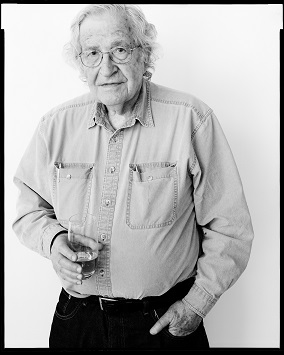
| Let's say I began the program with a litany of
unremarkable observations, accepted as given by the big institutions
in our culture. The United States is a democracy. The United States
supports the free movement of goods and capital between nations. The
United States has a free and unregulated information scene, a free
press, a diverse and competing set of voices all trying to persuade
you. The United States spent the decades after the Second World War
trying to export this country's systems and institutions to other
parts of the world: capitalism, multiparty democracy and a free press.
Noam Chomsky's work replies, in effect, 'False, false, false and
false. It isn't that way at all.' And why those ideas are accepted by
so many and repeated without objection in so many places every day in
this country is an interesting subject for inquiry. Even in the
counsels of the people he so aggressively criticizes, Chomsky is given
his due. The New York Times says, He is arguably the most important
intellectual alive.' The Chicago Tribune calls him the most cited
living author.' Born in Philadelphia, he just marked his 70th
birthday, son of a Hebrew language scholar, Noam Chomsky was a
self-directed researcher and scholar only lightly immersed in the
world of classes, papers and final exams. His independent scholarship
earned him BA and MA degrees and entry into the Society of Fellows at
Harvard University in 1951.
Chomsky's work lies at the intersection of philosophy, political
science and linguistics. The phrase 'necessary illusions' comes from
the writing of theologian Reinhold Niebuhr. The phrase 'manufacture of
consent' from the journalist Walter Lippmann. The strong critique of
the assumptions made by both those phrases runs like a strong spine
through Noam Chomsky's work. It's my pleasure to welcome Professor
Chomsky, teacher of linguistics at MIT and author of many books. The
latest is "Profit Over People: Neoliberalism In The Global Order."
Welcome to "Talk of the Nation."
CHOMSKY: Glad to be with you.
SUAREZ: ... Well, it's a great time to have you on because it's the
day after one of the--the speeches that is accompanied by a certain
amount of hullabaloo and pageantry and the use of words and the way
words are used as tools of political persuasion is something you think
about a lot and--and write about a lot. Any comments on the State of
the Union, to get us started?
CHOMSKY: Well, I didn't listen to it, but I did read it i--the
transcript in newspapers this morning, so I can't comment on the
rhetorical character, and I'm not interested. What interested me was
the content, as always, not the rhetoric. So the major issue that was
discussed was, first one, Social Security and what to do about it. And
I noticed no discussion of the assumptions on the basis of which the
forecasts were made. Those assumptions are available from the Social
Security trust. They're based--and they're continually repeated as if
they're just facts. We--kind of like laws of nature.
The assumptions about a Social Security crisis are based on
some--are rather strange, to put it oddly, mildly--they are based on
the assumption that economic growth in the next 75 years will be
approximately half of what it's been for the past 75 years and even
below the quite anemic performance of the economy, contrary to Alan
Greenspan, in the last 25 years. In fact, they're estimating about a
1.4 average annual growth, which is hi--would be historically
unprecedented, and if true, would, indeed, lead to a crisis of the
Social Security trust fund. But, of course, if the economic growth is
that slow, it will also be reflected in sharp slowing of the stock
market, since the two can't diverge too far over time, which means
that the recommended alternatives don't make sense. And we can
proceed.
There's also talk about how they'll be--there's a growing number
of--the--the number of active workers supporting the population
will--the percentage of them will decline, which is true, but not
mea--or may be true, but what's not mentioned is that, according to
current projections, even what's expected is that the proportion will
be higher in the year 2050 than it was in the year 1950. And we can
proceed. There's a lot that's omitted. Another thing that's omitted is
that the major support for the, by now, bipartisan proposals of
shifting it over to--in part, at least to Wall Street, the major
support from that comes not surprisingly from Wall Street investment
firms. They're the ones who are sure to benefit from it. The effects
on others, one can debate.
SUAREZ: Well, I think Social Security is a good example of the kind
of--of a--socially shared institution. It's something that, either by
choice or by being dragooned, large numbers of people who live in this
country are part of and have some stake in. Yet, when you talk to
people about Social Security, the responses all fall into a very
narrow range of--out of--of the universe of possible responses about
your attitude toward the program, your own reliance on it, whether you
think you're gonna get it i--or not. It's like trying to fit 190
million people through a tiny funnel. We all come out with pretty
similar takes on it. How does that happen?
CHOMSKY: Well, I'm not really sure that that's true. But it's--we
know about articulate opinion, the opinion that we read, say, in the
national press, but public opinion is a much more complex affair, and
as you know--you know--we all know, the answers that one finds
determi--are determined, to a large extent, by the way in which
questions are asked and the context in which they're asked. I--I think
my suspicion would be that a--an appropriate--a serious study of
public opinion would show very broad support for Social Security. In
fact, up until recently, it's been regarded as the third rail of
domestic politics. You're not allowed to touch it. It's only after a
very intense, I would call it, propaganda campaign of the past years
that the--there has been an elite consensus which may or may not have
filter--filtered down to the public, that the program is unacceptable
and has to be somehow scrapped. That's a big change in the last few
years. And all we know for can--we can say confidently is that it's
been an elite consensus.
SUAREZ: You write about and talk about an awful lot how ideas and
opinions get out into the general public and how there is tolerance
for a fairly narrow range in American political discourse, but has--a
lot of people who are sort of sometimes derisively referred to as
techno-utopians come out of--come out of the '90s burgeoning of--of
access to computers and the Internet and so on and talk about a
democratization of information.
CHOMSKY: Mm hmm.
SUAREZ: And there are people who say, 'Look, if I want to find out
things, I can find out things. I don't rely on ABC, CBS and NBC
anymore,' and the mass population, by and large, doesn't either. So
might this be a good time to--to rebuild the way we talk about
our--our shared problems and--and the way we try to find shared
solutions?
CHOMSKY: Well, if I--if I understand what you're suggesting, it is
that we essentially put aside the--the major media and turn to other
means of finding information. I--I don't actually recommend that. I
think, with all my--you know, I have plenty of skepticism and
criticism of the media, but I spend a lot of time reading them and
learn a lot from them. Ha--I--I do think that it is quite true that
the Internet and the Web have offered very wide ac--not only access to
information but opportunities for people to interact with one another,
to interchange ideas, to organize and so on, and that's been
ef--that's been highly effective in many ways. It's been effective in
getting around the narrow constraints that we--we find in the public
media. There's dramatic examples of that in the last few years. I
could give you a couple, if you would like some illustrations.
SUAREZ: Sure. Sure.
CHOMSKY: Well, okay, maybe the most striking example is--has to do
with the Multilateral Agreement on Investment. That was such a
striking example that it seriously frightened the international
business press. This is a--an agreement that--a--a treaty that was
negotiated essentially in secret--although it was perfectly
public--for about three years in the OECD among the--the rich man's
club, as it's called, the 29 rich countries. It--the--there was
participation--public participation namely by the business world, so
the--the International Council on Business, which is the international
organ of the Chambers of Commerce, basically--now that was deeply
involved all the way through. The corporations were involved all the
way through. The national media knew all about it. It wa--it--it--when
it finally hit the press, BusinessWeek described it accurately about a
year ago as the mo--the explosive trade deal you've never heard of.
Now both parts were correct. It was explosive and you'd never heard
of it unless you were right in the center of the corporate sector and
the parts of the government that catered to it. That was kept under a
veil of secrecy for almost three years. It finally broke through as a
result of activism that used the Internet, in p--in large part; first
in Canada, then in other countries. There was a leaked version of the
treaty that was put on the Internet. It got around to various
activists and public interest groups.
Finally, a wave of opposition--public opposition developed, which
was so strong that early--well, la--early last year, 1998, the major
media had to finally begin paying a little bit of attention to it,
a--a--misleadingly, but at least some. And the pressure was enough to
be a significant factor in the rejection of the treaty, the
refu--the--the non-endorsement of the treaty at least, on the
scheduled dates last April and again last October as a--several major
countries, in fact, backed out, in large part under public pressure.
That caused, well, near hysteria in the inter--in the international
business press, quoting trade diplomats as saying that, 'The day may
be past when we can reach trade agreements behind closed doors and
have them rubber-stamped by Parliament.' That's close to a quote from
The Financial Times. And it was a striking example of how the Internet
was, in fact, used by public interest groups, by grass-roots
organizations to confront, to a--to evade the limitations by choice of
the major media, which had kept it silent, and to have a big effect on
at least delaying a program that the public would be strongly opposed
to if they knew about it. That's one of the reason--that's one
example. There are others. The--and, in fact, it should be noted that
the Internet and the Web are now a terrain of considerable struggle.
President Clinton mentioned last night, accurately, that the
Internet had been developed through public expense and public
initiative. It was a state project. It developed from--in fact, since
the late 1960s, it's been developed in the huge state sector of the
American economy. It was only handed over to private corporations a
few years ago, commercialized, and open to advertisers and so on,
i--incidentally over the opposition of about two-thirds of the public
on--according to industry polls. And right now, the--the--the--the
business world has made it very clear that they would like to take it
over to eliminate what's called its once eclectic properties--you
know, it's easy access to lots of people--and to turn it into
essentially a--you know, a home-marketing service, marketing for both
goods and ideas and attitudes. Much of the public is opposed to that.
They want to have control of or at least a share of this public
creation, which is now being handed over to private profit. And that
is a significant terrain of conflict and struggle right at this
moment.
Un--let me just make one other comment. When one talks about
the--the fact that through the--i--ra--assuming that this remains in
the public domain and is not turned over to private--to private power
and private control, which is a big assumption, but if that were to be
true, still, we should be a little cautious about saying that it
provides access. It surely does provide access to people with a degree
of privilege, people like us, and in a rich society like ours, that's
a large number of people. But it's not the typical situation by any
means.
Alan Greenspan was just quoted at the top of the news as talking
about the outstanding performance of the American economy, but he had
a very narrow part of the economy in mind. He didn't have in mind the
typical American family, which, as compared with 20 years ago, 25
years ago, is working about 15 hour--putting in 15 hours more a week a
year to keep living standards either stagnating or declining. When you
have that--the US has by far the--the highest workload of any major
industrial country--and under those conditions, when a family has to
have two people working hard to keep food on the table, talk about
easy access to information by avoiding the national media is a little
bit misleading.
SUAREZ: If you're just joining us, Noam Chomsky is my guest this
hour on "Talk of the Nation." He joins us from member station WBUR in
Boston. His latest work is called "Profit Over People: Neoliberalism
in Global Order." ... Atalachin, New York, is our first stop. Bill,
welcome.
BILL (Caller): Hi. How are you?
SUAREZ: Well, thank you.
CHOMSKY: Hi.
BILL: Dr. Chomsky, we've seen, to me, an astounding number of--of
enormous mergers, corporate mergers, in the last couple of years and
they seem to be gaining in frequency and size, as we speak. In--in
days past, I would've--I--I--I think there would have been some public
outcry over this--these combinations. And I'm equally astounded at--at
the acquiescence of the public toward these mergers and the
concentration of corporate power. What does it take to energize people
to respond to these things, and are you optimistic that there can be
any kind of handle on s--on such mergers? And by the way, how is Judy?
It's been about 35 years since I've seen your sister.
CHOMSKY: Be glad to give you her regard--you--her your regards.
BILL: Yeah.
CHOMSKY: The--that's my sister-in-law for those of you who don't
know. The--you're absolutely right about the mergers and acquisitions.
There's been a tremendous wave of them recently. In fact, that's a
large part of the--what Alan Greenspan calls the outstanding
performance of the economy. Doesn't improve the economy but it puts a
lot of money in the pockets of fewer and fewer people. The--just to
take one category, the kind we're most interested in right here; in
the media, the concentration has been very sharp.
There's a standard review of this that comes out every couple of
years by Ben Bagdikian, who is the--is now emeritus. He was the dean
of the department of journalism at the University of California, a
well-known journalist. His first edition in 1984--the first edition of
his book--estimated that about 50 major corporations
contro--vir--essentially controlled the media. His latest edition,
1997, has it down to 10 mega-corporations, and these are huge empires.
These are General Electric, the Disney empire and so on with very
complex web of controls. Well, 10 mega-corporations
controlling--virtually controlling the information system, that's a
very sharp attack on democracy, as he points out and has been
stressing for years, as have others. And that's part of the reason
that there isn't much public discussion about it. The--those who own
and dominate the information system have no pre--have certainly no
stake in arousing opposition to what they're doing. So it's not
surprising that these facts which you can find on the business pages
and others can find, if they really search, are not a matter of public
discussion.
When one speaks about the acquisi--acquiescence of the public, I--I
again would suggest some caution. I think to the extent that the
public is aware and has--is a--even able to pay attention to these
things, they're prob--they probably--they probably don't acquiesce.
I--again, we could check. Can one be optimis--optimistic about it?
Well, sure. I mean, country's a lot--you know--it's a little hard to
say after this century, maybe. The most terrible century in human
history. But if you look back, I think there is a general improvement.
For example, I'm critical of the media, but I think they're way better
than they were 40 years ago. I--and I--and I think that's the result
of a lot of popular activism and pressure and changes that have taken
place that have civilized the society, in many respects, from the '60s
on to the present.
It's a cycle that doesn't necessarily go upwards all the time.
There is--are regressions and we're in a period of regression, but, in
general, it seems to me upward. It seems the world's more free and a
better place than it was in the past, as is the United States. And I
think there's no reason to have any--there--there are no known limits
to how much improvement we can make. It's a matter of--of choice and
of will, not of--it's--i--it escapes the range of prediction
completely.
SUAREZ: But I'm wondering what real change there is. For instance,
in the months since the most recent Telecommunications Act, there's
been a tremendous concentration of ownership, especially of broadcast
properties, interlocking ownership that would have been impossible at
another time. But the product hasn't changed all that much. I mean,
comparing the thin gruel of five years ago with the thin gruel of
today isn't really a comparison that would--that would pay much--pay
much tribute to the idea that this a terrible thing that we have to be
concerned about.
CHOMSKY: Well, I'm--I'm not--I--I partially agree with you, I
don't--I think that media concentration is only one factor in the
narrowness of the spectrum of discussion and the very specific
perspectives that are adopted and presented. You're right, it's only
one factor. Nevertheless, it is a factor. Ten mega-corporations is a
more serious--a con--a--a reduction from 50 to 10 mega-corporations is
a significant attack on democracy as it is on the market.
You're right about the Telecommunications Act and that's
informative. The Telecommunications Act in 1996 was treated by the
media, not as a public interest issue, it was discussed on the
business pages. So you could find out about it on the business pages.
But it was a major question about American democracy. It certainly
wasn't treated that way. And I don't think very many people knew about
it or know about it now. It was called deregulation, but its effect is
exactly as you described, to accelerate concentration. It also
eliminated the very weak conditions on public interest that had--had
been imposed on the media.
Remember that the--you know, the airwaves in cyberspace, those are
public property by law, you know. If they're handed over to private
power, that's a choice, and the public has to know that that choice is
being made in their name. I th--I think that it's--it's a very serious
step to restrict sill--still further the public control and public
engagement in what the public owns, the Telecommunications Act was a
step towards reducing that public interest and public control.
The current effort of the corporate world to take over the Internet
and the World Wide Web--again public creations, largely--that's
another large step in that direction. And, in fact, we can go back in
history; take radio. When radio--now we're back in the 1920s. When
radio was becoming a major means of communication, there was quite a
considerable struggle over who was going to control it. Was it going
to be given over to private power or was it going to be in the hands
of public interest groups? The United States was unusual, in fact, I
think unique, in the industrial world in that it was handed over to
private power. There was a struggle, but there were church groups,
labor unions, public-interest groups and so on that sought to keep it
public, and they lost. By the 1930s, it was handed over overwhelmingly
to private power and so it has remained.
In the case of television, the issue never even arose in the United
States, again, differently from other industrial countries. The--and
now it's coming up with new forms of communication like the Internet,
new information technology and so on.
And--whi--while I completely agree with you that concen--that the
narrow concentration is only one factor in ensuring, essentially, that
something like a single voice is heard, with maybe a few inflections,
it's nevertheless an important factor. I do agree with you that it's
not the main one. We should be thinking about others. So if there
were, say, 50 mega-corporations controlling the media, I don't think
the product would look all that different because they basically think
alike anyway.
SUAREZ: You're listening to "Talk of the Nation" from NPR News.
I have to say I'm a little skeptical of your withdrawal of agency
from the people. A--time and again, in your books, you describe a--a
system that works to the detriment of people and I--when we come back
from the break, which is, unfortunately, going to start in a l--just a
couple of seconds, I want to talk to you further about how a populace
pushes back in--in the face of--of large structures that you say don't
work in their favor. So stick with us, don't go away. Noam Chomsky is
with us from Boston.
***************************************************
SUAREZ: Welcome back to the program. I'm Ray Suarez.
Today, we're talking with Noam Chomsky, a linguistics professor at
MIT and the author of many books, the latest of which is "Profit Over
People: Neoliberalism and Global Order." ...
Before the break--I--I didn't realize I was so close to the end of
my time there--I wanted to ask you about a human agency. I--I would--I
would, I think, agree with Bill that there is a certain amount of
acquiescence to the movement and dictates of big institutions, not
enough of a push back.
CHOMSKY: Mm-hmm. Well, I--for individuals alone, to push back is
next to impossible. Some of us who have--who enjoy a tremendous amount
of privilege, access to resources and so on, yeah, we can do it. But
for the general public, that's a virtual impossibility. That's why
just about every ch--the--the--the increase in freedom, democracy,
human rights and so on--and you can tra--trace it over the
years--that's been the result of popular struggle through organized
groups. Typically, the labor unions have been at the forefront of
this. One of the reasons why, if you compare s--the United States and
Canada, which are pretty similar societies in many respects, Canada
has a considerably more--a--a better record on health care or a range
of social issues than the United States. And you can trace it, to a
significant extent, to the difference in the role of the union
movement.
There's a good reason why the business world and the corporate
media have been intent for 50 years on trying to get people to hate
labor organization. This--really, that's one of the best means by
which individuals with limited resources can pool those resources, get
together, interact, find out about things which you do through
interaction with others, not sitting alone, construct programs, put
them on the political agenda, and so on and so forth. That's been a
major force for years, and very naturally, the business world has been
concerned about what back in the 1930s it called the hazard-facing
industrialists in the rising political power of the masses, in
part--in large part a reflection of labor organizing.
And to get back to concentration of the media, well, that's--it's
reflected in the sharp attacks against the labor movement in the past
years, particularly in the last 20 years--illegal attacks, I should
say. You go back to the 1950s; now there were about--still about 800
labor-based newspapers reaching maybe 20 million or 30 million people
a week with a very different picture of the world than the one y--you
find in the corporate media. You go back to the early part of the
century, and the popular-based, often labor-based media were roughly
on the scale of the commercial media.
The destruction of that voice has been quite significant. You can
see it in recent--in r--in--in issues of great significance to the
public. So take the trade agreements again; the--take, say, NAFTA.
There wa--there was virtual 100 percent me--media support for passage
of NAFTA. There was near 100 percent corporate support. On the other
hand, there was popular opposition. The popular opposition,
o--interestingly, remained pretty steady despite the overwhelming
onslaught. Furthermore, the national media, which are the only ones I
monitored closely, were so restricted on this that they did not even
permit the official position of the labor movement to be expressed.
The labor movement did--it's described all the time as anti-NAFTA.
That's absolutely n--that's actually not true. It was pro-NAFTA, but
for a different version of NAFTA. And the version it proposed happened
to be very similar to the one that was proposed by the Congressional
Office of Technology Assessment, the research bureau of Congress,
which has since been eliminated. They presented detailed critiques of
the specifi--of the executive version of NAFTA, which, they argued, I
think correctly, would be harmful to the people of all three countries
involved, though it would be very beneficial to investors. And they
called for construc--they proposed constructive modifications which
might benefit the populations of the three countries, not just
investors.
Try to find a reference to--to that in the national media anywhere.
It was blanked out. Nonetheless, despite what people heard, just to
sample from the sort of critical left end of the national media, was
that the labor unions were backward, nationalist, unenlightened,
crude, tactics, etc., etc. I happen to be quoting from the left end of
the spectrum. None of that was true, but nobody could know that unless
they happened to be--to have direct access to what the unions were
proposing. Well, you know, under tho--i--if there had been a press
which reflected popular concerns, not corporate concerns, you would
hear these voices and you would see these documents, and you would
have discussion about these issues.
One can, then, debate whether the current version of NAFTA is a
good or bad idea, but no such debate took place because the--a major
voice, which happens to be the dominant voice in the country, was
blocked out. Well, you know, that's one effect of the sharp
res--curtailment of--o--of--of the national information and discussion
system an--and its placement in the hands of a very narrow sector of
the society, the ones who agree with Alan Greenspan that there has
been an outstanding performance and who, incidentally, don't hear the
reasons that he gives for it, namely, what he calls greater worker
insecurity. His last testimony to Congress--I haven't read this one
yet--again praised the outstanding performance of the fairy-tale
economy and attributed it, in lar--in large measure, to greater worker
insecurity. And he cited the fear of workers to ask for a wage raise,
and--and--and, in fact, that's correct.
That's one of the consequences of the very sharp attack on unions
which has been taking place for 50 years, but peaked in the 1980s with
a really criminal attack. The Reagan administration essentially made
it clear to the business world that it wasn't going to enforce the
law. Illegal firing of organizers went up very sharply. That continues
in the Clinton years. I should say that this has been reported with
fair accuracy in the business press. But these are elements in--that
we have to--the unions aren't the only example, they're just the most
striking example, of how the public can organize to respond and react
to what is being done to them. And that's a good part of the reason
for the major attack on unions in the last 50 years.
SUAREZ: Grand Rapids, Michigan, is next. Claire, welcome to the
program.
CLAIRE (Caller): Hello.
SUAREZ: Hi, Claire.
CLAIRE: Hi.
SUAREZ: Go ahead, Claire.
CLAIRE: Oh. I was telling the screener that my husband and I moved
from Canada about a year and a half ago, and it continually amazes us
how capitalistic the US is, in comparison to even Canada. And--but the
thing we noticed most, because my husband works in medicine, is
medicine, how all the big corporations seem to be getting very rich at
the expense of a lot of people not even getting basic medi--medical
coverage. And that was one example. Another example was maternity
benefits, that corporations don't seem to have to pick up the slack to
help families have kids who will eventually be workers--that, you
know, sort of the little guy has to bear the brunt of that. Those were
my comments.
CHOMSKY: You know, I--I--I'd agree with that completely.
I--personally, I wouldn't use the word 'capitalistic,' for kind of
technical reasons. I'd--I think big business would never allow
capitalism to exist in any serious sense. The so-called conservatives,
if you take a look at them--they would have made genuine conservatives
turn over in their grave. But they're calling for big government. They
demand big government. They demand a big welfare state, but it has to
pour welfare to them. So they're very happy to have the--the public,
through government, bear substantial costs of--and--and--socialize the
costs and risks, effectively. And as long as the profits are
privatized, I think it's misleading to call that capitalistic.
But you're right that it's a very business-run society, m--much
more so than others. And that does show up. It shows up in comparison
to Canada and, in fact, to the industrial world generally. The United
States is the only major industrial society that doesn't have some
form or other of health protection for the general population.
There was a big flap about health care in the United States a
couple of years ago, and there, too, the public
opinion--public-opinion poll--studies were interesting. For many
years, the public has been l--a--a plurality; you know, it varies,
depending on how you ask the questions. But a substantial plurality,
sometimes majority, has been in favor of what's called in the United
States a single-payor plan, meaning Canada. Now the reason it's called
that is because there's very little familiarity with what goes on in
the rest of the world.
But some form of publicly supported health care for
everyone--that's been the gen--the public has been largely in favor of
that, which is pretty striking, because there's virtually no
articulate support for it. That became very clear during the
controversy a couple of years ago over health care. The choices that
were before--that were on the agenda were two forms of a hando--of
a--of handing over the public care system to corporations. One was the
Clinton form; one was the alternative Republican form.
Public--most of the--much of the public, probably most of it,
preferred an alternative, and that was noted in the commentary, but it
was called politically impossible, the standard reference to the fact
that a large part, sometimes a majority, of the public was calling for
something--what they call single-payer or some national plan. Well,
that was just dismissed as--when it was re--reported at all, it was
dismissed as politically impossible, which means that the business
world wouldn't accept it, and therefore it was politically impossible.
And that was accepted by the corporate media, by the national media,
as a correct way of looking at things. Yeah, that's--your--your--your
example is well taken.
SUAREZ: But if we look back at that experience and ask people about
it today, they will report that President Clinton and his wife,
Hillary, tried to nationalize health care. This is people who are
hostile to the plan. They will say that it was about government
control of health care, that it was an attempt to nationalize
one-seventh of the economy. This is not a lead opinion; it's not, you
know, some sort of troglodytic backwater opinion. It's the kind of
thing that if you stopped somebody on the street and asked them, you
have a fair chance of hearing.
CHOMSKY: I agree, but that's--remember that that's all they have
heard for years. If you look back at the facts a little bit
differently, the facts are that the Clinton plan, when everyone thinks
about it, was corporate-based, and it was one form of corporate-based
health care, and that a large part of the public, sometimes a
plurality, sometimes a majority, was in favor of an alternative, a
national plan, which was dismissed as politically impossible and not
discussed.
SUAREZ: Right. Thus--thus kept off the table. But that isn't to
say...
CHOMSKY: Kept off the--off the table and out of memory...
SUAREZ: Right.
CHOMSKY: ...because that is not the way--you know, when you
inundate people with a particular conception of what the world is
like, and they do not have the time, the resources or the
organization--and organization is crucial--to break out of that
framework, they may, though sometimes they don't, ultimately come to
regurgitate what they hear all the time.
I think that the agreement to--that what you're reporting is
correct, but I think it's extremely superficial. That's hard to show
and to test, but I think when you press a little bit, you find out
that people still have a very different picture right below the
surface.
SUAREZ: Claire in Grand Rapids, Michigan, thanks for your call.
Greg is next, in Vashon Island, Washington. Hi-ya, Greg.
GREG (Caller): Thank you, Ray, for letting me on. I--I feel like I
have to sort of abjectly thank you, because what I wanted to just
briefly try to talk to Dr. Chomsky about is--if ever there was a
backhanded compliment, I'm--I'm concerned that this might be one. I
think your contribution to freedom itself is invaluable, and I think
that I've--what--I--every--every time you appear speaking on
alternative radio broadcasts, I always go out of my way to try to
catch it. And I think somewhere or another, I think I heard
someone--so--someone say something kind of offhandedly that there is
a--a--a kind of a hesitancy by a lot of media outlets to invite you
on, and that part of it has to do with your vocal quality, your
delivery, and to some--to some degree, I--I--I can't help but think of
the word der--derision' or derisive,' that--that your--your delivery
is--is--is--after you were--you were s--you--you're just kind of
treating with scornful laughter at--at--at some of these subjects.
Now, a--again, I--i--as backhanded as this is, your work is
invaluable. Have you ever thought of maybe going to a vocal coach or
trying to work with Michael Beschloss or something, and just polish
things up a little bit, to make it...
CHOMSKY: Well, od--actually, it's--it's no--it's a suggestion I've
heard. In fact, I've--I've--I--I give so many talks all over the place
that I'm usually so hoarse I can barely make myself heard, and I--it's
been--I've had the suggestion from friends who are actors and so on
that I take acting lessons just to learn how to handle my voice. But
to tell you the honest truth, if I could be a good speaker, I wouldn't
want to be. I don't trust good speakers. People who are eloquent--as
soon as I hear them, I turn the radio off and I don't want to listen
anymore. And I think others should have the same reaction. We don't
want to be swayed by superficial eleg--eloquence, by emotion and so
on. What we ought to ask for is the opportunity to think things
through for ourselves. And if that comes with a, you know, tenth-rate
delivery, like mine is--probably is, as you say, well, yeah, that's
what I'd prefer if I had a choice.
SUAREZ: Greg in Vashon Island, Washington, thanks a lot for your
call. You're listening to "Talk of the Nation" from NPR News.
Matthew's with us now from Seattle. Hi, Matthew.
MATTHEW (Caller): Hi. Just want to thank you, Ray, for having
Professor Chomsky on. I've been a big fan of his work for many years
now. I have a question about a--the--the field of memetics. I'm not
sure if you're familiar with it. I assume you are, Professor.
CHOMSKY: Afraid not.
MATTHEW: Well, it's--it was--the ter--term meme' was coined by
Richard Dawkins in the last chapter of his book...
CHOMSKY: Oh, m--yeah. OK.
MATTHEW: ..."The Selfish Gene"...
CHOMSKY: I--yeah, I do know. Okay. Sorry. Yeah.
MATTHEW: ...in which he talked about, you know...
CHOMSKY: Yes, I know.
MATTHEW: ...evolution as the competition among genes for places on
the DNA chain.
CHOMSKY: Right.
MATTHEW: And memetics is a way of looking at the evolution of ideas
in that same way. Ideas called memes--they're the parallel to
gene--com--compete for spaces in our attention, in a sense. And I
think it complements your work very well in what you call intellectual
self-defense, looking at how we know what we know, why we think what
we think, you know, the context in which things are given to us, and
our perceptions that are kind of handed down from parents, from peers,
etc.
CHOMSKY: Well, Dawkins is an important scientist, and his notion of
memes is--it was intended as a metaphor, and metaphors are useful
insofar as they make you think in an innovative and constructive way.
If you find those metaphors useful, great. Personally, I'm--I don't.
But it--there's no real a--right or wrong about it. On intellectual
self-defense, I think that's an extremely important concept, and I
would like to stress again that, individually, it's virtually
impossible, except for very rare and usually pretty privileged people.
It's entirely possible when people get together with solidarity and
sympathy and cooperation and organization. Intellectual self-defense
can a--can achieve a very high level.
SUAREZ: But here--I--we're back at this question again. There is
a--a power, a force, that aggregate decisions by not organized people
take. The idea that they have over on Elm Street, which is pretty much
like the idea that they have over on s--Spruce Street, and then
somebody on Pine Street is sitting at their kitchen table and thinking
the same thing, and they make choices about their lives that other
institutions in this society have to respond to. They didn't go to a
meeting. They didn't put out a pamphlet, but they're saying, You know,
I think I'm being railroaded here. I think I'm being hustled here, and
I'm not gonna play along with this. I'm just going to keep living my
life this way.' And after a while, somebody's got to respond,
somebody's got to take note of that, whether it's in a--in a voting
booth...
CHOMSKY: Yeah.
SUAREZ: ...or in a sh--shopping center or supermarket or...
CHOMSKY: Yeah. I--I agree. Yeah. You cannot--e--I mean, even in a
totalitarian state, the leadership or military dictatorship--the
leadership cannot disregard public opinion. And, in fact, that's one
of the reasons they resort to very--usually pretty heavy-handed
propaganda to try to control it. And in a more free society, that's
certainly true. On the other hand, when a person on Elm Street and a
person on Spruce Street react individually by living their own lives
and going into a voting booth with the knowledge, which they should
have, that it doesn't mean much, then it's not going to have much of
an effect, in--incidentally.
To back that up, if you take a look at the last election, you find
that in approximately 95 percent of contested seats, the winning
candidate outspent the losing candidate. And if you look at campaign
contributions, you know, you'll see who they represent. Well, 95
percent's better than 100 percent, but it's a flaw, certainly. What
you say reminds me of an old, Wobbly, you know, IWW [International
Workers of the World] organizer back--oh, I don't know--50, 60 years
ago who--a singer who had--T-Bone Slim, his name was--who had a song
about how they tell us that the econ--that everything's fine, but they
never give us a chance to consult our neighbors to see whether,
indeed, that's true.
Well, he was on to something. When you consult your neighbors from
Elm Street to Spruce Street, you can learn a lot that you don't know
alone. Each individual alone may think, I don't like what's happening,
but I must be weird, because everything I hear says it's great.' On
the other hand, when you consult your neighbors, you find out it's not
so great. That's part of the reason to try to isolate people, to
atomize them. I mean, we have huge industries in the United States,
like the public relations and advertising industries, which are
aimed--their leaders tell us, if we want to bother reading it, their
ai--their aim is to isolate people, to separate them from one another,
to nullify the customs of the ages, to regiment their minds, to keep
them from interacting, because interaction's just too dangerous. They
may consult each--their neighbors and do things.
SUAREZ: Well, Noam Chomsky, I'm glad you were here today. Thanks
for joining us.
CHOMSKY: Glad to be with you again.
SUAREZ: And thanks to everyone who called us this hour. Noam
Chomsky is a linguistics professor at MIT and the author of many
books, the latest of which is "Profit Over People: Neoliberalism and
Global Order." He joined us from member station WBUR in Boston. |