
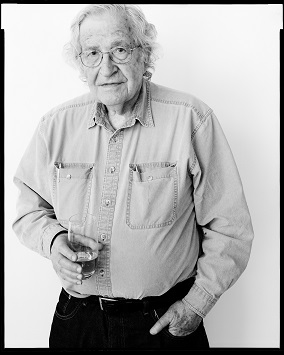
| QUESTION: You grew up in Philadelphia during the
Depression as the child of an academic family. What was being a kid in
that family like?
CHOMSKY: It was a first-generation family, so the lives of the
children were split between the first-generation immigrant community
and the outside world, so it was a pretty sharp split -- so sharp that
I never even told my parents about it, nor did my brother. We happened
to be the only Jewish family in a very anti-Semitic neighborhood of
German and Irish Catholics, and being out on the streets was a chancy
activity. It was openly pro-Nazi in those days. Those were the kinds
of problems you have when you're growing up in that environment. We
would go out and play with the kids in the street or play ball or
something, but all of that was a different world. The world we were
in, and very much immersed in, was a Jewish community, first
generation. Hebrew was the main issue -- pre-State of Israel, but some
form of pre-State Zionism, Jewish culture, Hebrew school, Hebrew
teaching and ceremonies. The associations and friends were all very
tightly knit, basically a first-generation immigrant community.
And there were other worlds. So, for example, my mother's family
and my father's family were two completely different worlds. My
father's family was deeply Orthodox. In fact, according to him, they
reverted to even more immersion in Orthodox Jewish practice once they
got here, as compared with the shtetl in the Ukraine, where they were
from. But it was very much a transplanted East European shtetl. So, my
grandfather -- who lived here for 50 years -- never learned a word of
English and lived in a four-block area between the synagogue and the
butcher store, and his daughter's house where he lived, and his
friends and so on.
QUESTION: Your mother's family was involved in leftist politics.
Did that have any affect on your later decision to become a political
activist?
CHOMSKY: I'm sure it did. But one of the big influences in my
childhood was an uncle who was a very interesting person. This was
during the Depression. He was one of the few members of the family who
had a job. The reason was that he was a cripple, and under New York
laws, that gave him the opportunity to have a newsstand. So he had a
small newsstand, which was one of the few sources of income for the
network of aunts and uncles and cousins and so on. He happened to be
very active. He had never gone beyond, I think, fourth grade, but he
was one of the most educated people I've ever met in my life. He read
everything and was interested in everything. He ended up being a
wealthy lay-psychoanalyst with an apartment on Riverside Drive. But
the newsstand, and in fact, in his whole circle, there was a very
vibrant, lively debating society and an exciting environment. He had
been through every imaginable left-wing sect and knew a lot about
them, and I'm sure this had an influence, as did the rest of the
family, or just the environment. You could not grow up in the 1930s
and have your eyes open and not see quite a lot of suffering. I have
vivid memories of desperate people coming to the door selling rags,
going with my mother in a trolley car and seeing security forces
attacking strikers pretty brutally, women mostly -- it happened to be
a textile plant. Things like that were fairly common. And then of
course, everything was happening in Europe, which was very ominous. It
was almost as if it was with us because there was tremendous concern
about it. And in fact, it was even alive right in my neighborhood,
which happened, unlike many, to be quite pro-Nazi.
QUESTION: People have characterized your political beliefs over the
years as "anarchist" or "libertarian." I don't think the labels are
necessarily important, but what is the basic philosophy behind your
political beliefs?
CHOMSKY: Let me just say regarding the terminology, since we happen
to be in the United States, we have to be rather careful. Libertarian
in the United States has a meaning which is almost the opposite of
what it has in the rest of the world traditionally. Here, libertarian
means ultra right-wing capitalist. In the European tradition,
libertarian meant socialist. So, anarchism was sometimes called
libertarian socialism, a large wing of anarchism, so we have to be a
little careful about terminology. I was drawn pretty early, maybe in
the early teens, towards anarchist thinking and activities, and even
spent a lot of time in anarchist bookstores and picking up pamphlets
and talking to mostly Europeans who had fled or had been driven out of
a pretty ugly continent in the 1930s. And that had a big impact. The
other major strain was what was coming out of my own closer home
background: the concept of deep concern for what was then Palestine,
the Jewish community in Palestine. The rise of Hebrew, the
collectivist institutions, the cooperatives, the kibbutzim, the
network of socialist institutions, which had elements in the fabric of
a kind of an anarchist or, in the European sense, libertarian strain,
which I found very attractive. So it was a mixture of those things.
QUESTION: What would a government based on anarchist principles be
like?
CHOMSKY: If it were really based on these principles, it would not
exist because a deep part of those principles is that there shouldn't
be any such authoritarian systems. Dismantling the state is a core
element of almost all left-anarchist thinking. Of course, that's a
goal. It doesn't mean that this society should not be organized and
governed; it should be, but by democratic institutions, based on
natural modes of association. Here, incidentally, you begin to get
differences of points of view and ideas, as to how human life and
society should be organized. There's no doctrine. It's not like
Marxism and Leninism where there are some books you read and that's
what you believe. This is a tendency in thinking, nobody owns it. It's
all generally based on the idea that hierarchic and authoritarian
structures are not self-justifying. They have to have a justification.
So if there is a relation of subordination and domination, maybe you
can justify it, but there's a strong burden of proof on anybody who
tries to justify it. Quite commonly, the justification can't be given.
It's a relationship that is maintained by obedience, by force, by
tradition, by one or another form of sometimes physical, sometimes
intellectual or moral coercion. If so, it ought to be dismantled.
People ought to become liberated and discover that they are under a
form of oppression which is illegitimate, and move to dismantle it.
What happens next? We don't really know. There are people who think
they know the answer. I'm not one of them. My view is, we don't
understand very much about human beings or human affairs, so anything
that would be done has to be experimentally tried, but I think there
are some leading ideas that make some good sense. For example, your
workplace is one point of contact and association. So, workplaces
ought to be democratically controlled by participants. To a limited
extent that's true in universities, probably more so than in most of
the society. But that ought to really happen fully in factories,
commercial institutions, academic institutions, everywhere -- it's the
workforce, the people who are participating in it, that should be in
control. That's one form of association, but people have a lot of
others: "I not only work here, I live in a community." So communities
are another kind of association. And again, they should be popularly
controlled by the participating members of the community. And there's
plenty of other kinds of associations, cultural associations, ethnic
associations, people who like the same kind of music, there are all
kinds of ways in which people interact with one another. The forms of
organization and association that grow out of those should be, to the
extent possible, non-authoritarian, non-hierarchic, managed and
directed by the participants. And then they have to interact -- which
leads to all sorts of questions that have to be worked out.
QUESTION: Has there ever been a civilization or a country that has
approached these ideals?
CHOMSKY: Sure. Ours. If you compare it with what it was not long
ago, it's moving in that direction. We don't have slaves, we don't
have kings, women have certain rights, ethnic minorities have certain
rights, there's free speech to a very large extent by comparative
standards. These are all steps towards those kinds of goals. It's not
a progress that is steady. Sometimes there is regression, like we
happen to be in a period of significant regression the last twenty or
twenty-five years, but on the whole, I think the cycle is pretty
definitely upwards. And there is also an expansion of a moral sphere.
I think there are things that are now considered serious, which
weren't even considered problems 30 or 40 years ago. So let's say, for
example, the fact that we're here, what happened to people who were
here? Well, you know the United States -- it's not a big secret -- is
based on some of the most horrendous ethnic cleansing of human
history, basically exterminating the indigenous population. When I was
a kid, that was considered fun. I was a radical kid, I'm supposed to
be attuned to this sort of thing, but I was playing cowboys and
Indians and we were the cowboys. The kinds of things we were doing
naturally then would be inconceivable today. You don't have to go back
very far to find examples. In 1969, my daughter's textbook in a
progressive community -- Lexington, Mass. -- had a chapter on the
massacre of the Pequot Indians, the first big massacre in
Massachusetts. It was presented pretty accurately but upbeat, as if
this was a great thing, killing all the women and children. After the
braves left the village, the Indians were frightened and fled, and we
all celebrate. That's what ten year old kids were being taught as
wonderful in 1969. And the same was true right up to the heights of
academic scholarship. One of the leading academic studies of American
diplomacy in, I think it was 1969, says something like, "At the end of
the Revolutionary War, Americans turned to their natural tasks, which
were felling trees and Indians, and expanding to their natural
borders." Felling trees and Indians? You couldn't say that now. The
moral realm has extended, so at least we recognize that something
happened and that we ought to be concerned about it. The movements
that are part of our lives now didn't exist 30 years ago, like the
environmental movement or the women's movement and so on. These are
large mass movements with plenty of participation and plenty of
criticism, as you can always say about any popular movement. But they
have undoubtedly civilized the society a lot. That's one of the
reasons why there is such hatred for the '60s on the part of
considerable sectors of the educated and privileged classes. They
regarded the society's becoming more civilized as a catastrophe. But
it happened, and it's made a big difference, and that's just in recent
years.
QUESTION: A lot of the stuff that you lecture about is pretty
horrible: genocide in East Timor, US-sponsored torture in Turkey,
which you have been speaking about in the context of the Kosovo
crisis. That's very, very depressing stuff. How are you able to be
constantly exposed to this kind of thing and keep a clear head about
it? Do you walk around in a constant state of depression always?
CHOMSKY: Not depression, it's more agitation. A lot of adrenaline
flowing. It may not show, but a lot of anger. But there are things
that just have to be done. I think the world is better than it was 30
years ago, our behavior is better than it was, but it's got a long way
to go. Take Turkey, since you mentioned it. This is not just torture;
torture is bad enough. This is some of the worst ethnic cleansing of
the 1990s. Incomparably worse than anything attributed to Milosevic in
Kosovo. And Turkey isn't being bombed. They're just doing it. This
means two to three million refugees, tens of thousands of people
killed, and maybe 3,500 villages destroyed. Every kind of hideous
terror that you can imagine. How are they managing to do it? Well,
because thanks to us, meaning Washington, meaning the Clinton
Administration, they're assured a very substantial flow of armaments.
And armaments doesn't mean pistols, it means jet planes, tanks, attack
helicopters. They have 80% of their arms coming from the United
States, and as the atrocities peaked in the mid-1990s, the flow of
arms increased. This is lauded by people like Vice President Al Gore,
who says that we can't ask Turkey to be democratic and then not help
them combat terrorism. And it's true, Turkey is combating terrrorism,
but so is Milosevic in Kosovo, and combating it pretty much in the
same way, except in the case of Turkey on a more massive scale by
attacking and destroying the civilian society that they regard as the
home for the separatist groups. Why, incidentally, is there a Kurdish
rebellion? A couple of days ago, a little item in The New York
Times pointed out that the head of the human rights group in
Turkey -- you have to be pretty courageous to have that occupation
there -- was just sent to jail for calling for a peaceful settlement
of the conflict. He also mentioned the word "Kurdish," which he isn't
allowed to mention. Under these types of conditions, there is turmoil,
and finally a terrorist group formed, which led to the uprising,
leading to a violent repression and huge ethnic cleansing and
destruction, which my taxes are paying for, and Bill Clinton is
leading -- the same person who claims that he is concerned about
ethnic cleansing in Kosovo. This tells you how much he is concerned
about it. These are things that are happening right in front of our
eyes, and which we can do a lot about. It's not happening on Mars.
It's not crimes being committed by somebody who we don't know how to
respond to. You don't have to bomb Washington to stop these crimes.
You don't have to bomb Ankara. You just have to stop participating in
them. And that means telling the truth about them. It means having the
stories on the front pages everyday and on the television screen and
so on. And that's not going to happen, unfortunately, unless somebody
makes it happen.
QUESTION: So among the things you mentioned, places where the US
has grown, it seems foreign policy is not among those. Has that also
improved in the last 30 years?
CHOMSKY: It has. Take the Kennedy Administration, one of the most
brutal and violent in modern American history. Among other things,
Kennedy sent the US Air Force to start bombing South Vietnamese
villages. That opened the US War against South Vietnam, which is what
we'd call the Vietnam War if we were honest. South Vietnam was always
the main target of US attack. The US had been running a kind of a
Latin American-style terrorist state there, but repression had led to
resistance, which got out of control, and Kennedy had to attack
directly. That meant bombing, napalm, crop destruction, and the
initiation of an enormous ethnic cleansing program that ended up with
millions of people being driven into concentration camps called
strategic hamlets or urban slums. Was there any protest? Not a word.
It went on for years. After five years when the US had spread the war
to all of Indo-China, and then there were about 250,000 American
troops rampaging around the country and the destruction was enormous,
they finally got a little bit of protest, and it was not so simple. I
remember the first talks I was giving around 1964 were in churches
with three or four people. If we wanted to have a meeting at MIT on
this we'd have to put together six topics: Venezuela, Iran, Vietnam,
the price of bread, a couple other things, and maybe you could get 10
people out. When we tried to have public meetings in Boston, the
Athens of America, like on the Boston Common, they were broken up
violently, and by students incidentally. The first one I spoke at or
tried to speak at was October '65. That was the first major public
demonstration. We certainly didn't do any speaking. We got out alive
because there were a couple hundred state troopers around who didn't
like what we were saying but didn't want to see anybody murdered on
the Boston Common. That went on for a while. Churches were attacked if
you had meetings. My wife and kids went to a women's demonstration in
Concord, Massachusetts -- not a very violent place -- and were
attacked there. That's liberal Massachusetts. And these are protests
after years of attacking a country 10,000 miles away and practically
wiping it out. Now that doesn't happen. I mean, things are bad, but
that doesn't happen. In fact, no American President could dream of
doing what Kennedy did with complete impunity, because the country has
become more civilized and won't tolerate it. So there have been
improvements. That's why during the 1980s, when the Reagan
Administration tried to duplicate what Kennedy had done in Central
America, they could not send US forces as they had hoped. They
couldn't send the US Air Force. They had to resort to a huge
international terror operation, enlisting others to do the actual
terrorism. That was a major war, except unlike the Vietnam War, they
could not attack directly. Occasionally they could, but not often.
Well, that's not very nice for the couple hundred thousand people who
were killed and the millions of refugees and so on, but it's better
than B-52s.
QUESTION: Your first foray into political activism during the '60s
was a work called The Responsibilities of Intellectuals. What are the
responsibilities of intellectuals, and has that changed in the 30-some
years since you gave that original talk?
CHOMSKY: The same as the responsibility of other people: act like a
decent human being. What is an intellectual? It doesn't mean you're
smart, it doesn't mean you have anything to say. It means you're
privileged enough and have sufficient resources and training so that
you have a possibility of pursuing issues independently and you are
able to articulate your conclusions. That's essentially what it means
to be an intellectual. It's not an occupation. The responsibility of
such people with those privileges is to find out the truth; here I
somewhat differ from my Quaker friends, not to tell the truth to power
-- which is mostly a waste of time (they know it already and don't
care) -- but to help powerless people understand better the
circumstances of their lives. Not by teaching them, because you don't
know either, but by interacting with them and bringing the resources
you have in an effort to try to make conditions of human life more
humane and just and free. Those are the responsibilities. And the
responsibilities just accrue through privilege. If you're working 50
hours a week to put food on the table, and you don't have the
resources and the access and the freedom, well, your responsibilities
are less.
QUESTION: It's interesting that you say that, because one of the
charges that has been laid against intellectuals is that they are
people in ivory towers and don't have any understanding of the real
world, but what you're saying is contact with the "real world" is a
necessary part of the life of an intellectual. If you are privileged
enough to be part of the intellectual class, then it's your
obligation--
CHOMSKY: With privilege comes responsibility. What I have been
describing is not the way intellectuals behave, in fact
overwhelmingly, it's the contrary. You become a respectable
intellectual by serving power, not by telling the truth or exposing
power -- I mean, that's almost tautologous. Why would powerful
institutions support the people who are trying to undermine them? It
wouldn't make a lot of sense for the corporate media to sponsor
attacks on the outrageous power of corporations. You don't expect that
any more than you expect the press in the former Soviet Union to be
devoting itself to exposing the crimes of the so-called Communist
regimes. And in fact, if you do play the game by the rules, the
chances of moving to positions of privilege and authority increase.
It's not like 100%. If it's in Iraq, it could be 100%, but you say the
wrong thing and you may end up in a torture chamber or something. But
in a much more free society like ours, the tails of the distribution
are pretty big so there's lots of ways of not succumbing to these
pressures, but the pressure certainly exists. And they are simply a
reflection of the distribution of power.
So, overwhelmingly -- and this goes as far back in history as you
like -- the respectable intellectuals have been the servants of power,
not the ones who criticized it and try to expose it. If you go back to
the Bible, there were essentially intellectuals. The word that is used
for them is prophets, kind of a mistranslation of an obscure Hebrew
term. But if you look at what they were doing, it was what you'd
expect intellectuals to be doing. They were giving geo-political
analyses: it doesn't make sense to fight a war against the Syrians and
the Egyptians, we’ll get wiped out. They were criticizing the
practices of the rich and privileged. They were urging decent behavior
towards widows and orphans. That's the role of decent, honest
intellectuals. They were not the ones who were praised and honored,
not at that time. Hundreds of years later, maybe, but not at the time.
I mean, at the time they were in prison, driven into the desert and
reviled and so on. Now there were intellectuals who were respectable
and well-treated and honored. They were the flatterers of the courts
of the kings. Later -- hundreds of years later -- they were called
false prophets. But that's typical of any society. At least I don't
know of any exceptions. So, take the Soviet Union, our "big enemy":
they had what we call commissars and dissidents, all intellectuals.
The commissars were the ones who were the flatterers of the court or
king, the dissidents were the ones who were exposing crimes and power.
Who was respectable? From our point of view, an enemy state, the
dissidents were honored and commissars condemned, but not inside the
country. It was quite the other way around. And we do exactly the
same. You see it very dramatically in our own domains.
QUESTION: Can you describe, in laymen's terms, what the dominant
ideas in linguistics were when you entered the field in the '50s?
CHOMSKY: The dominant ideas were what were called structuralist and
behaviorist. You were supposed to look at phenomena like texts or
behavior and find patterns and regularities and structures of elements
that you discovered in these phenomena. That was basically the field.
It was a study of behavior and the products of behavior, like say,
texts, and the structured patterns of elements that constituted them.
The shift of thinking that took place in the 1950s was part of a more
general shift of perspective towards psychology generally. Sometimes
it's called the cognitive revolution, not a term I like, but it's
used. This change of perspective was away from the study of phenomena
to the study of the internal principles of the mind and the brain,
which underlie those phenomena. What is it about the human mind and
brain that leads to the behavior and texts and other things that were
investigated in the linguistics of the period? These are no longer the
focus of attention. They provide some data, but they're at best
evidence for something else, namely the internal nature of the
creature that is acting this way. That means not only what the
“language organ” or faculty of language is in the human brain, but how
it gets that way, how it functions, how every aspect of it differs
among people. In what respects do languages differ? They look very
different, but we know they can't be. A few moments' thought suffices
to show that they must be very similar. The reason for that is that
each one of us -- you, me, a kid in Tokyo and so on -- picks up
language on the basis of very rudimentary evidence. What a young
child, and certainly an adult knows, goes vastly beyond any evidence
that they've been presented with. And they know pretty much the same
thing, making some huge leap beyond data to understanding. And that
can only be for one reason: either it's a miracle, or it's because of
their internal nature, which incorporates the result and uses the data
to kind of fine-tune the result. The various kinds of fine-tuning are
the different languages. So if some martian was looking at us, the way
we look at mice or something, we'd all look identical, we'd all seem
to be talking the same language with little variations here and there
which are sort of fine-tuned by experience. That's what you expect to
discover, miracles aside.
The shift of perspective in the '50s makes that a focus of
investigation. What is the core element of human nature that allows
every normal child (apart from real extremes of pathology) to undergo
a very systematic course of what we call learning -- but probably
ought to be called growth -- in which the language system just grows
in the mind the way other systems in the body grow? The way your
kidney and your heart and your circulatory system and so on grow:
under the stimulus of experience. Undoubtedly they're affected by
interaction with the environment and they come out different in
different people, but the basic structure is the same because that's
the way we're designed. It must be the same with regard to our mental
faculties as well, but the trick is to show it. So that's a completely
different subject. It turns out it's not an entirely novel subject,
because if you look back at the tradition, the pre-modern tradition,
these were questions that were seriously thought about. It's much
easier to study them now, as there was a tremendous amount of progress
in the last 30-40 years that would have been unimaginable two
centuries ago, but [there are] many of the same questions. That's why
I don't like the phrase "cognitive revolution." In many ways it's a
recovery of earlier insights and understandings.
QUESTION: What can you tell us about your new theory, "The
Minimalist Program?"
CHOMSKY: It's [either] right or wrong, but it's an attempt to move
the study to another plane if possible. In the last 20 years, an
extremely wide range of languages have been subjected to quite
intensive study to try to find the core principles that operate within
them and allow their users to carry out the kind of thing that you and
I are now doing, this kind of free, creative interaction using
language. A lot has been learned about the nature of these systems in
typologically very different languages, things that weren't even
dreamt of 20, 25 years ago.
That raises a question: Can we study deeper problems? And there are
some deeper problems that come to mind. It may be premature to try to
study them, but you can try. One question is, how well designed is
this system? I mean, we know a lot about it. Just to put it that way
doesn't mean anything. In order to determine how well designed it is,
you have to clarify what the design specifications are. So, for
example, suppose you had some super-sophisticated engineer, and you
wanted him to design an instrument to meet certain conditions, and you
have certain conceptions of good design. You can then raise questions
about how good a job the engineer did.
Well, let's take humans. There was a time, not very long ago, in
evolutionary terms, a moment ago, when there were advanced primates
walking around that didn't have a language faculty. They had pretty
much our mentality, our thought systems, modes of articulation and so
on. Not identical, but certainly similar, and somehow, by some
biological process that is not understood, this internal neural,
mental system underwent a change and ended up having a language
faculty inside it. Well, what conditions did that faculty have to have
in order to be usable? It had to meet some conditions. For example, it
had to have some sort of interaction with a sensory motor system,
otherwise you couldn't externalize the use of the language that you're
carrying out internally. You and I can interact because I'm saying
something and you're hearing it. So whatever my language faculty is,
it has to be able to interact with a sensory motor system, which to a
large extent was probably already there. So that's one condition, one
design specification.
Well, that's not the only one. Language is articulating our
thoughts. So whatever system of thought we have -- big mystery, we
have a lot of data about it at least, but not much understanding --
the language faculty has to interact with that. Okay, well there’s two
kinds of design specifications. Whatever the system is, it's minimal
condition is that it be able to interact with the sensory-motor system
and it be able to interact with the thought system.
Let's imagine this evolutionary fable, and I stress fable, in which
you have a primate wandering around pretty much like us, with no
language faculty. The engineer we're imagining wants to install a
language faculty in such a way as to meet these minimal design
specifications, and he develops it. Okay, that's the language faculty.
Now we can ask how good a job was done. Was it a good design? Well,
those are questions that you can begin to clarify now. You can sharpen
up those questions enough to make a research project out of it. And
when you pursue it -- in the last few years it's been pursued fairly
intensively -- you seem to be reaching some pretty surprising
conclusions. It turns out that an enormous amount of the descriptive
apparatus that was used by linguists to account for languages is
probably a mistake. When you dismantle it and eliminate it, you find
simpler systems that just satisfy the design specifications, do not
use all of that paraphernalia, and do the job as well or better. And
as this is pursued, it seems to be that the system is remarkably
well-designed to satisfy the minimal specifications that it must meet
to be useable at all.
That's the main theme of at least my current work and related work,
what people call, The Minimalist Program. Minimalist because you want
to set up a very high standard of explanation, namely, descriptive
devices are justified only to the extent that you can show that they
satisfy minimal design specifications, otherwise they're not
justified, they're extra baggage you have to find a way to get rid of.
It's a very difficult standard to meet. But it's led in interesting
directions. If it turns out that the language faculty is indeed
reasonably well-designed to meet minimal conditions, that would be
quite a surprise from a biological point of view. You don't really
expect that of complex organisms. It may be true of shells or of
viruses, but a complicated organism you would expect to have evolved
in a kind of accidental way, by just a series of accidents of history
more or less. I don't really think that's how organisms do evolve, I
think their evolution probably is determined to a very significant
extent in terms of physical and biochemical and other processes that
are just part of nature and that allow a certain channel within which
selection can take place. But if anything of the sort I've just been
describing turns out to be true, then it will be the case that higher
human mental faculties are more like, say, snowflakes than one might
have guessed. That is, they just came out that way because that's the
way nature determines it. |