
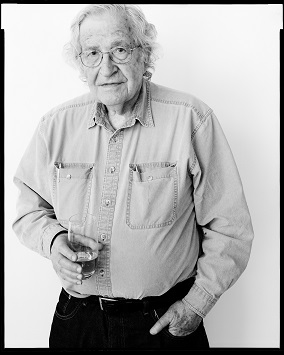
SOUTH END
PRESS: What do you think are the most significant achievements and
failures of the left over the last twenty years?
NOAM CHOMSKY: You mean achievements of popular movements. Well, one
quite remarkable achievement were the solidarity movements of the
1980s. These are completely unprecedented in the history of
imperialism, to my knowledge. They were far more extensive than the
protests of the 1960s and also much more deeply rooted in the
mainstream of American society. They were centered in Midwest churches
and that sort of thing, quite mainstream. And in fact they went very
far.
I don't think there has ever been a case in which thousands of
people literally went to the countries under atack. Many of them even
decided to live in villages, in the hope that a white face might
restrict state terrorism, which was of course extraordinary. Networks
of communication were established so that millions of people knew lots
of things about what was going on, which were kept out of the
mainstream information sytems. And in fact although it didn't prevent
hundreds of thousands of people from being slaughtered, it certainly
prevented much worse things from happening. This was not just Central
America, but also South Africa, and others. These were really
significant achievements.
On the other hand, there have been major setbacks. The activism of
the 1960s inspired really serious fear among elites. Large sectors of
the population that were supposed to remain in apathy and passivity
actually became engaged and tried to enter the public arena and press
for their own demands. That what's called a "crisis of democracy"
among liberal elites.
SEP: Why do you think progressives were able to break through these
barriers during the solidarity movements, but are less able to now?
NC: Well, there are different issues. It is one thing to try to
block terrorist attacks against campesinos in Central America. It is
something quite different to attack the central institutions of state
capitalist society: the private financial and industrial institutions,
which are in effect private tyrannies, and which by law are
unaccountable to the public. When you try to consider those, you are
really facing the absolute foundations of power. State terrorism in
Central America is a peripheral part of domestic power.
SEP: How should the left organize in this kind of climate?
NC: Well, in the traditional fashion, but it has to face new
issues. To be concrete, take the Multilateral Agreement on Investment
[MAI], which has been under intense negotiations in secret by the rich
countries, the OECD, since May 1995. It is scheduled to be signed,
they hope in secret, in May 1998. It has been a remarkable tribute to
the American free press that they have been able to maintain near
total secrecy on this for 3 years. Of course, the business world knows
all about it, the media leaders know all about it, and so on, they are
heavily involved. But it hasn't broken through in the United States,
except through the efforts of some activist groups. Even Congress
claims not to know about it, and probably most congressmen don't.
The reason it has been kept secret is an awareness that the public
isn't going to like it one bit when they hear about it and in fact,
will be outraged. One issue that activists ought to become involved
in, and many are, in Canada even more so, is exposing this.
SEP: You've talked about the 1970s and 1980s. How about in the last
ten years, the late 1980s and the 1990s?
NC: It is a complicated time. For one thing, this has been a period
in which a substantial part of the population ahs been under rather
serious attack. Of course, poverty in the United States is not the
same as poverty in Central Africa. Nevertheless, for the majority of
the population, probably about two-thirds, wages have either stagnated
or declined. Contrary to what is claimed, this is not a period of
significant economic growth. In fact, this is the slowest recovery
from recession in U.S. postwar history, and U.S. growth per capita is
around the average for the rich countries. There is a lot of
falsification around this. A very small percentage of the population
has become extremely wealthy. Most of the population is either
stagnating or declining.
Public opinion studies show rather interestingly that people have
just diminished their expectations. If they can somehow get by, that
is about all they hope for.
SEP: What are some promising areas in which you see alternative
institutions being created?
NC: That runs across the board. From media to community and worker
controlled enterprises, to support for the people who are suffering
from the attack on heath care and what is called welfare reform, which
is the destruction of support systems for poor women and children.
In every one of those areas, alternative institutions can be
constructed for self-help, and popular organization and communication
and pressure, and also efforts to enter the political arena to change
these tendencies, using whatever means are available within the
parliamentary institutions. And there are means.
And then on to trying to get to the cancer itself. Not to its
symptoms.
SEP: How did you become politicized?
NC: That goes back to when I was four years old, and seeing people
coming to the door trying to sell rags so they could have enough food
to eat. Or when I was travelling on the trolley car with my mother,
and watched, passing by, a textile factory where police working for
the managers were beating up women workers outside. Watching my
unemployed relatives, who were mostly working class. It is just what I
grew up with.