
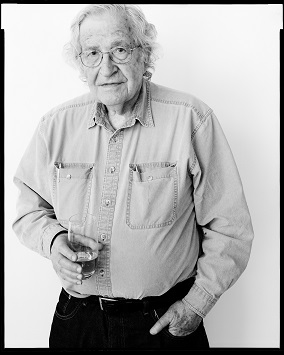
| QUESTION #1: Could you comment on whether or not
you believe the U.S. has a moral obligation, because of its
capabilities, to intervene in international affairs?
CHOMSKY: We should, I think, bear in mind that moral concepts apply
at root to people. States do have legal obligations, but they are not
moral agents, though their citizens can influence them to act in
morally responsible and legally admissible ways, or can allow them to
act quite differently.
Individuals are responsible for the foreseeable consequences of
what they do, hence for the course of international affairs to the
extent that they can influence events by action, or inaction. We
happen to be citizens of by far the most powerful state in the world.
Our action/inaction can therefore have unusual influence; and unlike
many others, we are privileged to be able to act without undue fear of
repression. Accordingly, our moral responsibilities -- sometimes
obligations -- reach far beyond those of others, in general.
Just what these responsibilities are, and whether they extend to
the very serious matter of intervention, has to be determined case by
case. There are no formulas; each case has to be examined on its
merits, with careful inquiry into the actual facts (which may not be
easy to determine), the options available, the requirements of
international law, and the likely consequences of action or inaction.
The simplest cases are those that fall under a traditional medical
doctrine: First, do no harm. These include crucial examples of recent
and current history. Consider two. One of the world's worst violators
of human rights is Indonesian dictator General Suharto, who came to
power with an army-led massacre that the CIA described as "one of the
worst mass murders in the twentieth century," ranking it alongside the
crimes of Stalin, Hitler, and Mao. These crimes were carried out with
US support, which has not wavered as Suharto compiled a shocking
record of terror against his own population and invaded a small
oil-rich country (East Timor), killing some 200,000 people and robbing
its resources. The invasion was in direct violation of a UN Security
Council resolution to withdraw at once. These crimes too have been
carried out with the decisive military and diplomatic support of the
United States. Accordingly, it was -- and is -- our moral
responsibility as citizens to terminate these crimes. That would
require no "intervention," only withdrawal of support, a far simpler
matter.
During these years, Saddam Hussein has also carried out major
crimes. The worst by far were committed in the 1980s, including his
gassing of Kurds at Halabja in 1988, chemical warfare against Iran,
torture of dissidents, and numerous others. His invasion of Kuwait,
though a serious crime, in fact added little to his already horrendous
record. Throughout the period of his worst crimes, Saddam remained a
favored ally and trading partner of the US and Britain, which
furthermore abetted these crimes.
The Reagan Administration even sought to prevent congressional
reaction to the the gassing of the Kurds, including the (failed) plea
of Senate Foreign Relations Committee Chairman Claiborne Pell that "we
cannot be silent to genocide again" as the world was when Hitler
exterminated Europe's Jews. So extreme was Reaganite support for their
friend that when ABC TV correspondent Charles Glass revealed the site
of one of Saddam's biological warfare programs a few months after
Halabja, Washington denied the facts, and the story died; the State
Department "now issues briefings on the same site," Glass writes (in
England).
There were no passionate calls for a military strike against this
brutal killer and torturer. Quite the contrary: much of what was
known, including US support, was downplayed or not reported. After the
Gulf War, the Senate Banking Committee found that the Commerce
Department had traced shipment of "biological materials" of a kind
later found and destroyed by UN inspectors, continuing at least until
November 1989. A month later, during his invasion of Panama, Bush
authorized new loans for Saddam: to achieve the "goal of increasing
U.S. exports and put us in a better position to deal with Iraq
regarding its human rights record...," the State Department announced,
facing no criticism in the mainstream (in fact, no report). The Bush
Administration continued to support the mass murderer up to his
invasion of Kuwait, which shifted his status from ally to enemy, much
as the Suharto coup and slaughters of 1965 shifted Indonesia from
enemy to friend. In these and many other cases, the criterion that
distinguishes friend from enemy is obedience, not crime.
Immediately after the Gulf war ended in March 1991, Washington
returned to support for Saddam. The State Department formally
reiterated its refusal to have any dealings with the Iraqi democratic
opposition: "Political meetings with them would not be appropriate for
our policy at this time," the Department spokesman declared. "This
time" was March 14 1991, while Saddam was decimating the southern
opposition under the eyes of US forces, which refused even to grant
rebelling Iraqi military officers access to captured Iraqi arms, to
defend the population and perhaps overthrow the monster. Had it not
been for unexpected public reaction, Washington might not have
extended even weak support to rebelling Kurds, subjected to the same
treatment shortly after.
The official reason for protecting Saddam was the need to preserve
"stability." Administration reasoning was outlined by New York Times
chief diplomatic correspondent Thomas Friedman. While opposing a
popular rebellion, he wrote, Washington did hope that a military coup
might remove Saddam, "and then Washington would have the best of all
worlds: an iron-fisted Iraqi junta without Saddam Hussein," a return
to the days when Saddam's "iron fist...held Iraq together, much to the
satisfaction of the American allies Turkey and Saudi Arabia," not to
speak of Washington. Iraqi democrats did not regard this as "the best
of all worlds." A leading figure of the opposition, Ahmed Chalabi,
described the outcome as "the worst of all possible worlds" for the
Iraqi people, whose tragedy is "awesome." The US, he said, was
"waiting for Saddam to butcher the insurgents in the hope that he can
be overthrown later by a suitable officer," an attitude rooted in the
US policy of "supporting dictatorships to maintain stability."
Washington claims to have supported the democratic opposition in
later years. Their own picture is different, however. Just last month,
the British press reported Chalabi's observation that "everyone says
Saddam is boxed in, but it is the Americans and British who are boxed
in by their refusal to support the idea of political change."
It was our responsibility, indeed obligation, to compel Washington
to end its support for Saddam's worst crimes when they occurred,
perhaps even to intervene to terminate them had that been necessary.
Quite possibly, as in the case of Suharto, withdrawal of support would
have sufficed. Currently the Iraqi Democratic opposition is advancing
concrete proposals for overthrowing Saddam in favor of a popular-based
alternative. They are requesting US support but not military
intervention, which they have consistently opposed. How realistic
these proposals are it is hard to judge, but we have a responsibility,
I think, to ensure that they receive serious and honest attention, and
to ensure further that Washington abandon the "refusal to support the
idea of political change," apparently still in force. Again, there are
no simple general formulas. Slogans are easy, sometimes policy choices
too, particularly when we are carrying out or abetting crimes and can
desist. But choices are often hard and complex, with unpredictable and
possibly extreme consequences. There is no alternative to the careful
evaluation of each case, on its merits.
QUESTION #2: Considering U.S. interventions during the Cold War,
i.e. Cuba, Iran, Nicaragua, etc., is America's willingness to use
force against Iraq just a continuation of previous policies? Or does
it illustrate a fundamental shift in how the U.S. intervenes, from a
covert model to more overt action?
CHOMSKY: The US has often resorted to overt action in past years.
To mention only one example, in 1961-1962 the Kennedy Administration
moved from support for large-scale state terror in South Vietnam,
which had already killed tens of thousands of people, to a direct
attack, including US Air Force bombing, napalm, crop destruction, and
numerous other crimes. These assaults -- aggression by any reasonable
standards -- laid the basis for further escalation from 1965, by then
extended to the rest of Indochina. Millions were killed in the ruined
countries. Unknown numbers more have suffered and died from the
effects of chemical warfare and from unexploded ordnance, and still
do. Those were not covert actions.
There have been many other cases. George Bush's invasion of Panama
-- condemned by two UN Security Council resolutions that Washington
vetoed -- was overt.It is also worth recalling that when Saddam
Hussein invaded Kuwait a few months later, the prime concern of the
Bush Administration was that he would emulate what the US had just
done in Panama. Chairman of the Joint Chiefs Colin Powell posed the
problem sharply: "The next few days Iraq will withdraw," putting "his
puppet in" and "Everyone in the Arab world will be happy."
If so, the outcome would have been much like the recent US invasion
of Panama, though Latin America was far from happy; it was in an
uproar, bitterly opposed to the US actions, particularly the Group of
Eight Latin American democracies, which expelled Panama (already
suspended) because it was under the rule of a puppet regime maintained
by foreign force.
Overt actions are nothing new. In fact, because of internal changes
in the US, Washington may be less likely to resort to overt action
than in the past. The Reagan Administration sought to emulate in
Central America what Kennedy had done in South Vietnam, but quickly
retreated in the face of unanticipated popular reaction; it turned to
clandestine and state terror throughout the region, rather than direct
US assault, and was indeed condemned by the World Court for the
"unlawful use of force" and ordered to desist, a judgment dismissed
here with contempt; its crucial wording was not even reported in the
mainstream press, nor was there any concern when the US vetoed a
Security Council resolution calling on all states to observe
international law, mentioning no one, though all understood what was
intended. A leaked National Security Policy Review in the first months
of the Bush presidency concluded that "In cases where the U.S.
confronts much weaker enemies, our challenge will be not simply to
defeat them, but to defeat them decisively and rapidly"; delay might
"undercut political support," understood to be thin. That is part of
the reason why US doctrine shifted to "Low Intensity Conflict" or
quick demolition of a "much weaker enemy."
US military doctrine is unusual in that US casualties are not
tolerated and overwhelming force must be available. That is why the US
has so rarely taken part in difficult peacekeeping operations, which
involve interactions with civilians that require restraint and carry
risks; these are left to Canada, Ireland, Norway, Fiji, and others. In
Somalia, for example, US forces were sent only after the worst
fighting had declined, and recovery from famine was underway. The
intervention turned into a disaster because US forces resorted to
massive force, following Pentagon doctrine, as soon as problems arose.
The US command estimated 6-10,000 Somali casualties in the summer of
1993 alone, two-thirds women and children. What happened was later
attributed to UN incompetence, but that is an evasion.
The patterns of US intervention depend ultimately on decisions by
American citizens, including the decision to stay quiet or even not to
know. In principle such actions are under popular control; in fact
too, if we so choose.
QUESTION #3: What do you think about the hearings being held in the
U.S. Congress on assassinating Saddam? Do you think the U.S.
government, including Congress, is overstepping its limits?
CHOMSKY: Assassination of Saddam is, in my opinion, a minor issue.
Even attempts to assassinate Castro, criminal no doubt, are marginal
in the context of the terror attacks against Cuba from 1959.
There is, however, no doubt that "the U.S. government, including
Congress, is overstepping its limits" in the matter of Iraq. Those
limits are clear and explicit. They are embodied in the Charter of the
United Nations, a "solemn treaty" recognized as the foundation of
international law and world order, and also "the supreme law of the
land" under the Constitution. The Charter declares unambiguously that
the UN Security Council alone "shall determine the existence of any
threat to the peace, breach of the peace, or act of aggression, and
shall make recommendations, or decide what measures shall be
taken...." The one exception is the right of self-defense against
"armed attack" until the Security Council acts (Article 51). The
fundamental principle is that member states "shall refrain in their
international relations from the threat or use of force." These are
the "limits" that bind law-abiding states.
Outlaw states reject these conditions: Suharto's Indonesia and
Saddam's Iraq, for example. Washington too rejects them. Its position
was forthrightly articulated by Secretary of State Madeleine Albright
when UN Secretary-General Kofi Annan undertook his February 1998
diplomatic mission: "We wish him well," she stated, "and when he comes
back we will see what he has brought and how it fits with our national
interest," which will determine how we respond. When the Security
Council endorsed Annan's agreement, President Clinton announced that
if Iraq fails the test of conformity (as determined by Washington),
"everyone would understand that then the United States and hopefully
all of our allies would have the unilateral right to respond at a
time, place and manner of our own choosing." UN Ambassador Bill
Richardson added that the US retains the right of "unilateral use of
force." Other officials too stated clearly and unambiguously that the
US will resort to the threat or use of force as it chooses, whatever
the UN Security Council decides; and in this case, in the face of
opposition in the region so extreme that only Kuwait was willing to
give even tepid support for the planned military strikes, while other
client states condemned US threats as "bad and loathsome" and reacted
by moves to improve relations with Iran (United Arab Emirates, Saudi
Arabia).
The reaction here to Washington's stand was instructive. At one
extreme, doves praised the Administration for its violation of
international and domestic law; at the other, hawks denounced it for
weak gestures towards our explicit legal obligations. Congressional
leaders warned that the US was "subcontracting" its foreign policy to
the UN Security Council and "subordinating its power to the United
Nations," obligations for all law-abiding states. No less remarkable
was the fact that the fundamental issues of adherence to "the supreme
law of the land" were off the agenda for the media and commentators.
In the US, that is; elsewhere they were discussed. Accordingly, though
many words flowed, we can hardly say that in this country there was a
meaningful "debate" over the current Iraq crisis.
Returning to the matter of assassination, we should not forget that
far more serious crimes are being committed daily against the Iraqi
people. The harsh sanctions policy pursued under US pressure "enhances
the leadership" and "diminishes the people," a UN administrator
observed, reflecting the common view of diplomats and aid officials in
Iraq, and many analysts elsewhere. The sanctions are a major factor in
the rapid increase in disease, malnutrition, and early death,
including 567,000 children by 1995. UNICEF reports 4500 children dying
a month in 1996. In a bitter condemnation of the sanctions in January
1998, 54 Catholic Bishops quoted the Archbishop of the southern region
of Iraq, who reports that "epidemics rage, taking away infants and the
sick by the thousands" while "those children who survive disease
succumb to malnutrition." The UN Food and Agriculture Administration
warns further that the epidemics may lead to "biological disaster" in
the region, noting the spread of screw worm infection, raging in Iraq
and now detected in Kuwait. Senior UN and other international relief
officials in Iraq warned that the planned bombing could have a
"catastrophic" effect on people already suffering miserably. The head
of CARE (Australia) warned that a military strike "will produce a
massive humanitarian disaster." There is no evidence, to my knowledge,
that such factors were a factor in US planning.
By comparison, assassination of Saddam would be at worst a very
minor crime.
QUESTION #4: Do you believe that the U.S. public has an adequate
opportunity to form rational opinions about U.S. policy given the
quality of media coverage?
CHOMSKY: No, I do not. As noted, the central and most important
issue was simply excluded: namely, the question of Washington's
authority to violate international law and its own laws by the
unilateral threat and use of force.
There were many distortions, though none as striking as this
omission, in my view. One example was strikingly illustrated at the
televised "Town meeting" on February 18. Defending US plans to attack
Iraq, Secretaries Albright and Cohen repeatedly invoked Saddam's
ultimate atrocity: he was guilty of "using weapons of mass destruction
against his neighbors as well as his own people," his most awesome
crime. "It is very important for us to make clear that the United
States and the civilized world cannot deal with somebody who is
willing to use those weapons of mass destruction on his own people,
not to speak of his neighbors," Albright emphasized in an angry
response to a questioner who asked about US support for Suharto.
Putting aside the evasion of the question raised, Albright and Cohen
only forgot to mention that Washington supported and continued to abet
the crimes that are now belatedly condemned. Reporters and
commentators refrained from mentioning these not insignificant facts,
let alone stressing that it was not Saddam's crimes that turned him
into the new Hitler; rather his disobedience.
There are many other examples. Thus, the New York Times reported
that "Israel is not demonstrably in violation of Security Council
decrees." That is clearly false. Israel has violated dozens of
Security Council resolutions, and there would be many more examples if
the US did not routinely veto them. Of particular relevance here is
Resolution 425 of March 1978, which orders Israel to withdraw
forthwith and unconditionally from Lebanon. It remains in Lebanon with
US support. Its most recent proposals continue to violate the Security
Council Resolution.
Indonesia's extraordinary crimes and the strong US support for them
have also been largely suppressed or distorted, and still are, often
in scandalous ways.
It is easy to go on with a long list. To return to question (1),
while the US public has a moral responsibility to monitor its
government's actions, quite often only those who undertake or have
access to independent research are in a position to act in a sensible
and informed manner, a serious departure from functioning democracy.
QUESTION #5: What does the recent crisis, namely the US' insistence
that it reserves the "right" to use force against Iraq, tell us about
the direction US foreign policy is headed in the post-Cold War world?
Doesn't this set a dangerous precedent, if not for US policy, but for
the future of the international system?
CHOMSKY: My only reservations have to do with the phrases
"post-Cold War world" and "precedent." The US has always insisted on
its right to use force, whatever international law requires, and
whatever international institutions decide: the United Nations, the
World Court, the Organization of American States, or others. While the
World Court was reaching its (expected) judgment in April 1986,
Secretary of State George Shultz declared that "Negotiations are a
euphemism for capitulation if the shadow of power is not cast across
the bargaining table," condemning those who advocate "utopian,
legalistic means like outside mediation, the United Nations, and the
World Court, while ignoring the power element of the equation." Saddam
would surely agree, along with many others in modern history.
Such rejection of the rule of law has often been dramatically
explicit. Thus, immediately after the 1954 Geneva Accords on a
peaceful settlement for Indochina, which Washington refused to accept,
the National Security Council secretly decreed that even in the case
of "local Communist subversion or rebellion NOT CONSTITUTING ARMED
ATTACK" (my emphasis) the US would consider the use of military force,
including an attack on China if it is "determined to be the source" of
the "subversion"; the NSC also called for converting Thailand into
"the focal point of U.S. covert and psychological operations in
Southeast Asia," undertaking "covert operations on a large and
effective scale" throughout Indochina, and in general, acting
forcefully to undermine the Accords and the UN Charter. The wording,
repeated verbatim annually in planning documents, was chosen so as to
make explicit the US right to violate Article 51 of the Charter, which
permits the use of force only in immediate self-defense against "armed
attack."
The US proceeded to define "aggression" to include "political
warfare, or subversion," what UN Ambassador Adlai Stevenson called
"internal aggression" while defending JFK's escalation in South
Vietnam. US attacks were therefore transmuted into "self-defense"
against "internal aggression." When the US bombed Libyan cities in
1986, the official justification was "self defense against future
attack," a ludicrous distortion of the Charter applauded by legal
specialists in the national press. The US invasion of Panama was
defended in the Security Council by appeal to Article 51, which, US
Ambassador Pickering declared, "provides for the use of armed force to
defend a country, to defend our interests and our people," and permits
the U.S. to invade Panama to prevent its "territory from being used as
a base for smuggling drugs into the United States" -- an astonishing
concept of "armed attack," which passed without criticism. In June
1993, when Clinton launched a missile attack on Baghdad, killing
civilians, UN Ambassador Albright appealed to Article 51, explaining
that the bombing was in "self-defense against armed attack" -- namely,
an alleged attempt to assassinate former president Bush two months
earlier. The claim would have been remarkable even if the US had had
credible evidence of Iraqi involvement, which, officials conceded,
they did not.
These and innumerable other examples illustrate far-reaching
contempt for the rule of law. The US has always relied on the rule of
force in international affairs. International law, treaties, the World
Court, War Crimes Tribunals, moral judgment, etc., are regularly
invoked against enemies, often quite accurately. But the precedent to
which Mr. Whitman refers has long been established.
The US, of course, is not alone in these practices. Other states
commonly act in much the same way, if not constrained by external or
internal forces. Hence the enormous moral responsibility of citizens,
particularly in more powerful and free societies. We may decide to
disregard the historical and documentary record, but it seems to me
hardly wise or honorable to succumb to illusions about it. |