
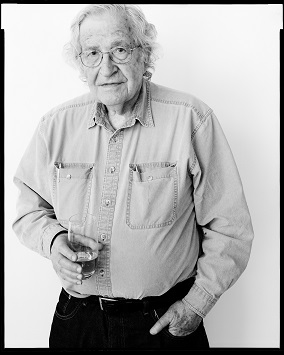
| QUESTION: You have said that in authoritarian
conditions "most people internalise the values and then regard
themselves as acting more or less freely." HIV=AIDS=Death for many
people generates values that are deeply held. Why might people be
driven to choose profound limits to their freedom of actions?
CHOMSKY: Under all conditions, people tend to internalise values
and see themselves as acting freely. I'm not sure this is more true
under more authoritarian conditions. Thus in a brutal state, people
may adopt the values (perhaps out of fear) but not internalise them,
whereas in a more democratic society, where forces are more hidden,
there may be a tendency to internalise values without much awareness.
To say that people have internalised "HIV=AIDS=Death" seems to me an
overstatement, though perhaps some have. I suspect an investigation
would show that many people have accepted the weaker assumption that
HIV is likely to lead to AIDS which in turn is likely to lead to
suffering and premature death. As to whether that assumption is
correct, that is a different question. Rational people will look at
the evidence and arguments, and decide accordingly. I am not convinced
that people have some kind of "drive" that leads them "to choose
profound limits to their freedom of action".
QUESTION: In Britain we have continuously been told there's an AIDS
epidemic, while on average less than 650 people per year have died
with such a diagnosis. Do you think language is becoming less
meaningful as society becomes increasingly sloganistic?
CHOMSKY: I don't know whether use of language is more or less
"sloganistic" when hundreds of billions of dollars are spent every
year to "control the public mind" (to borrow some terms of the public
relations industry) or when people parrot rhetoric of organised
religion, to select one of many examples. On referring to the spread
of AIDS as an "epidemic", the term "epidemic" is used to suggest that
the problem is serious and should be a matter of grave concern. With
that I agree.
QUESTION: Technically of course "epidemic" need not refer either to
infection or disease -- it's a phenomenon affecting people, unexpected
in prevalence e.g. even an epidemic of lawlessness. According to a
report in the Wall Street Journal the CDC is redressing a
self-confessed public relations excess geared towards keeping the
heterosexual population anxious and therefore vigilant about HIV/AIDS.
The cumulative total for "HIV positivity" in the US was revised
downwards in 1995 from some 1,000,000 cases to between 500,000 and
700,000. Do you believe in consistent full open accountability of
government agencies?
CHOMSKY: Of course, I believe in open accountability of government
and other power systems, such as private corporations. In the former
case it exists to a considerable extent, and citizen pressure has
widened the boundaries, and should continue to do so. In the latter
case, it barely exists at all. Whether the Wall Street Journal
article you cite is accurate one has to evaluate in the usual manner:
by investigation. If it is accurate, one then has to assess to what
extent it is reasonable to use the term "epidemic" to suggest [...]
QUESTION: In 1986 the International Committee for the Taxonomy of
Viruses formalised the name Human Immunodeficiency Virus for a
collection of indirect molecular-biological markers which could be
linked with at least transitory deficiency of the cellular immune
system. Do names and language cast their own spell?
CHOMSKY: Linguistic expressions carry all sorts of connotations. In
technical usage one tries to divest them of such associations. The
question that seems to be lurking here is a different one: namely, is
the technical term that has been selected an appropriate one on
scientific grounds? Maybe yes, maybe no, but that does not seem
related to "the spell of language."
QUESTION: "Is the technical term.. [HIV]..appropriate on scientific
grounds?" - really, assuming that the Group for the Scientific
Reappraisal of AIDS, numbering 500 official members including two
scientific Nobel winners, aren't all balmy, and given that plenty of
examples are available of a far wider range of scientific skepticism
sympathetic to the group over whether the proposition of a viral cause
for AIDS is tenable -- not least because of the enduring questions
over whether the theory of the existence of retroviruses deserves to
be held! -- may we not argue that the 1986 adoption of the finite term
HIV by the ICTV was a fascistic imposition?
CHOMSKY: I think we agree that's the core of the matter: To what
extent is it reasonable to assume a viral cause for AIDS? To answer
that question we have to investigate the facts, no trivial matter. The
fact that 500 people including two Nobel laureates rejected the
assumption is perhaps enough evidence to make one want to initiate the
investigation. One can find plenty of eminent scientists, including
Nobel laureates, who will express skepticism or disbelief about most
propositions in science. That's what science is like: uncertain, and
constantly changing. But I don't think we can simply conclude from
that that it is "fascistic" for a scientific organisation to take a
stand on some issue. The facts of the matter have to be investigated.
QUESTION: It's in the nature of science to seek to quantify and
qualify discoveries. HIV is only a theory, from the very beginning it
was said to be impossible to isolate. Does the media generally not
articulate uncertainty?
CHOMSKY: I don't understand what it means to say X "is only a
theory," whether X is HIV, evolution, quantum physics, set theory, or
whatever. The word "only" seems out of place. One of the ways to try
to understand the world is to construct explanatory theories, as best
we can. In empirical inquiry, that's the most that can be achieved.
Whether the theory of X is a good one or not is always a fair
question, but we should not confuse the issue by saying that it is
"only a theory". As for the media, there are all sorts of operative
factors that distort the media product.
QUESTION: Assuming that most journalists are underqualified to
arbitrate on dense scientific matters, and given that the
HIV-causes-AIDS hypotheses were unveiled at a seminal, vigorously
reported government press conference (Health Secretary Margaret
Heckler, NIH scientist Robert Gallo, 1984) before any scientific
challenge of Gallo's propositions had been made, or any peer review
given beyond the establishment journal Science's routine referees, and
that his hypothesis was later declared by the US Senate Committee of
Research and Integrity to be the outcome of "scientific misconduct"
(1992), has much changed since the time of Galileo and Papal Bulls in
the way science or counter-science is translated into popular social
practice?
CHOMSKY: One doesn't know what insight the events give without
exploring them in detail, including the procedures followed by Science
and the merits of the Senate investigation, and the relevance of what
happened in the Gallo case. The analogy to Papal Bulls seems to me
wildly off the mark. In the contemporary natural sciences,
fortunately, things have progressed quite far from the days when the
Church could legislate Truth and Falsity, and error tends to be
discovered and corrected pretty fast.
QUESTION: What tools does a social analyst like yourself use to
distinguish between illusion and material reality?
CHOMSKY: If any tools are known, I'm unaware of them. We use our
intelligence, as best we can.
QUESTION: What gives you confidence when appropriate that you have
successfully distinguished between superstition and rational reality?
Is any theory ever fully vindicated?
CHOMSKY: Theories are never "fully vindicated" in the empirical
sciences, and in principle cannot be. That should be a truism. What
gives one confidence? The question should be: What should give one
confidence? (since what does give confidence is an idiosyncratic
personal matter). If "full confidence" is intended, nothing should
give it. If a degree of confidence is intended, that has to be
evaluated case by case.
QUESTION: What might be some consequences of the apparently growing
dependence, in Western culture at least, on technological probing of
reality?
CHOMSKY: If one is interested in understanding the world, one will
use whatever technology is available and useful for the task. If
reliance on technology displaces other and better means to gain
understanding, one will naturally object to it. As for the "growing
dependence in Western culture on technological probing of reality",
that doesn't capture exactly what I see where I look around me, or
read poll figures on the prevalence of highly irrational beliefs about
the physical world (let alone the world of human life and society).
QUESTION: Regarding "safe sex", within the gay community now, and
indeed in general, we have a moral majority. Do you think it's to be
challenged?
CHOMSKY: I presume polls would show that most people would approve
of "safe sex" rather than "unsafe sex", and that inquiry would show
that many choose the latter nonetheless. But I'm probably missing the
point.
QUESTION: Really? Current ideology is that sex can be unsafe
because "the AIDS virus" can be transmitted that way. Despite many
scientists doubting this, it is a felony or misdemeanour in 29 US
states to engage in "risk" sexual behaviour if a person is "aware
he/she's HIV positive". Professor of law Philip Johnson of UC Berkeley
has said of these laws, "Of course they're irrational laws; they occur
in the context of irrational fear." Can one reasonably detect
similarities between these legislations and their moral incitements
and, for example, religiously motivated legislation in the issues of
abortion, or homosexuality or racial equality?
CHOMSKY: If you think the evidence is unpersuasive that "the AIDS
virus" can be transmitted sexually, then by all means try to establish
your conclusion and convince people of it. Citing a professor of law
at Berkeley isn't helpful. Laws are generally "irrational" in the
sense of his comment. It doesn't follow that all laws should be thrown
out, just as the skepticism of some scientists doesn't mean that all
of science should be placed in the category of Papal Bulls. Again, one
has to investigate case by case.
QUESTION: Throughout human history, theorists and intellectuals
like you have challenged official truths about science and human
nature, putting their lives and careers at risk, often silenced or
ridiculed. Can you describe some general principles of successful
dissident organisations, i.e., ones that have more or less brought
about the changes they sought?
CHOMSKY: I know of no principles of successful organisation and
struggle, beyond the obvious ones. About those, I have no more to say
than the participants in popular organisations in the slums of Haiti,
to go to the opposite extreme of privilege in the hemisphere where I
live -- and where quite impressive developments have taken place, of a
kind that I've seen many times under conditions of extreme duress,
around the world, and in sectors of privilege in the rich countries as
well. There are no magic tricks. When we believe it is our duty to
challenge orthodoxy, we don't ask someone how to do it: we'll get no
useful answers. Rather, we do it. This isn't quantum physics. It's
mostly a matter of using common sense. Whatever the issue, what is
needed is not specialised knowledge or great insights, which are
lacking in any event, but rather energy, dedication, courage, honesty
- the simple virtues. We should also be aware of our extraordinary
privilege, which offers us opportunities that are not available to the
great mass of poor and struggling people throughout the world --
opportunities to inquire, understand, and act.
QUESTION: If public health systems aren't working in the interests
of the public, how might people respond to the possibility that their
health is being compromised by economic forces?
CHOMSKY: I think that honest people should seek to understand how
the public health system works, and work to make it as responsive as
possible to the informed decisions of the public -- but that seems
close to truism. How should this be done? By the usual mechanisms of
popular organising and education, available to a considerable extent
in relatively free societies like ours, with little personal risk or
cost.
QUESTION: HIV/AIDS self-help groups which started as dissidents and
later founded the voluntary sector have provided information and
support to change preconceived ideas about homosexuality and AIDS.
Today, these organisations have become institutionalised and also
promote state-sponsored drug-therapies. Do you think that in order to
push for change Continuum must make compromises with the
establishment?
CHOMSKY: What tactics Continuum should follow, I can't say. I don't
mean to suggest that tactical decisions are insignificant; on the
contrary, they regularly have direct and often substantial human
consequences, and therefore require careful thought and attention. But
choice of tactics depends on goals and an assessment of the
circumstances. As for challenging "preconceived ideas", that is always
appropriate, whether the ideas are about homosexuality or AIDS or
anything else. A reasonable person will not easily adopt "preconceived
ideas" on matters of any significance, but will try to find what seems
to be the best ideas. As the whether standard ideas are the best ones,
they usually are not, but that is a matter that requires specific
inquiry.
QUESTION: Do you feel the language of war and conflict translates
successfully to the human body's functions? "Defences compromised",
"titanic struggle" against "invaders", "zapping microbes", etc. -
where does the popular language of our biological identities derive
from?
CHOMSKY: I don't see any particular problem in referring to "the
body's defences against disease" etc. The other terms you mention are
picturesque, presumably used to attract attention. In a paper in a
technical journal they would be out of place. In a public discourse I
don't happen to like them much, but it's a matter of taste.
QUESTION: HIV/ AIDS "dissident" concerns were first discussed years
ago at an international conference. The tenth such conference is due
to be held next year. What are the best political purposes of
conferences?
CHOMSKY: The "political purposes" of any activity, including
conferences, are (I suppose) to clarify our understanding, sharpen our
agendas, and place them in the public arena as prominently as we think
important in the particular case. |