
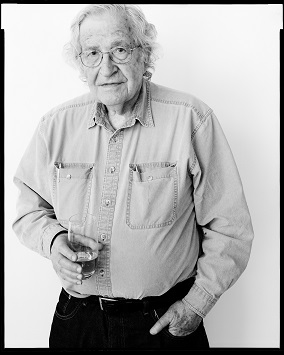
| QUESTION: Noam Chomsky has a multi-hued career:
linguist, distinguished lecturer, university professor, researcher and
public intellectual. But it's as a critic of politics, government and
the media that Noam Chomsky is best known. His indictment of the media
of North America fills volumes and, more often than not, his critique
of how the media does their job is ignored by the very media that he
indicts. Noam Chomsky was in Vancouver last week and I spoke with him
then.
You're in Vancouver for a little celebration of a film about you.
Does the popularity of the film surprise you? Because it's enormous.
CHOMSKY: Well, actually, it's the first I've heard that I'm here
for a celebration of the film but -- Does the popularity surprise me?
Yeah, I think it was amazing. Actually, it's not popular in some
circles. I haven't seen it and I was kind of skeptical about the whole
project but I liked the people [who made it] very much. But, yes,
you're right: worldwide, the reaction has been astounding.
QUESTION: I'm surprised you've never seen it.
CHOMSKY: Well, partly, because I'm not much attuned to the video
culture.... I wasn't part of the project -- I mean, I was part of it
in the sense that the moon is part of the project of filming the moon.
And I have various reservations about it. With all the efforts that
I'm sure they made, there's something inherent in the medium that
personalizes the issues. And these are not personal issues. I mean,
they followed me around giving talks all over the place just as I'm
giving talks all over the place here. But the reason I'm doing that is
because somebody else is doing the real work, the work that counts,
the work that matters: the organizing and the planning, follow-ups and
so on. I'm just participating in other people's activities. And I
doubt that there's any way of conveying that in a film.
QUESTION: As we speak, your country and our country are arguing
about Cuba. And the mass media in the United States are filled with
stories about Cuba. Could we use Cuba as a case study for a moment?
Tell me what we learn about the way the media works by the way the
Cuba story is being dealt with.
CHOMSKY: Not only is the Cuba story being dealt with but the front
page story right now is Palestinian terrorism. And in fact in the case
of Cuba, it's an act of terrorism -- that is, shooting down two
civilian planes, actually probably within the range of international
conventions -- but surely an unwarranted act, maybe a terrorist act.
So, terrorism's a big issue: shooting down unarmed planes and so on.
And we're worried about terrorism in the Middle East. On the other
hand, for years, our client state, Israel, has been intercepting ferry
boats and other boats in international waters -- say, ferry boats
going from Cyprus to Lebanon -- sinking them, killing people in the
water, kidnapping people and putting them in Israeli jails. This has
been going on for years. That's way beyond anything Cuba's accused of
or, for that matter, anyone else in the international arena. But
that's not considered terrorism. Well, that's a pretty striking
example.
Let's keep to Cuba. In the case of Cuba, for say thirty years or
so, the sort of official line in the United States is that we have to
defend ourselves against Cuba because it's an outpost of Soviet
imperialism and threatening us. By that logic, the Soviet Union had
every right to carry out a terrorist war against Denmark and to
embargo it and so on because surely Denmark was a far greater threat
to the Soviet Union than Cuba is to us. But let's put that aside.
November 1989 the Berlin Wall collapses. Okay. No more Soviet threat.
What happens to U.S. policy towards Cuba? Well, it becomes harsher.
Becomes harsher from the liberal Democrats, incidentally. They pressed
Bush from the right to finally pass a bill which he originally vetoed
-- because it's so contrary to international law -- which makes the
embargo against Cuba harsher. That's because the threat of the Russian
empire is gone. Well, the media reacted to that without batting an
eyelash. Turns out all these years we weren't afraid of the Soviet
threat: it was that we have so much love for democracy that we
therefore have to carry out a terrorist war against Cuba and embargo
it and strangle it and so on and so forth. In fact, going back to the
beginning, the U.S. officially determined -- we now have the documents
-- to overthrow the government of Cuba at a time when Castro was
anticommunist and there were no Russians around but he was showing
signs of independence. U.S. planes were attacking Cuba from Florida
within months after Castro's takeover and a few months later, March
1960, a formal decision was made to overthrow the government. Now
since that time, the United States has, first of all, invaded Cuba,
but then carried out extraordinary terrorist attacks against it for
years. Probably, Cuba was the target of more international terrorism
than probably the rest of the world combined -- certainly nothing to
compare with it -- at least up until [the U.S.-sponsored attack on]
Nicaraugua in the 1980s which did exceed it as a terrorist attack. But
that's considered legitimate. It's never discussed. The U.S. is
presented as the victim: Cuba is taunting us, tweaking our nose...
QUESTION: It's presented by whom?
CHOMSKY: By the U.S. media. So, occasionally they'll say -- as
[they did] the day before, yesterday, when I left Boston -- the
headline said that there is bitter animosity between the two
governments. As if it was somehow symmetrical. Like we're embargoing
and attacking Cuba and Cuba's embargoing and attacking us, sort of.
That's about at the outer limits. Well, you know, this is pretty
remarkable if you think about it. It'd be pretty hard to carry
something like that off in a totalitarian state.
QUESTION: When you co-wrote the book Manufacturing Consent in the
mid to late eighties, one of the issues you raised concerned media
concentration -- and you wrote before Time-Warner or Disney-ABC. Has
media concentration increased significantly since you wrote
Manufacturing Consent?
CHOMSKY: I should clarify something -- which was also one of the
reasons I was skeptical about the film. The book that you're referring
to is a co-authored book and in fact the lead author who more or less
did the framework for it is Edward Herman. He's an economist at the
University of Pennsylvania. And the work that you're describing is his
work. He's a specialist on corporate control and he did the work on
media concentration. I mean, I agree with [my] co-author but it's his
work. However, I should tell you that, personally, I don't regard that
as a huge issue. It's true that media concentration is increasing and
getting worse and that's a bad thing but the differences are not
enormous. Let's take Warner, which you mentioned. Back in 1974, before
the concentration, twenty years ago, Warner Communications, part of
Warner Brothers, it was a big outfit but not a huge mega-conglomerate.
They had a publisher, a rather successful textbook publisher, which
published a book critical of U.S. foreign policy that an executive in
the Warner offices didn't like. He ordered the publisher to stop
distributing the book. When they didn't -- refused to stop
distributing it -- he put the whole publisher out of business and
destroyed their entire stock. Well, that book happened to have been
written by Edward Herman and me. It was our first joint book. Nobody
batted an eyelash about this. This isn't censorship, it's just
corporate tyranny -- which is 'freedom.' But that was before they
became a huge conglomerate. Well, how much worse can it get? Have you
heard of an example like that -- where a conglomerate not only stops
the distribution of a book but puts their entire stock out of
existence 'cause they don't like one book they published?
QUESTION: Quite a story.
CHOMSKY: Incidentally, this story's been well known for twenty
years but it doesn't bother anyone. In fact, about the only person I
know who's even commented on it is Ben Bagdikian who has written very
well about media concentration and who also mentioned this case.
QUESTION: And why do you suppose that is?
CHOMSKY: Because we're at the dissident fringe. It's just like not
reporting terrorism when it's carried out by your own state or client
state and the victims are permissable victims. I mean, this is
obviously not on the scale of terrorism but it's the same logic.
QUESTION: So what social purpose do you see the media playing?
CHOMSKY: Well, you can't characterize it in a phrase. It's
complicated. But to a sort of a first approximation, the media behave
exactly as you would expect institutions of that character to behave.
I mean, take, say, the commercial media. These are big conglomerates,
big corporations, very profitable ones, parts of even bigger
conglomerates and, as you say, now becoming, you know, going into
mega-merger stages. They have a product, namely audiences. They sell
it to a market, namely advertisers. The major media -- like the New
York Times and the Washington Post, the ones that kind of set the
agenda for others -- they're directed to privileged sectors of the
population, decision-making sectors, managerial sectors, cultural
managers, and so on. So they are huge profitable businesses selling
privileged audiences to other businesses. Well, what kind of picture
of the world would a sane person expect to emerge from that
interaction? Not hard to figure out. And there is, by now, thousands
of pages of pretty solid documentation showing that what you expect,
you get. Hardly surprising. On more or less minimal free market
assumptions, that's about what you'd expect. The interest of the work
is showing that the expectation is not only verified but is
overwhelmingly verified. On the other hand, there are conflicting
factors, so if you look more closely, you find that there are plenty
of journalists who have just plain professional integrity and honesty
and want to get to the truth. Some of them, incidentally -- some of
the best known of them -- are even more cynical about the media than I
am but find ways to work within them [and] kind of often get off quite
important things. Another conflicting factor is that the major media
-- say the national media, the ones I mentioned -- they have a sort of
an internal contradiction, just the way the schools and the
universities do. I mean, on the one hand they have a kind of an
indoctrination function and it's real. On the other hand, they have
the responsibility to present to important people -- people who make
big decisions -- to present them with a tolerably realistic picture of
the world. And those two demands enter into conflict. You see it
pretty dramatically in a journal like the Wall Street Journal, which
has some of the best reporting in the country because their audience
had better know what the facts are if they're, you know, making money
and things like that. On the other hand, when you turn to the
editorial pages, it's not even a comic strip.
QUESTION: Back in 1988 when your book, which you co-wrote, was
published -- Manufacturing Consent, we're speaking about -- we were
just beginning to see the emergence of what's been called the 500
channel universe. Do you think that the multiplicity of TV channels is
good news or bad news?
CHOMSKY: You could ask the same question about the discovery of the
printing press. Depends how it's used. Technology is usually pretty
neutral. It doesn't care whether you use it to coerce people or you
use it to free and liberate people. And all the communications
technology from print to radio to television to the Internet has
coercive potential and it has liberatory potential. It depends who's
in charge. If it's democratically run and controlled, it can reflect
public interests and serve public interests. If it's privatized, put
under the control of private tyrannies -- or totalitarian states and
so on -- which aren't responsive to not only the public will but don't
encourage -- in fact, discourage -- public participation, well, then,
it'll be something quite different. Depends which way it goes. Right
now, there's a struggle over the Internet. And also over the multiple
channels. If the multiple channels just become more and more ways for
the same tyrannical organizations to carry out their agenda... Their
agenda is very clear: you can read it in the manuals of the public
relations industry where they're quite frank about it and have been
for a long time. Their agenda is to carry out what the leading guru of
the PR industry, Edward Bernays, years ago called the conscious and
intelligent manipulation of the organized habits and opinion of the
masses. Which he regarded as a central part of democracy. He was,
incidentally, no reactionary. He was a Kennedy-Roosevelt liberal,
highly respected around Cambridge. And what he was presenting -- this
happened to be in the main manual of the PR industry but it reflected
general intellectual attitudes -- that means creating artifical wants,
atomizing people, separating them from one another, making sure they
don't disturb us important folk in the political arena, turning them
into isolated atoms of consumption, obedient, having the 'right'
opinions which don't bother us, and properly jingoistic and supportive
of power. That's the agenda. And they're happy to tell you about it.
And they spend huge amounts of money on it. Well, if that's what the
500 channels turn into, [it's] just another technique of coercion. But
they don't have to.
QUESTION: Professor Chomsky, how wired are you?
CHOMSKY: Oh, I'm a kind of a Luddite. I very reluctantly agree to
use any technology. In fact, about the only reason I have a computer
is because my teenage son was beginning to look at me with such
contempt and ridicule that I thought I'd better do it.
QUESTION: Are you on the net?
CHOMSKY: No. Although indirectly I am because I have a lot of
friends who are, you know, involved in this stuff so they send stuff
off to me. Including my wife, who's a high tech freak.
QUESTION: Oh, yeah? What an interesting household you must live in.
CHOMSKY: Yeah, I don't know a radio from a tape recorder but she
goes around fixing everything and all that stuff. Incidentally, I've
been in an electronics lab for forty years so it takes a little work
not to know it.
QUESTION: Is it hard to be... to be you?
CHOMSKY: It's... yeah, the hardest thing that I find is, you know,
staying up at night, not sleeping, thinking of all the thousands of
requests that I've got there that I'd really like to fulfill because
the people are really doing extremely important and often very
courageous things and I just cannot do it. It's physically impossible.
That's really frustrating.
QUESTION: Your work is often reviewed without, as you have said,
the batting of an eyelash. Do you never get discouraged?
CHOMSKY: I'm not expecting to be applauded by people in faculty
clubs and editorial offices but that's not my audience. I mean, I feel
good about it when I... Well, I was in India a couple of weeks ago and
visited rural, self-governing villages and the people there were happy
to see me. I was in Australia before at the invitation of Timorese
refugees and, you know, they were glad that I was helping them. Last
night, gave talks at a labor federation -- I've done that in the
United States often -- and those are the people I want to talk to. As
long as the circles of people who matter to me seem to find it helpful
and want it -- and are sometimes grateful and so on -- what else
should I care about?
QUESTION: Is it perhaps proof that you're at least partly right
that for the most part your ideas and analysis of the media are
ignored by the media?
CHOMSKY: It's not just the media, incidentally. It's a little bit
misleading. I mean, I do write about the media but that's because
they're visible. Basically, I write about the doctrinal system. That
includes journals, media (mostly elite media), the schools,
universities, a good part of scholarship, what's called the
intellectual community and so on. The easist one to study
systematically, [if] you really want to do careful systematic analysis
and comparisons and so on, well, then you use the daily media because
you have a data base which you can sort of run experiments on.
QUESTION: In reviews of your work, the comparison between you and
Bertrand Russell or George Orwell surfaces. Are you comfortable with
those comparisons?
CHOMSKY: I don't feel part of that company. Both of them are people
who I very much admire. In fact, the one big picture up in my office
is [of] Bertrand Russell and I was delighted and honored to be invited
to give the memorial lectures in Cambridge at Trinity College after he
died, which I did. A lot of Orwell's work, I think, is terrific. I
mean, Homage to Catalonia, which in my view is his greatest
book, was an eye-opener to me when I read it, although at the time I
already knew a lot about the Spanish Civil War. Russell's a
complicated figure but I think he's a really outstanding figure -- one
of the outstanding figures of the twentieth century. And recall that
he was reviled and denounced bitterly because he wasn't just sort of
sitting there making occasional comments about the world but -- in his
eighties -- was out in the streets protesting, involved with people
who were trying to stop atrocities and so on. And he was bitterly
reviled -- you should read what the New York Times was writing about
him in the sixties.
QUESTION: That's in the [New York Times] index, isn't it?
CHOMSKY: Yeah, that's in the index. Bitter denunciations of
this monster who's daring to criticize U.S. atrocities in Vietnam and
to call for an end to nuclear weapons and so on. Well, that goes with
the turf. You try to do something that has moral value and people in
power aren't going to like it. I mean, you can trace that back to
Biblical times. Just remember that the people who we call the Prophets
were not the people who were respected in those days. The respected
intellectuals in those days were the ones who centuries later were
called false prophets. Take a look at what happened to the people who
centuries later were called Prophets -- well, same with Russell, in my
opinion. And same throughout history. That's what you expect.
The work that Orwell's most famous for is not his best work. It's
work which was kind of easy. It's satirical criticism of the official
enemy, a totalitarian state, which is sort of the easiest target. And,
of course, particularly easy because he happened to be lining up with
power in this case -- not that he was dishonest about it -- but that
he was. On the other hand, Orwell did occasionally say something about
the much more significant and more important topic, namely, doctrinal
controls in free societies. Obviously, that's far more important. For
one thing, it's more challenging and difficult but for another thing,
it's right here, and it's always more important to -- I mean,
elementary moral considerations say you should focus on what you're
doing and not what some enemy's doing. That's obvious. Orwell did have
one essay in particular on "Literary Censorship in England" which was
written as an introduction to Animal Farm, back in the early
forties. And in it he said that England's a very free society but he
said that nevertheless ideas can be silenced without any official
means. There are all sorts of ways of doing that. He didn't go into it
much, he just had basically two sentences. Here's what he said. He
said the press is owned by wealthy men who have every interest in not
having certain ideas and opinions and attitudes expressed. And he said
there's also a process of socialization by which -- particularly in
the elite educational system -- you sort of internalize values, as he
put it: you learn that there are certain things that it just wouldn't
do to say. That's part of a good education. And he said the effect of
this is... To lead [Orwell] to the conclusion that ideas are silenced.
The outcome is often not very different from a brutal totalitarian
state of the kind that he was describing. Incidentally, that
introduction was not published: it surfaced in his unpublished
materials about thirty years later. And it's still not very well
known. I've quoted it -- and it's there, you can find it -- but that's
the one case that I know of in which Orwell dealt with the challenging
and morally significant problem for us of what we're like. It's always
easy to denounce some other guy.
QUESTION: And fifty years later are you more optimistic or
pessimistic than George Orwell?
CHOMSKY: I don't regard the issue of optimism and pessimism as
meaning anything. Say, back in the early sixties, when I started
getting seriously active in [protesting] the war against Vietnam, I
was hopelessly pessimistic. The U.S. by that time had been bombing
South Vietnam for years, killed probably a hundred thousand people or
more than that, was using napalm, crop destruction. You simply
couldn't get two people in a room together to talk about it. My own
view was it would never be possible to see any organized opposition to
the war. And I've felt the same about many other things. I mean, take,
say, Timor. For years and years, I've been working on the Timor issue.
Press wouldn't cover it -- true in Canada, as well. Half of the United
States probably doesn't know where France is. I mean, try telling them
something's going on in Timor. Well, you know, it finally got to the
point where it became a significant issue, significant enough among
the public so that Congress actually was impelled to put constraints
on arms sales to Indonesia. Of course, Britain and Canada and
Australia are delighted to go in and make as much money as they can by
slaughtering Timorese but nevertheless when the biggest guy on the
block indicates that he doesn't like something, that has an effect.
And it does have an effect. And it can get more [so]. So should you
get optimistic or pessimistic? Well, over the years things slowly
change -- often for the better, sometimes for the worse -- that's the
course of history. I mean, it's because lots and lots of people are
not succumbing to pessimism that we don't live under feudalism and we
don't have slavery and we have parliamentary democracy and we have
workers' rights and some kind of social contract and so on and so
forth.
QUESTION: Professor Chomsky, thank you for your time.
CHOMSKY: Glad to have a chance to talk to you. |