
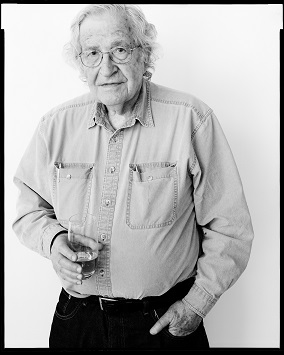
| QUESTION: Professor Chomsky, for nearly four
decades now you have been the leading figure in generative grammar,
which is the most influential paradigm in modern linguistics, and you
have become one of the leading Western intellectuals in the political
campaign against manipulation and oppression. I would like to ask you
a few questions ranging from linguistic theory to your political
opinions.
Surveying the development of Generative Grammar from Syntactic
Structures (1957) up until the Minimalist Program, would you
characterize this development as a continuous process whose inner
logic has culminated in a minimalist program for linguistic
theory, or has generative grammar gone astray at some point and then
returned to insights of a former stage?
CHOMSKY: In retrospect, I think one can detect a kind of inner
logic, though it would be an exaggeration to say that it was
evident all along. And over the years, there have been many
tendencies, experiments, and conflicting ideas, some of which have
proven more fruitful than others, some of which seem (again in
retrospect) to have been wrong turnings.
QUESTION: Are there stages within the history of Generative
Linguistics that you would highlight as rather revolutionary,
marking major breakthroughs in the field?
CHOMSKY: I think there was a really significant change that
crystallized about 1980, in the so-called principles-and-parameters
(P&P) approach. To explain, it's necessary to sketch some basic
problems of the field and the way they were addressed.
The first attempt to give a general presentation of generative
grammar was my Logical Structure of Linguistic Theory (LSLT,
1955; parts of a 1956 revision were published in 1975); Syntactic
Structures, which you mention, was an adaptation of this for an
undergraduate course at MIT, with material added on topics of
particular interest in this context (specifically automata theory).
The main line of work since then will be easier to sketch with some
current terminology.
We are concerned with the human language faculty. Like other
biological systems, it has a modular structure. We can at once
distinguish two components: a cognitive system that stores
information, and performance systems that access this information for
articulation, perception, talking about the world, asking questions,
and so on. Let's focus on the cognitive component. It has an initial
state, close to invariant across the species, and undergoes changes of
state until it pretty much stabilizes, apparently pre-puberty. We may
refer to a state of the language faculty as a language, or to avoid
pointless terminological debate, an I-language, where I is to
suggest internal, individual, and intensional,
the approach being internalist and individualist and characterizing in
intension a procedure that generates expressions (thus, it provides a
specific way of generating the class of expressions that constitute
its extension). We say that a theory of a language (a grammar)
achieves descriptive adequacy to the extent that it characterizes the
I-language correctly, and thus provides a correct account of the
expressions generated and their properties. We say that a theory of
the language faculty attains explanatory adequacy to the extent that
it gives the initial state. The term explanation is appropriate
in the sense that the initial state can be considered abstractly as a
procedure that determines an I-language, given data, and thus provides
an explanation for the properties of the I-language and the
expressions it generates, given the boundary conditions of
experience. By language henceforth I mean I-language, in
the technical sense.
LSLT and other detailed work of the 1950s (particularly G.H.
Matthews, Hidatsa Syntax) at once revealed a tension between
descriptive and explanatory adequacy. As soon as serious descriptive
work was undertaken, it was discovered that available accounts of
language, however extensive, barely scratched the surface; even the
most comprehensive grammar provided little more than hints that
sufficed for the intelligent reader; the language faculty was
tacitly presupposed (without awareness, of course). The same is true
of the most comprehensive dictionary. To attain descriptive adequacy,
it seemed necessary to construct extremely intricate and complex
grammars, radically different for different languages. On the other
hand, to approach explanatory adequacy it was necessary to assume that
the states attained are determined to an overwhelming extent by the
initial state, which is language-invariant. Thus languages must all be
cast to the same mold, differing only superficially. The major
research project was aimed at overcoming this tension by showing that
the apparent complexity and variety of language was only superficial,
the result of minor changes in a fixed and invariant system.
This work reached its culmination in the P&P model, which, unlike
earlier work in generative grammar, constituted a major break from a
tradition of some 2500 years. Traditional grammars are rule- and
construction-based. Thus a grammar will contain rules for constructing
verb phrases or relative clauses in English, and these are different
from the rules for constructions in other languages. As noted,
traditional grammars only gave hints and examples, but generative
grammar proceeded pretty much on the same model, attempting to fill in
the gaps, which were quickly discovered to be huge. The P&P approach
dispensed entirely with both rules and constructions. It postulated
general principles of the language faculty and a finite array of
options (parameters), which appear to be limited to a subpart of the
lexicon and peripheral parts of the phonology. A language is
determined by a choice of values for the parameters.
The constructions of traditional and early generative grammar
disappear; they are taxonomic artifacts, like terrestrial mammal.
The verb phrases and relative clauses of English result from the
interplay of fixed principles that are not specific to these
constructions, with particular values for parameters. This approach
could be called a breakthrough, in that it provided a radically
new conception of language and also led to a great deal of new
empirical work in languages of broad typological variety. New
theoretical ideas were also developed in the effort to show that the
variety of possible human languages can be reduced to fixed and
invariant principles with limited options of variation -- so that, in
effect, we can deduce Hungarian by setting parameters in the fixed
system one way, and deduce Swahili by setting them a different way.
That goal is, naturally, far from attainment, but for the first time
it has been intelligibly formulated and the task of approaching it can
be addressed constructively, and indeed has been.
QUESTION: With your 1991 paper on economy of derivation and
representation, a discussion has been generated as to what extent the
language faculty is contingent on the operation of cognitive
principles of economy. Doesn't this appeal to general cognitive
principles of economy create a problem for the claim of the autonomous
nature of the language faculty?
CHOMSKY: The question of autonomy of the language faculty is not a
dogma, but an apparent discovery, one that remains unaffected by the
introduction of principles of economy of derivation and
representation. Even the earliest work in generative grammar made
crucial appeal to such principles, though at the time, in a different
way: as part of the evaluation procedure that selected among
grammars of a permissible format, given data. The principles of
economy that have been proposed in recent work are quite natural,
in that they seem to provide a kind of optimal design for a system
like the language faculty (an intuitive judgment, but not a vacuous
one). But they still appear to be specific to the language faculty,
not general cognitive principles. More recent work in the
minimalist program carries these efforts further, attempting to
reduce assumptions to what is conceptually necessary and to
show that the properties of the I-Language are otherwise determined by
interface conditions (that is, by the ways performance systems access
the linguistic expressions generated by the I-language).
If this program succeeds, the specificity of the language faculty
will reside in the nature of the interface conditions, the properties
of the lexicon, the economy conditions, and some elementary features
of the computational procedure that forms linguistic expressions from
lexical items -- perhaps close to invariant across languages. If
correct, this approach will identify the specificity of the language
faculty, and we may then ask about its autonomy: are there cognitive
systems, or other biological systems, which share these properties in
significant ways? For the moment, the answer to that question seems
negative -- but again, it is an empirical issue, not a theological
doctrine.
QUESTION: Contrary to views that have proclaimed the end of
transformationalism, the derivational nature of the computational
system still plays a crucial role in the most recent developments of
Generative Grammar. Can this role only be established through
theory-internal considerations or can you think of any external
evidence that might support this view?
CHOMSKY: First, we have to distinguish the two notions
transformationalism and depth of derivation. On
derivational depth, I'd go beyond what you suggest. As principles and
assumptions become simpler, quite typically explanations become longer
and more complex. Much the same seems to be true here. As the
principles of the language faculty have become more refined, the
derivation of linguistic expressions, though determined by fixed
principles and parametric choices, becomes increasingly intricate;
properties of expressions are not directly stated by rules specific to
them but derived from an interplay of invariant principles.
Accordingly, the derivational nature of the computational system
becomes even more fundamental than before. As for
transformationalism, that has to do with a specific property of
natural languages, namely, that expressions are commonly interpreted
in a position different from the one in which they physically appear.
Thus in the sentence the book seems to have been written t by John,
the phrase the book is interpreted in the position of t
(its trace); it is given the same interpretation as in has
written the book. That property of natural language is pervasive
and widespread, and every theory of language has to capture it
somehow. Speaking abstractly, the relation of the phrase to the
position of its interpretation (in the example given, the relation of
the book to its trace) is a transformation. Exactly how
transformations are to be described is an empirical question. For now,
the evidence seems to me considerable that they are operations that
move an expression from one position to another, leaving a copy (a
trace). That's a theory-internal conclusion, but one that seems
reasonably solid at the moment.
As for external evidence, the term is not very clear, in my
opinion. The example I just gave is one of innumerably many like it
that provide evidence of the kind of displacement that is
captured by transformational rules. Is it internal or
external? Suppose that a study of priming effects in parsing
distinguishes effects of trace from other unpronounced items.
Would that be internal or external evidence? The same
question can be asked about studies of electrical activity of the
brain that distinguish between the effects of different
transformational operations. The notions external and
internal derive from an approach to the study of language that
seems to me dubious from the start, an approach that seeks to
distinguish linguistic from psychological evidence. A
specific datum does not come with its purpose written on its sleeve.
It is just a bit of data, which may be understood as evidence for
something, within a particular theoretical framework. Judgments about
the interpretation of sentences (essentially, perceptual judgments)
are data, along with the results of priming studies and electrical
activity of the brain. We seek any data that may provide evidence
bearing on the nature of the language faculty.
QUESTION: In his recent book, Bright Air, Brilliant Fire. On the
Matter of the Mind, G.M. Edelman claims that cognitive science
rests on a set of unexamined assumptions, one of its crucial
deficiencies being that it makes only marginal reference to the
biological foundations that underlie the mechanisms that cognitive
science purports to explain. Do you feel that this view has something
to it and that it might also affect the kind of linguistics that you
are advocating?
CHOMSKY: Edelman's description is correct: there is a great gap
between computational and connectionist theories of the brain, on the
one hand, and the study of the anatomy and physiology of the brain, on
the other. But his conclusions from this familiar observation are
seriously in error, in my opinion. Our common concern is to learn
about the brain: its architecture and components, their states and
properties, their interactions, their constitution, and so on. Within
the cognitive sciences, computational and neural net theories have
been developed to account for some of these aspects of the brain and
its function. There are also accounts of the brain in other terms: in
terms of cells, electrical activity, and so on. Naturally, we hope to
unify these: to show, for example, how electrical activity relates to
representations and derivations, or how these elements of
computational systems relate to cells. For the present, there is no
real understanding of the problems of unification. That is a rather
typical feature of the history of science. A century ago, for example,
there was no way to unify chemistry with physics. Chemists described
the world in terms of elements, valence, the periodic table, Kekulé's
rational formulae, atomic weights, etc. Physicists described
the world in terms of particles in motion, electromagnetic fields,
etc. The two approaches could not then be unified, why, no one knew.
It turned out that the more fundamental discipline had to be
radically modified for unification to proceed. With the Bohr atom and
the quantum theoretic revolution, Linus Pauling was able to give an
account of the chemical bond in terms of the new physics, thus
unifying the disciplines (note that this was not a case of
reduction, in any meaningful sense of the term).
Suppose that a century ago someone had argued that chemistry "rests
on a set of unexamined assumptions, one of its crucial deficiencies
being that it makes only marginal reference to the physical
foundations that underlie the mechanisms that it purports to explain."
That would have been true in the sense that the unification problem
remained unsolved, and indeed was unsolvable in terms of the physics
of the day. The standard Norton History of Chemistry points out that
"The chemist's matter was discrete and discontinuous, the physicist's
energy continuous", a "nebulous mathematical world of energy and
electromagnetic waves ..." It seemed (and indeed was) impossible to
relate the former to the latter.
Like many others before him, Edelman is properly intrigued by the
distinction between the discrete and discontinuous nature of brain as
seen from the standpoint of the cognitive sciences and the continuous
and endlessly varied character of the brain as seen by the
neuroscientist. He sees this gap as a "crisis", which seems to me a
bit melodramatic. However one evaluates that, he then proceeds to a
completely erroneous conclusion: that it is a crisis for the cognitive
sciences, which would be on a par with the claim, a century ago, that
chemistry is facing a "crisis" because it is based on "unexamined
assumptions" of discontinuity that are "refuted" by the physics of the
day -- inadequate physics, as was later learned. Neither move makes
any sense at all.
What we should do is to pursue all approaches to the brain as best
we can, seeing what one can learn from the other. The discoveries of
the chemist provided certain guidelines for the revolution in physics,
and it could turn out that the discoveries of the cognitive scientists
will do the same for the brain sciences. Or, the latter might develop
some new approach to properties of language and other aspects of
cognition that would suggest new directions for the cognitive
sciences. One can have no doctrines about such matters.
QUESTION: It has been claimed by representatives of the generative
paradigm that linguistics can be ascribed a foundational role among
the cognitive sciences. Don't you think that this claim is a bit
overstated?
CHOMSKY: I'm not familiar with such claims, but I see no merit to
them. As far as I understand these matters, the language faculty seems
to have quite different properties from other cognitive systems, and
thus plays no foundational role (whatever exactly that might
mean). It is possible that some other systems derive in some fashion
from the language faculty. It's not implausible to speculate, for
example, that the innate basis for mathematical understanding is a
kind of abstraction from properties of the language faculty;
that might explain the fact that humans have an innate capacity for
mathematics that has surely not been specifically selected. The same
might be suggested for some aspects of musical ability. It has also
been suggested that properties of language derive in some fundamental
way from properties of the visual system. Again, these are questions
about which little is known; the chips fall where they may.
QUESTION: What are your views on the sociobiological research
program? Do you think that there are any connections with the basic
assumptions of generative linguistics?
CHOMSKY: Sociobiology is reasonable enough as a research program.
It has substantial results for simpler organisms, but little to say
about humans, to my knowledge, beyond speculations of various kinds,
the earliest, to my knowledge, in Kropotkin's work on mutual aid as a
factor in evolution. The research program is concerned with
biologically-determined elements of human behavior and understanding,
and in this respect, has a similarity to the study of language -- or,
for that matter, any biological system. Beyond that, I see no clear
connections.
QUESTION: Donald Davidson's view of the Private Language Problem
seems to come close to what you said about this problem in
Knowledge of Language. Do you see any correspondence between
Davidson's theory of language and your theory of linguistic knowledge,
or is there any other contemporary philosopher of language you would
consider to advocate a related notion of linguistic knowledge?
CHOMSKY: Davidson observes correctly that in an ordinary
communication situation between (say) Smith and Jones, each will use
any means to determine the intentions of the other. Thus in his terms,
Smith will construct a passing theory to interpret what Jones
is saying, employing any evidence available. From that correct
observation he concludes that there is no such thing as language. This
conclusion has two aspects. First: there is no need to postulate a
common language shared by Jones and Smith to account for their
communication. Second: there is no portable interpreting machine
set to grind out the meaning of an arbitrary utterance -- that is,
no I-language.
Three comments are in order. First, his argument is invalid in both
cases. From the fact that Smith constructs a passing theory,
nothing follows about the basis on which he does so. It would be like
concluding from the chaotic properties of weather systems that there
is no jetstream. In particular, nothing follows about common
language or I-language.
Second,despite the invalidity of the argument, Davidson's first
conclusion is correct, though understated. Not only is there no need
to postulate a common language, but there is no intelligible
notion of common language to postulate. That is a truism that
has always been assumed, virtually without comment, in the empirical
study of language, which has no place for such notions as Chinese
or German, as is well known.
Third, Davidson's conclusion about a portable interpreting
machine (an I-language) is incorrect, as far as we know; he
suggests no reason to assume otherwise.
There are philosophers whose concept of linguistic knowledge is
close to my own: James Higginbotham, Sylvain Bromberger, Julius
Moravcsik, Akeel Bilgrami, Jerry Fodor, and others in varying degrees
and ways, though there are also differences among us. I do, however,
feel that the leading currents in philosophy of language and mind are
seriously in error, for reasons I've outlined elsewhere.
QUESTION: In your political work you studied the structure of power
and the manufacturing of consent. Do you think the conclusions that
you reached with respect to politics are applicable to the development
of scientific paradigms and the dynamics established in academic
fields? For example, in a recent book by Randy Harris, The
Linguistic Wars, a picture is put forth that suggests the
existence of analogous structures in the linguistic debates.
CHOMSKY: Studies of human interactions in social and political
systems reveal factors that surely enter into scientific work as well.
Doubtless a close look at the world of scholarship and science will
reveal all sorts of conniving, malice, pursuit of self-interest,
attempts to establish a guild structure that protects interests
and power, and so on. James Watson depicts his work with Francis Crick
in such terms, and cocoon-like protective structures are quite common,
and highly destructive, in the humanities and social sciences, surely.
The history of modern linguistics reflects such factors. I think they
are largely responsible for the fact that generative grammar has
largely found its academic home outside institutions in which the
humanities faculty wields extensive influence. Within generative
grammar, fortunately, there has not been too much of this, at least in
the parts I'm familiar with.
I've experienced a good deal of this personally, for idiosyncratic
reasons. I actually have no serious professional qualifications in any
field that was identifiable 40 years ago -- which is why I am teaching
at MIT, a scientific university, where no one cared much about
credentials. I'm largely self-taught (including linguistics), and my
work happens to have ranged fairly widely. Some years ago I did some
work on mathematical theory of automata. At the time, I gave invited
lectures in mathematics and engineering departments at major
universities. No one believed that I was an accomplished professional
mathematician, but no one cared either; people were interested in
determining whether what I said was true or false, interesting or not,
susceptible to improvement and further work or not. On the other hand,
when I've worked in such areas as history of ideas or international
affairs, the reaction has commonly been quite different, ranging from
near-hysteria of an often comical variety to fury that I should even
dare to step upon this sacred turf without the proper letters after my
name. I don't think it's very hard to explain the difference, which is
quite striking.
Turning to Harris's book, I'm afraid it is largely fantasy, of a
currently fashionable kind. Harris constructs a breathless account of
a great war, in which I'm supposed to have led one of the contending
armies, fighting a great battle to maintain my iron control of the
discipline -- a construction based on the needs of the text, if
I have the terminology straight. Unfortunately for the story, I had
little interest in the war and took no part in it. At the time
(late '60s and early '70s), I was much engaged in a war, but it was a
different and rather more significant one; the games he is describing
struck me as largely childish, and I kept to what seemed to me more
serious pursuits. In order to sustain his story line, Harris claims
that the papers I wrote were my effort to destroy the new heresy.
One paper was indeed in part a response to criticisms from generative
semantics; it was based on a talk at a 1969 conference in which the
organizer, Stanley Peters, virtually pleaded with me to respond to
such criticisms, which I had previously ignored; having little time, I
flew to the conference, gave the paper, and went on to other and more
pressing demands. The other papers that Harris mentions had quite
different sources and motivations, as is perfectly clear from internal
evidence. As for my efforts to destroy the heresy, the story also
requires omission of the fact that every syntax appointment in my own
department in those years happened to be a generative semanticist,
that we made serious efforts to induce them to stay on, and that I
also went well out of my way to help other young generative
semanticists to establish their own departments. But in postmodern
fairy tales, facts are an irrelevance.
Attempts to provide psychosocial Foucaultian accounts of what
happens in science may or may not have some interest (in my opinion,
they are of little interest), but they have to be done seriously and
accurately. Otherwise we have something on the level of gossip
columns.
QUESTION: What do you think about the recent agreements
between Israel and the PLO?
CHOMSKY: This is a long story, which I've written about extensively
elsewhere. To understand the agreements, one has to be clear about the
course of Middle East diplomacy since the 1967 war. Two major issues
have held up a settlement: territorial arrangements and Palestinian
rights. There has been general agreement since late 1967 that a
settlement of the Israel-Palestine issue should be based on UN 242,
which calls for a full peace settlement among states, saying nothing
about Palestinian rights, and calls for Israeli withdrawal from
territories occupied in the war. The international consensus at the
time was that withdrawal meant complete withdrawal to the
pre-war borders, apart from minor and mutual adjustments. In
particular, that was the explicit stand of the United States, as the
documentary record shows very clearly. At the time, the Arab states
rejected full peace and Israel rejected full withdrawal. Thus an
impasse.
Matters changed in February 1971, when President Sadat of Egypt
endorsed the proposal of UN negotiator Gunnar Jarring for a full peace
settlement with Israel in these terms (with nothing for the
Palestinians). Israel recognized this as a genuine peace offer, but
rejected it, stating that it would not withdraw to the pre-war
borders. The US then had to make a decision: would it keep to its
earlier policy, thus accepting Sadat's offer, or would it abandon its
earlier policy and adopt Israel's refusal to withdraw? There was an
internal bureaucratic struggle, in which Kissinger prevailed. In
accord with his position, the US insisted upon stalemate,
meaning no diplomacy. The Jarring-Sadat initiative collapsed, and it
has been largely erased from history, being inconsistent with the
preferred image of Washington the peacemaker. In the real world, since
1971 the US and Israel have opposed the international consensus on
withdrawal, and still do.
The matter of Palestinian national rights came to a head in January
1976, when the UN Security Council debated a resolution calling for a
settlement incorporating the provisions of UN 242, but adding the call
for a Palestinian state in the West Bank and Gaza. The resolution was
backed by virtually the entire world, including the Soviet bloc, the
PLO, and the major Arab states (including Egypt, Jordan, Syria). It
was opposed by Israel and vetoed by the US. Since then the US and
Israel have led the rejectionist camp, refusing to accept the right of
national self-determination of one of the two contending parties: the
indigenous population of the former Palestine. The US-Israeli position
is thus a counterpart to that of the fringe rejection front in the
Arab world, although matters are not described in these accurate but
politically incorrect terms, for obvious reasons. The events
just described have also been essentially excised from history, even
in most of scholarship.
Given its international isolation on these issues, the US has been
compelled throughout this period to veto Security Council resolutions,
vote alone with Israel (and occasionally one or another client state)
against General Assembly resolutions, and block diplomatic initiatives
from all sides. That continued until the Gulf War, which established
that "What We Say Goes", as President Bush defined the New World Order
while the bombs and missiles were falling. Specifically, the war in
effect extended the Monroe Doctrine to the Middle East, establishing
unchallenged US control over the region and putting Washington in a
position to implement its own rejectionist solution. By then, the PLO
was a declining force, increasingly unpopular in the territories. By
1993, Israel had come to recognize that Arafat would be more
capitulationist than the Palestinian negotiators, and therefore
decided to make an agreement with him directly; presumably Arafat
agreed on the assumption that he could salvage some personal authority
and power in no other way. The Oslo agreements basically affirm
US-Israeli rejectionism. The long-term solution is to be based on UN
242 alone, with no recognition of Palestinian national rights. There
is to be no general Israeli withdrawal. Rather, with US financial aid
and diplomatic support, Israel will continue to establish facts
in the territories according to long-standing plans to take over the
resources and usable land, but without responsibility for the
population; there have been a series of such Israeli plans, from the
Allon Plan of 1968 to the Sharon plan and others of the last few
years. Settlement and huge infrastructure projects continue in the
occupied territories after the Oslo agreements, always with US
support. The clear intention is to divide the West Bank into two
cantons, separated by the expanding region of greater Jerusalem,
which extends to a few miles from Jericho. Israel has also made it
clear that it intends to keep the Jordan valley and the more valuable
parts of the Gaza Strip (Gush Katif). The Palestinian cantons are to
be absorbed within the Israeli economy, along lines spelled out in the
May 1994 Cairo agreements.
For the Palestinians, the accords are an almost complete surrender,
showing again that those who have the guns usually get their way. It
could be argued that this is the most they can obtain, under
prevailing conditions of external power. Perhaps so, but that is a
different matter.
It should be stressed that these matters are presented in an
entirely different light by intellectual opinion, which has its own
tasks and commitments. But that's the way the facts look to me. As
noted, I have more detailed discussion elsewhere.
QUESTION: Thank you very much for this interview, Professor Chomsky. |