
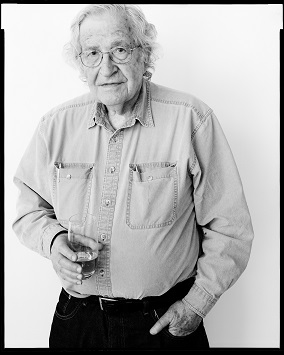
| When Michael Albert went to Poland in 1980, he
discovered that the Poles assumed there were two Noam Chomskys. "In
linguistics, he's the Freud," says Albert, Chomsky's editor at
Z Magazine and a friend since the
Sixties, when Albert, then a physics student, was organizing antiwar
protests at MIT. "All the branches of modern linguistics stem from his
work. And for over a quarter century his political analysis has
inspired the peace movement. The Poles had no idea that one person
could do all that."
Maintaining two full-time careers has required sacrifice, of
course. On a recent Saturday Night Live, as an obvious plug,
one of the actors carried a copy of The Chomsky Reader
throughout a skit. Albert telephoned Chomsky to say, "Hey, you're on
television!" and found himself having to explain what Saturday
Night Live is. So Chomsky doesn't know anything about popular
culture. He doesn't watch TV. He doesn't listen to rock & roll. He
goes to maybe one movie a year. He has little time for a private life.
What Noam Chomsky does know about is how the human brain creates
language. Consider for a moment that you are now reading and
understanding a sentence that you have never read or understood
before. Consider that you do this hundreds of times a day in exchanges
of information vastly more complicated than the last sentence. How can
such a high level of intelligence and creativity -- fully in
possession of the average person -- be explained? "There's only one
answer to that," says Chomsky. "It's built in. We're born with it. If
a smart Martian came to Earth, he would see that. He would see that
all human languages are the same. The trick is to find the fundamental
rules of all languages -- a formidable but reachable goal."
Chomsky has spent his academic career doing highly technical
research (anyone for finite automata theory?) in an effort to find
those rules, called fixed universals. He theorizes that what we are
born with is, roughly, a box of switches in the brain. The culture a
child is born into determines how those switches are set. In one
pattern the switches become Hungarian. In another, Urdu. In all
cultures, the switches start clicking around the age of two, and the
child will start producing original sentences much as he or she will
start producing secondary sexual characteristics at eleven. A
description of that box of switches will tell us a lot about how the
brain thinks, which has hitherto been almost a complete mystery.
One of the implications of Chomsky's work (it isn't proved yet) is
that human language and most behavior are "appropriate but uncaused,"
a highly heretical notion in the behaviorist wing of psychology. In
other words, we are born with an enormous, unpredictable capacity for
creativity, an "instinct for freedom [actually, a term of Bakunin's]."
This concept places Chomsky at the frontier of psychology, philosophy
and linguistics and square in the eighteenth-century tradition of the
Enlightenment -- Rousseau, the Cartesians and other ferocious
libertarians.
Believing that the best way to maximize our genetically endowed
freedom is through
anarchism, which he defines as "libertarian socialism," Chomsky
has been unrelenting in his attacks on the American hierarchy and the
nation-state in general. This has made him a prophet dishonored in his
own land. One of the most respected and influential intellectuals in
the world outside the United States, he is barely known to the average
American. His books are rarely reviewed in the major media or standard
academic journals. His essays appear only in small left-wing magazines
like Z (150 West Canton Street,
Boston, MA 02118). Network TV ignores him in favor of the General
Electric-approved weenies who appear on Sunday-morning talk shows.
When he is mentioned at all, he is usually smeared as a "self-hating
Jew" for his devastating criticism of Israel's treatment of the
Palestinians. He has left the New York Times in an especially
vulnerable spot: How to explain that one of the smartest people on
earth thinks the newspaper of record is a reeking pile of lies about
U.S. war crimes? Even worse, he proves it on a regular basis. With
footnotes. Well, there's just no explanation for such a thing, so the
paper ignores him.
Noam Chomsky was born December 7th, 1928, in Philadelphia. His
father, William, a Hebrew scholar, had emigrated from a small village
in the Ukraine to avoid the draft. His mother, Elsie, was also a
Hebrew scholar and a writer of children's books. By all accounts,
young Noam was highly precocious, and his parents had the foresight to
enroll him at an experimental progressive school. By the age of ten he
was writing editorials defending the anarchists in the Spanish civil
war. As a teenager he often took the train to New York to hang out at
his uncle's newsstand, where working-class Jewish radicals would
gather to discuss politics and literature. He got his Ph.D. in
linguistics from the University of Pennsylvania and since 1955 has
taught at MIT, where he has revolutionized his field several times. By
the early Sixties, Chomsky had a very pleasant life carved out for
himself: a house in the 'burbs, a young family he loved and fulfilling
scientific work. Then he noticed the Vietnam War and began speaking
against it long before it was physically safe to do so. He refused to
pay his taxes (a protest he continued until the mid-Seventies) and
helped to organize Resist, which counseled young men against the
draft. When Dr. Benjamin Spock was put on trial for just that, Chomsky
was an unindicted coconspirator. In 1967 he shared a jail cell with
Norman Mailer after a demonstration at the Pentagon. In The Armies
of the Night, Mailer noted that Chomsky, "although barely thirty,
was considered a genius at MIT." Mailer saw him then as "a slim
sharp-featured man with an ascetic expression, and an air of gentle
but absolute moral integrity." The description remains apt.
Now sixty-three, Chomsky maintains a grueling schedule. By day he
does his teaching and research. Several nights a week, in church
basements around the nation, he gives lectures on the evils of U.S.
foreign policy. In the isolated subculture of the genuine left, a
Chomsky lecture will galvanize the atomized and leave a residue of
moral energy for months. And he writes books faster than most of us
read them. A good place to start is The Chomsky Reader
(Pantheon), a collection of biting and often hilarious essays. His
latest book is
Deterring
Democracy (Verso), a stunning evisceration of U.S. policy toward
the Third World. If you prefer TV, you might try
Manufacturing Consent: Noam
Chomsky and the Media (Necessary Illusions, 10 Pine West, No. 315,
Montreal, PQ H2W 1P9), an excellent two-part video biography. And many
of his lectures are available on audiocassette (David
Barsamian, 1814 Spruce, Boulder, CO 80302).
Oddly, he does not consider himself a writer. "I don't practice any
craft," he insists. He says he hasn't even read his essay "The
Responsibility of Intellectuals," published in The New York
Review of Books (which won't touch him now) in 1967. It was
transcribed by a student from one of his off-the-cuff talks. Yet it
defined the peace movement as much as any document and pushed the name
Chomsky up there with Thoreau and Emerson in the literature of
rebellion. What is the responsibility of intellectuals? "To speak the
truth and expose lies."
QUESTION: Let's start with the title of your latest book,
Deterring Democracy. What do you mean by 'democracy,' what do our
rulers mean by 'democracy,' and why are they deterring what you mean
by 'democracy'?
CHOMSKY: Well, like most terms of political discourse, democracy
has two quite different meanings. There's the dictionary meaning, and
then there's the meaning that is used for purposes of power and
profit. According to the dictionary, you can say a system is
democratic to the extent that citizens have ways to participate in
some meaningful fashion in decisions about public affairs. That's not
a yes or a no matter. You have a lot of different dimensions in
different societies. In the ideological sense of democracy -- the
Orwellian sense, in which the word is actually used -- a society is
democratic if it's run by business sectors that are subordinated to
the business sectors that run the United States. If it has that
property, it's a democracy. If it doesn't, then it's not.
So, for example, Guatemala in the early Fifties was a capitalist
democracy in the dictionary sense of the word. In fact, it was one of
the most democratic governments in the Third World anywhere. It had
lots of popular support, there's no doubt about that. Read the CIA
analyses. One of the things they were worried about was that the
government had so much support. But Guatemala was following policies
of which the United States did not approve: independent nationalism,
domestic development, land reform and so on. This was harming the
interests of the elements that the United States regards as the
natural rulers -- they being the business classes that are linked to
U.S. corporations and the military, insofar as they follow U.S.
orders. Therefore the United States had to overthrow that government
in 1954 to safeguard what we call democracy.
Or Nicaragua in the Eighties, to take a more recent case. An
election occurred there in 1984, in fact, but not according to U.S.
ideology. In newspapers, in journals of opinion, there wasn't an
election. The first election was in 1990. In historical reality, there
was one in 1984. There has probably never been an election in history
so closely investigated. The Latin American Studies Association, the
professional association of Latin American scholars, did its first
detailed analysis of any Latin American election. The Dutch
government, which is very reactionary and pro-American, sent a
delegation. The Irish parliament sent a delegation. Masses of
observers. And the general conclusion, even by the most reactionary of
them, was that this was a pretty effective election.
QUESTION: I recall reading arguments in Z Magazine that
there was more democracy in Nicaragua than there is in the United
States during most presidential elections.
CHOMSKY: In the dictionary sense, that is certainly arguable. In
the formal sense -- did the voting machines work and so on -- it
doesn't compare with the U.S. It's a Third World country. But it is
quite common in Third World countries for there to be a broader range
of choice than in the United States. That's because we have a
democracy in the Orwellian sense. The government doesn't come in and
stop candidates, but the breadth of choice is very narrow. Which is
what we call an efficient democracy.
Anyhow, that election in 1984 did not take place, because it did
not satisfy the condition that the U.S. could determine the outcome.
In fact, the U.S. tried to disrupt the election in every possible way.
The contras, who were just a terrorist force run by the U.S., did what
they could to disrupt it. And did. They attacked polling booths and so
forth. There was a U.S. candidate, a banker who had spent most of his
life in the U.S. According to the press here, he was the popular
candidate. There was no evidence for that. When it was clear he wasn't
going to win, he was induced to withdraw. He was on the CIA payroll,
it later turned out. And then the press here says, "Oh, there was no
election, the major candidate withdrew." It was pooh-poohed as not a
real election, which made it legitimate to go on attacking Nicaragua.
Somoza didn't bother us, but this bothered us.
Then when the 1990 election came along, the country had already
been driven into total misery. It had been virtually ruined by the
combination of contra attacks and economic warfare that was probably
even more lethal. When Nicaragua announced the election, the White
House announced pretty clearly that a vote for the U.S. candidate
would mean an end to economic strangulation.
Meanwhile, in violation of the agreement of Central American
presidents that the U.S. terrorist forces should be disbanded, we
continued to maintain the contras. This was called "humanitarian aid,"
which the World Court had already ruled was military aid. But that was
only the World Court. And again we have the Orwellian question of what
is law and what isn't. So we made it clear that the contras would
continue their terrorist attacks unless the population voted our way.
And then under conditions of terrorist attack and economic
strangulation, an election took place. They voted George Bush's way,
so that was an election. You can argue about why they did it. But the
White House made it clear: "If you vote our way, you'll survive. If
you vote the other way, Ethiopia will look good in comparison."
Therefore, that was a free election. And the first one, which the U.S.
could not control, wasn't a free election. Incidentally, there was
something like unanimous agreement on this in the United States across
the articulate spectrum.
QUESTION: Everyone from Michael Kinsley to Patrick Buchanan, the
full range of opinion, from left to right.
CHOMSKY: Anthony Lewis. Everybody was just euphoric about the
outcome of this democratic election. The New York Times was
particularly funny. They had a headline saying, AMERICANS UNITED IN
JOY -- the kind of headline you'd see in some weird, exotic,
totalitarian state, like Albania. Maybe. Another headline said,
VICTORY FOR U.S. FAIR PLAY, meaning, "Vote our way or you die."
So you take your choice. Which language are you going to talk --
English or Orwell? Orwell himself didn't have the imagination to think
of these things.
QUESTION: Well, Nineteen Eighty-four was as much about the
United States and England as it was about Stalinist Russia.
CHOMSKY: He may have meant it that way, but the only reason he
became admired was that you could interpret both Nineteen
Eighty-four and Animal Farm as being just about the Soviet
Union. That made him acceptable.
QUESTION: Do you get sick when some far-right ideologue like Norman
Podhoretz cites himself as being in Orwell's tradition of standing up
to power and seeing through propaganda?
CHOMSKY: Given the part of Orwell that Podhoretz is talking about,
he isn't being completely unrealistic. He's interested in the part of
Orwell that was condemning the official enemy. But you might just as
well say that Podhoretz is in the tradition of every Soviet commissar.
Any Soviet commissar would condemn U.S. crimes. In fact, you could
read Pravda and have tears rolling down your cheeks at the
terrible treatment of blacks in the American South or American crimes
in Indochina. They're just terribly emotional about U.S. crimes. Just
as Norman Podhoretz is terribly emotional about their crimes.
But honest people, whether in the Soviet Union or here, will care
about the crimes of the state that they are a part of and for which
they bear some responsibility. We understand this when we talk about
the Russians. We don't honor Russian party hacks who condemn American
crimes. We honor Soviet dissidents who condemn Soviet crimes. Except
we don't apply that same logic at home. That would be inconceivable.
That would be rational. And honest. And if you're rational and honest,
you're pretty much excluded from the educated classes, from the
privileged classes. Those are properties that are very dangerous.
QUESTION: If you read the standard conservative columnists, they're
very consistent about taking anything that connotes good and
attributing it to power and anything that connotes bad and attributing
it to the poor or some other scapegoat.
CHOMSKY: Yes, it's very consistent. And it's the exact analogue of
what you find in Pravda in the days of Stalin. But in the
Soviet Union under Stalin, you could sort of understand why somebody
would be a party hack or else shut up. It was just too dangerous. Try
to be an honest person, you end up in the gulag. Try to be an honest
person in the United States, nothing much will happen to you.
QUESTION: Here, they make you poor.
CHOMSKY: And they can vilify you. There's a penalty involved. But
it's nothing like being tortured or murdered. Here, it's a lot easier.
That means the people who don't do it here, particularly the
privileged ones, are at a much lower moral level than the worst
commissars under Stalin.
QUESTION: Why is there less murder and torture here? If you look at
Central America, our leaders are plainly capable of it. My
interpretation of the Sixties -- events like Kent State, the
assassination of Fred Hampton of the Black Panthers, the framing of
Geronimo Pratt -- is that those events were meant to send the message
that the death squads can operate here, too.
CHOMSKY: You have to understand the nature of American society.
There was assassination of Black Panthers. The worst case I know of
was the assassination of Fred Hampton. It's striking that they would
pick him. The Panthers, like a lot of groups that come out of the
ghetto, were a very mixed group. They ranged from ordinary thugs to
serious organizers who were regarded as a real threat. Fred Hampton
was an effective organizer in the Chicago ghetto. He was one of the
main targets of the FBI terror campaign, and they ended up killing him
with the cooperation of the Chicago police department after an FBI
setup. But you'll notice nobody cared about that. For example, that
didn't come up in the Watergate hearings. Nobody said to Richard
Nixon, "Wait a minute, you organized the Gestapo-style assassination
of an organizer in the ghetto." What they said in the Watergate
hearings was: "You called a powerful guy a bad name. The Constitution
is collapsing."
So Fred Hampton could be assassinated. But privileged whites did
not get assassinated, even ones who were very outspoken. That reflects
the nature of American society. It is not a totalitarian state. It is
a very free society that is off toward the capitalist end of the
spectrum. It's not pure capitalist society, of course. Such a society
couldn't exist for a week.
QUESTION: Don't you think that if the left ever gets its act
together in the Nineties, we'll see more of that sort of government
activity?
CHOMSKY: No, I don't think so.
QUESTION: Not like
COINTELPRO?
CHOMSKY: Well, COINTELPRO, yeah. COINTELPRO was differentiated.
COINTELPRO directed against blacks was murder. Against whites it was
disruption, defamation, circulating stories about sexual conduct,
things like that. That was a big difference, and the difference had to
do with who is privileged and who is not privileged. In our society,
people with power and wealth are relatively free. Freedom is a
commodity, like anything else in capitalist society. You have as much
of it as you can buy. And if you're wealthy and the right color, you
can buy a lot. The privileged people who actually run the country,
they don't want the state to have power to go after people like them.
So they'll actually protect the civil rights of people they hate if
they come from the right class.
QUESTION: Do you ever wonder about the psychology of these American
commissars? You've written about the filtering process by which the
obedient rise to the top and the disobedient end up elsewhere, but I
wonder what goes on in their heads.
CHOMSKY: I don't think it's that hard to figure out. All the people
I've ever met, including me, have done bad things in their lives,
things that they know they shouldn't have done. There are few people
who say, "I really did something rotten." What people usually do is
make up a way of explaining why that was the right thing to do. That's
pretty much the way belief formation works in general. You have some
interest, something you want, and then you make up a belief system
which makes that look right and just. And then you believe the belief
system. It's a very common human failing.
Some people are better at it than others. The people who are best
at it become commissars. It's always best to have columnists who
believe what they're saying. Cynics tend to leave clues because
they're always trying to get around the lying. So people who are
capable of believing what is supportive of power and privilege -- but
coming at it, in their view, independently -- those are the best.
The norm is that if you subordinate yourself to the interests of
the powerful, whether it's parent or teacher or anybody else, and if
you do it politely and willingly, you'll get ahead. Let's say you're a
student in school and the teacher says something about American
history and it's so absurd you feel like laughing, I remember this as
a child. If you get up and say: "That's really foolish. Nobody could
believe that. The facts are the other way around," you're going to get
in trouble.
QUESTION: Do you remember the fact you came up with?
CHOMSKY: Well, this happened so often. I got thrown out of
classes...not a lot...I don't want to suggest it was any real...there
are people who did it constantly, and they end up as behavior
problems. You raise too many questions, you ask for reasons instead of
just following orders, they put you in certain categories:
hyperactive. Undisciplined. Overemotional. It goes all through your
education and professional life. A journalist who starts picking on
the wrong stories will be called in by the editor and told: "You're
losing your objectivity. You're getting a little too emotionally
involved in your stories. Why don't you work in the police court until
you get it right?"
That does start in childhood. If you quietly accept and go along no
matter what your feelings are, ultimately you internalize what you're
saying, because it's too hard to believe one thing and say another. I
can see it very strikingly in my own background. Go to any elite
university and you are usually speaking to very disciplined people,
people who have been selected for obedience. And that makes sense. If
you've resisted the temptation to tell the teacher, "You're an
asshole," which maybe he or she is, and if you don't say, "That's
idiotic," when you get a stupid assignment, you will gradually pass
through the required filters. You will end up at a good college and
eventually with a good job.
QUESTION: To me the question is, Why is that one kid more resistant
to lying to get ahead? There is such a thing as moral courage. Some
people have it and some don't.
CHOMSKY: There are individual differences which we don't
understand. Just like we don't understand why some people like math
and some people like rock & roll. Fortunately for the human race,
people are very different from one another. If we were all alike, life
wouldn't be worth living. Probably a lot of the differences are
genetically determined. Some of them have to do with the effect of
early training on your genetic endowment. There are all kinds of
reasons. Nobody understands a word of this, so you can speculate or
have any intuition you like.
On the other hand, there are some things that if we're honest, I
think we'll recognize. One of them is the capacity to form beliefs
that are self-serving and then to believe those beliefs. If that's a
major feature of your intellectual makeup, chances are you'll go far.
Take that issue of the New York Times Book Review (October
20th, 1991) and look at the review of the James Reston memoir. It says
this was a man that everybody admired, had an independent eye, hated
the Vietnam War and so on and so forth. The fact of the matter is,
James Reston made a career out of having lunch with Dean Acheson and
writing a column the next day from what Dean Acheson told him to say.
And that was called an "insider's scoop." Very profound. As for hating
the Vietnam War -- he loved it. He was writing articles about how we
were defining the principle that no people should be subjugated to
anyone else. And our Creator endowed us with that destiny. The most
embarrassing trash. But it doesn't matter. I'm sure whoever the
reviewer was believes everything he was saying. And if he didn't
believe it, he wouldn't be the reviewer.
QUESTION: It was Fred Barnes of The New Republic.
CHOMSKY: I don't know him. Maybe he thought he was telling the
truth. Maybe he didn't. Maybe he's laughing.
QUESTION: You've never watched him on the Sunday talk shows?
CHOMSKY: No, I'm afraid I can't tolerate that. I wouldn't know him
from Adam. Without knowing him, I suspect he believes it. My point is,
the only people who make it to where they will be allowed to express
themselves in that august medium are the ones who have already
demonstrated their own subordination to power.
There are some journalists, I should tell you, who are very well
aware of this and are trying to work within a system of power and
authority that they understand very well. You know people like that.
And I know people like that. I think it's very honorable to see what
can be done within the institutions, despite their hierarchical,
authoritarian structure.
QUESTION: During every election you read these heart-rending
editorials about why it's so important to vote for whatever office
happens to be on the ballot. Yet no one ever asks the question of why,
if it's such a great idea to vote for your senator, it would not be an
even greater idea to vote for your boss.
CHOMSKY: No, that's out. A crucial part of the ideology is that
you're allowed to criticize Congress, the president, local
politicians. You're allowed to say they're all crooks. But you're not
allowed to say that the corporate system is at the heart of it all. In
fact, you're not even allowed to see that. No, the idea of voting for
your boss is just off the agenda.
But if you really believed in eighteenth-century libertarian
doctrine, the doctrine of the Founding Fathers, that's just what you'd
be asking. They were not just opposed to a powerful state. They were
opposed to concentrations of power. It happened back in their day that
the concentrations of power that were visible were the state and the
feudal system and the church, so that's what they were against.
In the nineteenth century a new concentration of power came along
that they hadn't paid a lot of attention to, namely corporate power;
that had a degree of influence and domination over our lives well
beyond what the Founding Fathers could have foreseen. Yet their
principles would lead you to ask exactly that question: Why should we
be subordinated to the boss? Why should investment decisions be in
private hands? Why should private power determine what is produced and
what is consumed and what are working conditions? Why should you
follow orders? Why shouldn't everybody participate democratically and
decide what is to be done?
QUESTION: Whenever the Times or any other newspaper writes
about the destruction of the ozone layer, they present it as this
unavoidable tragedy, like an earthquake or a hurricane. Yet the
chemistry of what chlorofluorocarbons do to ozone molecules has been
known since 1973. Du Pont and our political rulers have been
stonewalling, and now we're in a situation where hundreds of thousands
of people are going to die of skin cancer and get cataracts. If these
chemicals had been manufactured in Eastern Europe, we'd surely be
blaming communism. But the idea that capitalism did this to us...
CHOMSKY: Did this in its natural workings. Not out of corruption.
It did it because what drives the system, and what's supposed to drive
the system, is tomorrow's profit. People who think about long-term
effects are out of the system, by its very nature. And that's supposed
to be a good thing. In the economics literature, future lung cancers
are called an "externality." It doesn't show up in the market system.
When you're selling chemicals, you're supposed to be maximizing profit
for the stockholders. And if you're not doing that, it's immoral. You
don't maximize profit by worrying about people getting cancer in
twenty years. If you do worry about that, you won't be chairman of the
board very long. That's the way the system is built, and it's admired
because of that property. Ask Milton Friedman. If Du Pont had started
to worry about the ozone layer and had shifted their resources to deal
with it, somebody else could well have driven them out of business.
That's the nature of the system.
This is not a very profound comment. A twelve-year-old can
understand it. But they better not. Just like they better not
understand that there's a question about why you shouldn't be allowed
to vote for your boss. Why have a boss at all? Why not have collective
decision making? Nobody's shown that it can't work. Take any
successful scientific enterprise -- and MIT is one -- people work
together. I taught a class yesterday, and I was standing up front and
the students were down there, but they were telling me things as much
as I was telling them things. And they come in afterwards and tell me
that I'm wrong. And then we try to figure it out. That's the way that
you make progress. It's just taken for granted. If we had a system in
which I was telling them what to think and they were not allowed to
tell me when they thought I was off the wall, we would have nonsense.
QUESTION: What is the practical difference between an anarchist and
a Marxist? The wisdom of having a vanguard party?
CHOMSKY: I'm completely opposed to that. First of all, Marxism, in
my view, belongs in the history of organized religion. In fact, as a
rule of thumb, any concept with a person's name on it belongs to
religion, not rational discourse. There aren't any physicists who call
themselves Einsteinians. And the same would be true of anybody crazy
enough to call themselves Chomskian. In the real world you have
individuals who were in the right place at the right time, or maybe
they got a good brain wave or something, and they did something
interesting. But I never heard of anyone who didn't make mistakes and
whose work wasn't quickly improved on by others. That means if you
identify yourself as a Marxist or a Freudian or anything else, you're
worshipping at someone's shrine.
If the field of social and historical and economic analysis was so
trivial that what somebody wrote a hundred years ago could still be
authoritative, you might as well talk about some other topic. But as I
understand Marx, he constructed a somewhat interesting theory of a
rather abstract model of nineteenth-century capitalism. He did good
journalism. And he had interesting ideas about history. He probably
had about five sentences in his entire body of work about what a
postcapitalist society is supposed to look like. Insofar as he has a
legacy of actual policy and organizing, that's Leninist, which is
probably the most reactionary wing of Marxism. Lenin was a pretty
orthodox Marxist and, as I read him, never really believed that
socialism was possible in Russia. The iron laws of history mandated
that it come about in the advanced industrial societies. In fact, he
and Trotsky moved very quickly to squash and destroy the socialist
tendencies in the Russian Revolution: factory councils, anarchist
worker organizations.
Lenin's idea was that you have a group of revolutionary
intellectuals, who are the smart guys, and they're to drive the
society to a better future, which the Slavs are too dumb to
understand. That's basically the idea, which is not all that different
from the ideology of capitalist democracy. You can almost interchange
them. If that's Marxism, we ought to be very much opposed to it. In my
view,
socialism was dealt an enormous blow in Russia in 1917, from which
it has yet to recover.
QUESTION: You once pointed out how it was in the interest of both
the United States and the Soviet Union to claim that what was going on
there was socialism.
CHOMSKY: Oh, yeah. Very much in their interest. For the U.S. it had
the obvious purpose of defaming alternatives to capitalist autocracy.
And for the Soviet Union it had the benefit of giving the moral appeal
of socialism, which was enormous. So for both power systems it was
very utilitarian to propagate this outlandish lie that the Bolshevik
revolution was socialist. If socialism means anything, it means worker
control over the means of production and decision making. That's the
minimum.
QUESTION: Have you ever thought about giving up? A lot of my
friends have concluded that people are just sheep. I say that if
that's so, we might as well join the Republicans, steal as much money
as possible and live comfortably.
CHOMSKY: If there's nothing to be done. Well, we don't know if
there's anything to be done or there isn't. Outside of science, nobody
knows a lot about anything. Especially when it comes to human beings,
we know almost nothing except what you feel intuitively or what your
experience tells you. But if you look over history, you can see
definite improvement in the past twenty or thirty years. I think
there's been a cultural revolution in this country, and people in
power are scared to death of it.
That's why there's all this comical stuff about political
correctness. It's a kind of joke; it's so silly. Here are people who
have run the ideological system with an iron hand, and then in some
literature department somewhere, somebody says something that isn't
orthodox, and they go crazy. I must have read 200 articles about this
new orthodoxy taking over the universities, destroying the golden age
of absolute freedom of speech. I haven't read one article defending
it. If this is an orthodoxy that has taken over everything, how come
everybody is attacking it? To the simple mentality of a commissar,
this idea won't occur.
This stuff about the quincentennial is interesting in this respect.
There's a big fuss now about the "left fascists," who are dumping on
Columbus and denying all the wonderful things Columbus brought. What
they're saying is, for 500 years we went along, denying two of the
worst acts of genocide in human history, maybe the worst act -- the
destruction of the Native Americans, which was tens of millions of
people -- and the destruction of large numbers of Africans through the
slave trade, both of which got their start through Columbus. We've
been celebrating genocide for 500 years, and that's not a problem. The
problem is that the left fascists are now reversing it.
Anyone with a gray cell ought to be saying, "Thank God the left
fascists are taking over and trying to get this straight." Virtually
no one is saying that, of course. Our more educated circles are as
retrograde as they ever were. That the controversy is taking place now
is a reflection of a very substantial improvement in the cultural
climate.
QUESTION: Is that the true legacy of the Sixties?
CHOMSKY: The Sixties left an enormous legacy. Do you think there
would have been a word of protest about the quincentennial if it
hadn't been for the Sixties? Would there have been one person who
stood up for Anita Hill and said, "This is a form of sexual
harassment"? That's why everyone hates the Sixties. It might lead to
real democracy. There was a phrase for it in the Seventies. It was
called "the crisis of democracy." The crisis was that people weren't
apathetic and passive anymore. They'd become organized and were trying
to do something. This was the liberals, incidentally, who wrote the
book
The Crisis of Democracy, the people around Jimmy Carter, the
Trilateral Commission.
The important aspect of the Sixties to understand is that the
heroes were mostly people you never heard of: the Freedom Riders, the
SNCC workers, the guys who were down there week after week getting
their heads bashed in for organizing. In the Vietnam movement there
was never any illusion about leadership. The leadership was whoever
showed up. We're not allowed to understand that now. We are meant to
think of popular movements as things that grow out of individual
leadership and individual charisma. The reason we are meant to think
that is that it disempowers people. It makes them think they can't do
anything for themselves.
QUESTION: I'd like to ask you about another of your detractors.
When Bill Moyers interviewed Tom Wolfe on PBS, Wolfe accused you of
subscribing to the "cabal" theory of capitalism. In Deterring
Democracy you refer disparagingly to his description of the Reagan
era as "one of the great golden moments that humanity has ever
experienced."
CHOMSKY: For people at his income level, that's quite true. In my
view, it was crucially responsible for -- not 100 percent -- the
catastrophe of capitalism that just devastated the Third World in the
Eighties. It was what they call the "lost decade" in the Third World.
Tens of millions of people suffering and dying. In just the years 1980
to '88, South African terror around its borders, supported by the
United States, was responsible for about a million and a half people
killed. If you count up the children who died of malnutrition as
income levels dropped, you get a real monstrous toll. It's bad enough
what happened in the United States, if you look at any group other
than the privileged. If you add all that up, it's been a very ugly
period. A person who could call that one of the golden moments in
history... well, take Germany in 1939. A person who could call that
one of the golden moments in history, we'd know what to think of him.
QUESTION: Did you read Paul Johnson's book Intellectuals?
CHOMSKY: It was quite comical. He concludes there that my
opposition to the Vietnam War was deduced from syntax. He literally
says that. You have to be technically insane to be able to say a
phrase like that.
QUESTION: I'd like you to respond to one quote from it: "Throughout
the 1960s, intellectuals in the West...became increasingly agitated by
American policy in Vietnam, and by the growing level of violence with
which it was executed. Now therein lay a paradox. How came it that, at
a time when intellectuals were increasingly willing to accept the use
of violence in the pursuit of racial equality, or colonial liberation,
or even by millenarian terrorist groups, they found it so repugnant
when practised by a Western democratic government to protect three
small territories from occupation by a totalitarian regime?"
CHOMSKY: Who were we saving it from? We attacked South Vietnam.
There were no Russians, no Chinese, weren't even any North Vietnamese
in the beginning. We attacked South Vietnam. That's saving? We brought
Cambodia into the war by attacking it. We attacked Laos. For the sake
of argument, let's forget that North Vietnam is Vietnam. Let's even
forget that the government he says we were defending, Saigon, claimed
that Vietnam was one indivisible country -- that was article 1 of the
constitution that the United States wrote for them. Let's forget all
that stuff, and let's pretend that North Vietnam was the most
monstrous society in history. We were attacking South Vietnam. As a
commissar and party hack, Paul Johnson can't see that. He's not alone.
Nobody can see it. The fact that the
United States attacked South Vietnam, though trivially true, is
just not a part of consciousness.
I remember a couple of weeks ago in the New York Times Book
Review, there was a review of a book by Zalin Grant, a book about
a Vietnamese collaborator. It was very laudatory about this man. He
had collaborated with the French. Then he collaborated with the
Americans. According to the book, around 1961 or 1962 he devised a
technique by which the United States client regime sent out death
squads to murder political organizers for the Viet Cong. These were
called "counterterror teams." Talk of the level of perversity here. We
invade another country. We set up a puppet government which everyone
admits had no popular support. We send out death squads to kill their
political organizers in their country, and our death squads are called
counterterrorists. That appears in the New York Times, and
nobody bats an eyelash. That says a lot about our intellectual
culture. Against this background, Paul Johnson can write such perfect
nonsense, mirroring his models in Stalinist Russia and Nazi Germany.
And Norman Podhoretz will think it's fine.
QUESTION: Do you vote?
CHOMSKY: I tend to vote down at the lower levels, local officials,
state representatives. Occasionally, I vote for president. I did vote
against Ronald Reagan.
QUESTION: You voted for Walter Mondale?
CHOMSKY: I voted for whoever was running against Reagan. The
Democrats could have nominated Charlie McCarthy, and I would have
voted for him over Ronald Reagan and George Bush, because they're
dangerous people. Well, not so much they themselves. Ronald Reagan
wasn't president. It was a dirty secret that the reporters kept for
eight years. During the Iran-contra hearings the Democrats were kind
of surprised to discover that the president lied and nobody cared.
That's because the population is sane. What difference does it make if
this pathetic clown was told, or remembered, what the policy was. He
wasn't supposed to know what was going on. He was supposed to show up
now and then and read his lines. Maybe they told him, maybe they
didn't. There could hardly be an issue of less significance.
But the point is, the people around him were extremely dangerous.
They call themselves
conservatives, which is nonsense. They're radical statists. They
believe in a very powerful and violent and obtrusive state.
QUESTION: Do you have any wisdom on the current election campaign?
CHOMSKY: It's like one of the worst Third World elections. Take
Honduras. Literally. They always have two rich guys with the same
program, and the campaign consists of insults and comedy and circuses.
There isn't any pretense of public involvement.
QUESTION: The only thing I like about Clinton is that he evaded the
draft, and they're using that to nail him.
CHOMSKY: The one sensible thing that Clinton did in his entire
life, and he's unwilling to stand up for it. It reminds me of Dukakis
and the ACLU. The most shameful PR initiative in '88 was that line
about Dukakis being a "card-carrying member of the ACLU," which
implies that if you're in favor of the Constitution, you're a
Communist. And Dukakis wouldn't say that. All he would say is: "No,
I'm not really a member of the ACLU. I don't really believe in the
Constitution." That was his only response, and that's what this thing
is like. I have a feeling that the Democrats can't compete on this
one. They're both business parties, but the Republicans make no claim
of being anything else. The Democrats have all these pretenses about
being the party of the people, and that keeps them so confused that
they can't win these propaganda wars.
QUESTION: Will you bother to vote in November?
CHOMSKY: There is an issue that would make me vote -- the prospect
of another four years of court packing with ultraright jurists who
hate civil rights. The court system has collapsed. The ACLU will
simply not take cases to the federal courts anymore. Another four
years of this will institute -- I'm not joking -- a fascist-style
legal system in which civil rights just don't exist. If there's
another issue, I can't find it.
QUESTION: The other night I was watching TV and a commercial came
on for shock absorbers. The slogan was "It's not just your car, it's
your freedom." I thought of you and your theory that people have an
"instinct for freedom." Madison Avenue and our politicians must
believe the same thing, because whenever they want to sell you shock
absorbers or beer or a war, they try to associate it with freedom.
CHOMSKY: Sure. They know that's what people want. Like everything
about human nature, you can't prove it. But in my experience and
intuition, that's correct. People want to be free, independent, not
oppressive, don't want to rob other people. I think most Americans
would be horrified if they knew what they were doing in the world. And
I think that's the reason for this whole edifice of lies.
It's an obvious question: Why don't our leaders tell the people the
truth? When they're going to destroy Iraq, say, why don't they
announce: "Look, we want to control the international oil system. We
want to establish the principle that the world is ruled by force,
because that's the only thing that we're good at. We want to prevent
any independent nationalism. We've got nothing against Saddam Hussein.
He's a friend of ours. He's tortured and gassed people. That was fine.
But then he disobeyed orders. Therefore, he must be destroyed as a
lesson to other people: Don't disobey orders."
Why don't they just say that? It has the advantage of being true.
It's much easier to tell the truth than to concoct all sorts of crazy
lies. Much less work. Why don't they say that? Because they know that
people are basically decent. In fact, that's the only reason for all
the fabrication. Our leaders believe that people are decent and that
there is hope. And I think they're right. In fact, the more distortion
and lies and deceit you hear, the more you know that people have an
instinct for freedom. |