
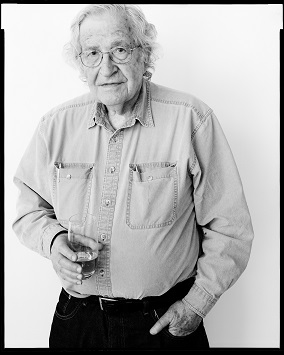
| Ever since the publication in 1957 of Syntactic
Structures, Noam Chomsky has been a towering eminence in
linguistics and the philosophy of language, and since the 1960s, he
has remained an astute and outspoken social critic Compositionists
familiar with Chomsky’s work only through his transformational grammar
and its compositional application, sentence combining may not be aware
of how profoundly Chomsky has influenced modern thought on language.
It would be fair to say that Chomsky’s scholarship over the last three
decades has forever altered our notions of the integral relationship
between language and the human mind. Especially noteworthy about
Chomsky’s positions as recorded in the interview below is that in this
age of social construction, meaning relativity, and Derridean
indeterminacy, Chomsky tenaciously contends that at the heart of most
human cognitive operations is a fixed, structured, biological
directiveness. In an age in which the preferred target of many
intellectuals is Plato, Chomsky serenely declares that “the reasoning
in the Platonic dialogues. . . is valid if not decisive,” and he holds
up “Plato’s problem’ as the key strategy for studying most phenomena
in the human sciences. Dismissing poststructuralist thought as
“uninteresting,” Chomsky notes that the question of indeterminacy is
not new, that “people have come at the question of indeterminacy from
many points of view,” and that it’s just part of the age-old
philosophic debate over the analytic/synthetic distinction. Yes, to a
certain extent “elements of fluidity and indeterminacy do enter,” he
concedes but also “there is a highly determinate, very definite
structure of concepts and of meaning that is intrinsic to our nature
and as we acquire language or other cognitive systems these things
just kind of grow in our minds, the same way we grow arms and legs.”
In fact, Chomsky complains of a “pernicious epistemological
dualism, in that “questions of mind are just studied differently than
questions of body.” Certainly, there is “an element of truth” to
theories such as the social construction of knowledge, but we seem, he
argues, to ignore the powerful evidence that “systems of knowledge in
particular [are] substantially directed by our biological nature.” For
example, if we want to study a physical phenomenon such as puberty,
“we allow our conception of rational inquiry to guide us, and it
guides us right to the study of innate structure”; if we want to study
meaning, “people don’t follow the same line of inquiry” even though
“the logic is the same.” Thus, Chomsky expresses frustration with the
current trend to dismiss out-of-hand all explanations of cognitive or
epistemological operations that rely on theories of innateness.
“That’s a very pernicious dualism,” he insists, “an extremely
dangerous version of traditional dualism.”
Chomsky also disputes Kuhn’s notion that scientific knowledge is
the ~, product of community consensus and periodically changes in
“paradigm shifts.” To Chomsky, there has been only one true scientific
revolution: “the Galilean revolution, the seventeenth-century
revolution stretching over a period including Galileo.” Even the
so-called cognitive revolution of the mid-1950s, of which generative
grammar was a major part, was only a recapitulation of changes that
first occurred in the seventeenth century, according to Chomsky.
What’s more, he argues, in many ways this second cognitive revolution
was a regression from advances made during the time of
Descartes. Thus, Chomsky is uncomfortable with talk of paradigm
shifts. About his own so-called Chomskyan revolution, he says, “It
seems to me like just normal progress.”
Chomsky also comments on a range of other issues relevant to
composition scholarship. While he supports the feminist movement, he
claims that there is nothing inherent in language that works to
reproduce patriarchal ideology; he agrees, though, that actual
language use tends to maintain structures of authority and domination.
He believes without question that “there’s a big degree of illiteracy
and functional illiteracy” in the nation and that the media, through
their insistence on “concision,” help to foster illiteracy, impose
conventional thinking, and block “searching inquiry and critical
analysis.” Chomsky applauds Paulo Freire’s liberatory learning
pedagogy and believes that “composition courses are perfectly
appropriate places” for helping students develop “systems of
intellectual self-defense and “the capacity for inquiry.”
Throughout the interview, Chomsky has much to say about teaching He
feels that teaching is “mostly common sense” and contends that “ninety
nine percent of good teaching is getting people interested.”
Paraphrasing nuclear physicist Victor Weisskopf’s teaching philosophy,
Chomsky says, “It doesn’t matter what you cover; it matters how much
you develop the capacity to discover.” However, he does believe that a
“sensible prescriptivism ought to be part of any education.” That is,
all students should master “standard English” even though “much of it
is a violation of natural law.” Although “a good deal of what’s taught
in the standard language is just a history of artificialities,”
students should learn it nonetheless because it’s part of our “rich
cultural heritage.” In keeping with his past statements denying the
relevance of linguistics to other disciplines, he doubts that
linguistics has anything to contribute to teaching reading and
writing.
Chomsky’s views on ideology, propaganda, and indoctrination are
also of interest to compositionists. He claims that intellectuals are
“ideological managers,” complicit in controlling “the organized flow
of information” because intellectuals are by definition those who have
“passed through various gates and filters” in order to become
“cultural managers.” In effect, “the whole educational system involves
a good deal of filtering towards submissiveness and obedience.” By
definition, those who are subversive or independent minded are not
called intellectuals but “wackos.” In fact, Chomsky is quite critical
of the distinction established between intellectuals—those in the
universities—and non-intellectuals. Arguing that often
non-intellectuals have a richer cultural life, he speaks disparagingly
of the principal activity that sets academics apart from others: “From
an intellectual point of view, a lot of scholarship is just very
low-level clerical work.”
In examining the media’s role in indoctrination, Chomsky says that
“the media’s institutional structure gives them the same kind of
purpose that the educational system has: to turn people into
submissive, atomized individuals who don’t interfere with the
structures of power and authority.” Similarly, democratic governments
use propaganda and “the manufacture of consent” in place of violence
and force to control the masses. “Indoctrination is to democracy,” he
philosophizes, “what a bludgeon is to totalitarianism.” This
atomization of individuals, this breakdown of independent thought, and
this general depoliticizing of society together create the perfect
environment, in Chomsky’s view, for a charismatic, fascist dictator to
seize power. “I think that’s one of the reasons why I’m very much in
favor of corruption.... A corrupt leader is going to rob people but
not cause that much trouble.... Power hunger is much more dangerous
than money hunger,” he argues.
Chomsky sees no contradiction between his somewhat radical
political views and his conservative, essentialist views on language.
In fact, he insists on separating his two (as he calls them) full-time
professional careers. He bristles at the criticism that he does not
apply his expertise as a linguist to the very same inequities that he
denounces as a social critic exploring how language helps maintain
power hierarchies, for example. Such questions, he claims, have no
intellectual depth and are of “marginal human significance.”
Infinitely more significant is helping Salvadoran peasants or
attending a demonstration in Washington.
Still, Chomsky’s political progressivism and philosophical
foundationalism seem oddly incongruous at first glance. He
confidently and steadfastly champions an eighteenth-century,
rationalist view of the world, while railing against state capitalism
and private ownership of the means of production. On second glance,
however, Chomsky’s world view is perhaps not so schizophrenic after
all. Just as his essentialist philosophy of innateness and biological
directiveness derives from eighteenth-century notions, especially
Humboldt’s concept of “infinite use of finite means” (from which grew
Chomsky’s generative grammar), so too does his political ideology
derive directly, as he puts it, from “classical liberalism—as
developed, for example, by Humboldt.” In the face of Marxists,
poststructuralists, and social constructionists, Noam Chomsky remains
unshaken—a devoted eighteenth-century rationalist.
Q. You have published an overwhelming number of works. Do you
think of yourself as a writer?
A. No, I’ve never particularly thought of myself as a writer. In
fact, most of what I’ve published is written-up versions of lectures.
For example, Syntactic Structures, the first book that actually
appeared, was essentially lecture notes for an undergraduate course at
MIT, revised slightly to turn them into publishable form. I would say
probably eighty or ninety percent of the work I do on political issues
is sort of working out notes from talks. Much of the material that
ends up as professional books is based on class lectures or lectures
elsewhere, so I tend to think out loud.
Q. So you see yourself first as a speaker, a lecturer.
A. The fact is that most of the writing I do is probably
letters. I spend about twenty hours a week, I guess, just answering
letters. Many of the letters are on questions that are in response to
the hundreds of letters that I receive which are thoughtful and
interesting and raise important questions (here’s today’s batch).
Hundreds go out every week, and that requires thought; some of them
are rather long. Those are actually written without being spoken.
Sometimes I do sit down and write a book, too, but most of the time I
don’t think of myself as a writer particularly.
Q. You have had a few words to say about your writing
process. In fact, you commented once, “I’m able to work in
twenty-minute spurts. I can turn my attention from one topic to
another without start-uptime. I almost never work from an outline or
follow a plan. The books simply grow by accretion.” Would you tell us
more about your writing process?
A. The reason for the twenty-minute spurts—which is a bit of an
exaggeration; maybe hour spurts would be more accurate—is just the
nature of my life, which happens to be very intense. I have two
full-time professional careers, each of them quite demanding, plus
lots of other things. I just mentioned one—lots and lots of
correspondence—and other things as well, and that doesn’t leave much
time. In fact, my time tends to be very chopped up. I discovered over
the years that probably my only talent is this odd talent that I seem
to have that other colleagues don’t, and that is that I’ve got sort of
buffers in the brain that allow me to shift back and forth from one
project to the other and store one.
Q. So you can’t when writing a book, for example, concentrate for
ten hours at a time.
A. No, I know that a lot of people don’t seem to be able to do
that, and it’s certainly an advantage to be able to do it. I can pick
up after a long stretch and be more or less where I left off. In fact,
I’ve sometimes had to. I have friends like this. I had, in particular,
one friend who just died a couple of years ago who was an Israeli
logician and who’d been an old friend since I was twenty or so. We
would meet every five or six years and usually pick up the
conversation we had been having as if we had just had it five minutes
ago and go on from there. As far as my books just sort of writing
themselves, that’s pretty much what happens. I don’t recall ever
having sat down and planned a book—except maybe for saying, “Well, I’m
going to talk about X, Y, and Z, and I’ll have Chapter One on X,
Chapter Two on Y, and Chapter Three on Z.” Then it’s just a matter of
getting the first paragraph, and it just goes on from there.
Q. That’s quite a talent.
A. Well, it’s probably because I’ve thought about most of it
before, or lectured on it before, or written a letter to someone about
it, or done it twenty times in the past. Then it becomes mainly a
problem of trying to fit it all in. I have discovered, if it’s
of any interest to you, that I write somewhat differently now that I
have a computer—quite a bit differently. I don’t know if it shows up
any different, but I know I write differently. I was very resistant to
the computer. I didn’t want to use it, and finally the head of the
department just stuck it in my room. My teenage son who was—like every
teenager, I guess—a super hacker carried me gently through the early
stages, which I never would have had the patience to do. Once I was
able to use the computer, I discovered that there were a lot of
things that I could do that I’d never done before. For example, I’d
never done much editing, simply because it was too much trouble; I
didn’t want to retype everything. And I never did much in the way of
inserting and rearranging and so on. Now I do a fair amount of that
because it’s so easy. Whether that shows up differently for the
reader, I don’t know. But I know I’m writing quite differently.
Q. As someone who is profoundly interested in the structure of
language as well as the use and abuse of rhetoric in political
contexts, you must have some thoughts about the nature of rhetoric.
For you, what are the most important elements of rhetoric?
A. I don’t have any theory of rhetoric, but what I have in the
back of my mind is that one should not try to persuade; rather, you
should try to layout the territory as best you can so that other
people can use their own intellectual powers to work out for
themselves what they think is right or wrong. For example, I try,
particularly in political writing, to make it extremely clear in
advance exactly where I stand. In my view, the idea of neutral
objectivity is largely fraudulent. It’s not that I take the realistic
view with regard to fact, but the fact is that everyone approaches
complex and controversial questions—especially those of human
significance—with an ax to grind, and I like that ax to be apparent
right up front so that people can compensate for it. But to the
extent that I can monitor my own rhetorical activities, which is
probably not a lot, I try to refrain from efforts to bring people to
reach my conclusions.
Q. Is that because you might lose credibility or lose the
audience?
A. Not at all. In fact, you’d probably lose the audience by not
doing it. It’s just kind of an authoritarian practice one should keep
away from. The same is true for teaching. It seems to me that the best
teacher would be the one who allows students to find their way through
complex material as you lay out the terrain. Of course, you can’t
avoid guiding because you’re doing it a particular way and not some
other way. But it seems to me that a cautionary flag should go up if
you’re doing it too much because the purpose is to enable students to
be able to figure out things for themselves, not to know this thing or
to understand that thing but to understand the next thing that’s going
to come along; that means you’ve got to develop the skills to be able
to critically analyze and inquire and be creative. This doesn’t come
from persuasion or forcing things on people. There’s sort of a
classical version of this—that teaching is not a matter of pouring
water into a vessel but of helping a flower to grow in its own way—and
I think that’s right. It seems to me that that’s the model we ought to
approach as best possible. So I think the best rhetoric is the least
rhetoric.
Q. In his critique of Western metaphysics, Jacques Derrida
exposed the indeterminacy of language, showing how meaning is never
fixed, always fluid, never certain. What are your thoughts on this
issue?
A. I don’t know this literature very well, and to tell you the
truth, the reason Idon’t know it is that I don’t find it interesting.
I try to read it now and then but just don’t find it very interesting.
People have come at the question of indeterminacy from many points of
view, and Ithink there’s an element of truth to it, but there’s also a
respect in which it’s not true. These are questions of fact, not of
ideology; therefore, there’s no grounds for dogmatism concerning them,
and they’re not a matter of pronouncements but of discovery. To the
extent that we understand things about language, the facts point
rather clearly, rather clearly, to a specific conclusion which
is halfway like that, but only halfway. What we find is that there is
a highly deterministic, very definite structure of concepts and of
meaning that is intrinsic to our nature and that as we acquire
language or other cognitive systems these things just kind of grow in
our minds, the same way we grow arms and legs. To that extent, meaning
is determinate. However, there’s a sense in which it’s not fully
determinate, and that is the way we use these conceptual and, in
particular, these rich semantic structures in our interactions with
one another and our interactions with the world. In that domain,
there’s a high degree of interest-relativity, intrusion of value,
relativity to purposes and intentions, modifiability often in a
somewhat rather creative fashion, and so on. At that level it’s true
that elements of fluidity and indeterminacy do enter; however, they
have their own structure. It’s just that we don’t understand very much
about it. So Ithink there’s an element of truth to that but it can be
carried much too far.
In the philosophical literature—those parts of it that I feel more
comfortable with and where I think I understand what people are
talking about—similar ideas arise in the study of what’s called
“meaning holism.” Take Hilary Putnam as an example, someone who’s
extended views originally due to Quine towards a general theory of
semantics which would express a viewpoint related to this—namely, that
the meaning of a word is never determinate (it’s certainly not
something in the mind), and if it’s not determinate then it depends on
the place of the concept within the whole intellectual structure, and
it can change, your beliefs change, the meanings change, and so forth;
that is, the intentions change, the meaning may be modified, and soon.
Well, I think that this thesis is half true. In the same
respect, there is a fixed structure of meaning and it’s an
interesting one, a very intriguing one. In fact, contrary to what is
believed by many people—for example, Richard Rorty—there are strong
empirical grounds for believing that there is quite a sharp
analytic/synthetic distinction that derives from intrinsic semantic
structures and is just a reflection of the fact that there are
probably biologically determined and quite rich and intriguing
semantic structures that are basically fixed. But there’s a sense in
which meaning holism is correct; that is, what we describe as meaning
in common-sense discourse, and in philosophical discourse, is never
fixed entirely by the structures that are present in the mind and
we’ve gotten that way because that’s the kind of creature we are. So
in that sense there’s some truth to meaning holism.
Q. So you probably wouldn’t agree with Bakhtin. Are you familiar
with hi~ work?
A. No, I’m not.
Q. His ideas sound very similar to this concept of meaning
holism.
A. Yes, but that’s the standard view. That’s the view of Derrida
to the extent that I understand him, but also of a large sector of
analytic philosophy and again, Richard Rorty. Donald Davidson, for
example, whom Ron’ quotes, argued—actually, I should say
“asserted”—that Quine’s demolition of the analytic/synthetic
distinction, his demonstration that this distinction doesn’t hold,
created the modern philosophy of language as a serious discipline.
Well, the analytic/synthetic question is a technical one but the point
is the same. If there were determinate meanings, there would be an
analytic/synthetic distinction. So the domain in which this issue is
fought out in philosophical terrain is over the analytic/synthetic
issue, but the real question is whether there are fixed, determinate
meanings. Doe the word house have a determinate meaning or can
it vary arbitrary depending on the way our belief systems vary? I
think the answer is right in between. There’s a fixed and quite rich
structure of understanding associated with the concept “house” and
that’s going to be cross-linguistic and it’s going to arise
independently of any evidence because it’s just part of our nature.
But there’s also going to be a lot of variety in how we us that term
in particular circumstances, or against the background of particular
kinds of theoretical understanding, and so on.
Q. Some thinkers draw on Rorty’s work to posit that knowledge
itself is a socially constructed artifact. That is, knowledge is not
absolute; rather, it is the product of consensus within any
given discourse community. This concept is related to Kuhn’s notion of
how knowledge is formed within the scientific community. What are your
thoughts about this theory?
A. There is an element of truth to it, obviously. There is no
doubt that the pursuit of knowledge is often, not always, but is
often—in fact, typically—a kind of communal activity. In particular,
that’s true of organized knowledge, say research in the natural
sciences, say what we do in this corridor; that’s obviously a social
activity. For example, a graduate student will come in and inform me I
was wrong about what I said in a lecture yesterday for this or that
reason, and we’ll discuss it, and we’ll agree or disagree, and maybe
another set of problems will come out. Well, that’s normal inquiry,
and whatever results is some form of knowledge or understanding;
obviously, that’s socially determined by the nature of these
interactions. On the other hand, most domains we don’t understand much
about—like how scientific knowledge develops, something we basically
understand nothing about—but if we look more deeply at the domains
where we do understand something, we discover that the development of
cognitive systems, including systems of knowledge in particular, is
substantially directed by our biological nature. In the case of
knowledge of language, we have the clearest evidence about this. Part
of my own personal interest in the study of language is that it’s a
domain in which these questions can be studied much more clearly, much
more easily than in many others. Also, it’s one intrinsic to human
nature and human functions, so it’s not a marginal case. There, I
think, we have very powerful evidence of the directive effect of
biological nature on the form of the system of knowledge that arises.
In other domains like, for example, the internalization of out
moral code, or our style of dress, we just know less. But I think the
qualitative nature of the problem faced strongly suggests a very
similar conclusion: a highly directive effect of biological nature.
When you turn to scientific inquiry, again, so little is known that
everything that one says is virtually pure speculation. But I think
the qualitative nature of the process of acquiring scientific
knowledge again suggests a highly directive effect of biological
nature. The reasoning behind this is basically Plato’s, which I think
is quite valid. That’s why it’s sometimes called “Plato’s problem.”
The reasoning in the Platonic dialogues, which is valid if not
decisive, is that the richness and specificity and commonality of the
knowledge we attain is far beyond anything that can be accounted for
by the experience available, which includes interpersonal
interactions. And, besides being acts of God, that leaves only the
possibility that it’s inner-determined. That’s the same logic that’s
constantly used by every natural scientist studying organic systems.
So, for example, when we study, metaphorically speaking, physical
growth below the neck, everything but the mind, we just take this
reasoning for granted. For example, let’s say I were to suggest to you
that undergoing puberty is a matter of social interaction and people
do it because they see other people do it, that it’s peer pressure.
Well, you laugh, just as you’re laughing now. Why do you laugh?
Everyone assumes that it’s biologically determined, that you’re
somehow programmed to undergo puberty at a certain point. Is it that
something is known about that biological program? Is that why you
laugh? No, nothing’s known about it. In fact, we know a lot more about
the acquisition of meaning and the fixed factors in that than we do
about the factors that determine puberty. Is it that social factors
are irrelevant to puberty? No, not at all. Social interaction is
certainly going to be relevant. Under certain conditions of social
isolation, it might not even take place. Why do people laugh? That’s
the question.
Q. What about knowledge in a particular field, say linguistics?
You came along with Syntactic Structures and changed the way we
think of linguistics. If your colleagues and followers had not
accepted and then helped champion that cause, you would simply be a
kook out in the wilderness with some crazy idea. But what happened is
that a large part of your discourse community accepted the ideas and
worked with them and perhaps refined them, and that became the
“knowledge” of the time. Well, perhaps in the future there will be
some revolution within the field that turns it completely in another
direction; your discourse community will have constructed new
“knowledge.”
A. That has happened several times in the last thirty years, but
that’s a totally different question. In fields that have a rational
nature, where the conditions of rational inquiry are observed and
there’s a sort of a common understanding of what it means to move
towards truth (or at least a better grasp of truth), and where there’s
a sort of common and rational understanding of the nature of argument
and evidence—and I think those things arc essentially fixed—in such
fields, there’s a course of development. It’s not perfect; all sorts
of erratic things happen. Sure, changes take place and some things are
accepted while others are not accepted, sometimes rightly, sometimes
wrongly, and there are ways of correcting error. But I don’t
understand what that has to do with the social determination of
knowledge. That’s a matter of how, through social interaction, each
person contributing tries to advance a common enterprise. Now this is
somewhat idealized because there are all sorts of personal conflicts
and somebody’s trying to undercut someone else, but let’s abstract
away from that; let’s abstract away from the vile nature of human
beings and talk about it as if we’re living up to the ideals that at
least theoretically we hold. To that extent there’s a common
enterprise, and understanding will grow as people participate in this
common enterprise. And it will change, and sometimes change radically.
Q. Has your colleague down the hall, Thomas Kuhn, ever discussed
the Chomskyan revolution in terms of a “paradigm shift”?
A. He hasn’t, but other people have; I don’t. My own view is
that while there have been several significant changes (Tom and I kind
of differ on this), there’s been basically one scientific
revolution: the Galilean revolution, the seventeenth-century
revolution stretching over a period including Galileo. That was a real
revolution, a different way of looking at things in many respects. For
example, there was a very sharp shift at that point from a kind of
natural history perspective to a natural science perspective. A
different attitude toward fact developed, a different attitude toward
idealization, a different concept of explanation. There was a complete
breakdown, especially with Newton, of the common sense notion of
mechanical explanation which led in new directions. Put all these
things together and I think that’s a radical shift in perspective. Now
there are very few fields of human endeavor where that shift of
perspective has taken place. In the study of language, I think that
shift did take place loan extent in the 1950s. You could call that a
“paradigm shift” if you want to use the term, but it seems tome to be
adapting the methods of the natural sciences to another domain; in
that respect, it’s not really a dramatic shift.
Furthermore, even if you look at the basic intellectual
developments and changes in points of view associated with what’s
called “the cognitive revolution” in the mid-1950s—of which the
development of generative grammar was a part and, in fact, a major
contributing part—I think they’re quite real; but in a number of
respects, rather critical respects, they recapitulate and revise
changes that took place during what I prefer to call “the first
cognitive revolution,” namely in the seventeenth century. For example,
a major shift in the 1950s was a shift of perspective away from
concern for behavior and the products of behavior towards the
inner processes that determine behavior and determine the processes of
behavior. Now that’s a shift towards the natural sciences because the
inner processes are real. They’re part of psychology, part of
biology. So that’s a shift towards the natural sciences, away from
behavior towards inner mechanisms and inner processes that underlie
behavior. It’s also a shift towards explanation rather than
description. Now that’s a big shift. But a shift like that took place
in what we might call the “Cartesian revolution” in the cognitive
sciences. Associated with this was a revival—it wasn’t a new
interest—of interest in what arc sometimes called computational models
of the mind, that is, theories of rules and representations, roughly.
Now that’s part of the same thing because the inner mechanisms and
inner processes appear to be computational systems, mentally
representative and, in some unknown manner, physically instantiated.
But that again is highly reminiscent of something that took place in
the seventeenth century—in particular, Descartes’ theory of vision,
which was a crucial breakthrough and developed a kind of a
representational, computational theory of mind. It was a major shift.
Another change that took place in the 1950s, part of the cognitive
revolution, had to do with things like, say, the Turing test for
general intelligence. But that’s just a watered-down version of a much
richer and more interesting seventeenth-century notion: the Cartesian
tests for the existence of other minds, which crucially used aspects
of linguistic performance, the fact that normal human linguistic
behavior has what I sometimes call—they didn’t call it this—a creative
aspect, meaning it s appropriate to situations but not caused by
situations (which is a fundamental difference); it’s innovative,
unbounded, and not determined by internal stimuli or external causes;
it’s coherent, whatever that means (we recognize that but we can’t
characterize it); it evokes thoughts in others that they may express
themselves, and so on. There’s a collection of properties and one can
turn those properties into an experimental program, as in fact was
suggested in the seventeenth century, to determine whether another
organism has a mind like yours. Now in that context there’s real
scientific inquiry being carried out in which one tries to determine
whether a machine, let’s say, is a person with a mind. That s a real
scientific question embedded in that rich framework of scientific
inquiry dealing with real questions, noting crucial facts about human
beings, which, in fact, are true facts. That all makes a lot of sense
In contrast, the twentieth-century version of this, sometimes called
the Turing test, is almost totally pointless. It’s just an operational
test to determine whether, say, a computer program manifests
intelligence, and like most operational tests it doesn’t matter how it
comes out because operational tests are of no interest or significance
except in some theoretical context. The reason I mention that is to
indicate that in this respect the second cognitive revolution was a
regression, in my view, from the first cognitive revolution.
Another question has to do with the body/mind relation. In the
seventeenth century, in the Cartesian system, the body/mind relation
was absolutely central. Descartes and the Cartesians had a plausible,
though we now know an incorrect, argument for the existence of mind.
The argument basically was that they had a conception of body based on
a kind of intuitive mechanics, a sort of contact mechanics—you know,
things pushing and pulling each other. Our normal intuitive,
common-sense notion of mechanics was what they meant by body. They
argued correctly that that concept had certain limits, and they
therefore postulated a second substance, a thinking substance, to deal
with things that plainly go beyond those limits, like the creative
aspects of language use. Well, then a body/mind problem arises. That’s
a real problem, but it didn’t survive Newton because Newton blew the
theory of mechanics out of the water. The concept of body disappeared,
and, since then, there is no concept of body and no classical
body/mind problem—at least there shouldn’t be, in my view. In the new
version, what we really just have is different levels of understanding
and they’re all natural and we try to relate them as much as we can.
In the twentieth-century cognitive revolution, something like the
body/mind problem reemerged but in a pernicious way, a way that’s
again a regression from the earlier version. The earlier version was a
metaphysical problem, hence a problem of reality, and a serious one.
The modern version is a kind of an epistemological dualism; that is,
questions of mind are just studied differently than questions of body.
The example I just mentioned is one. In the case of studying puberty,
we allow our conception of rational inquiry to guide us, and it guides
us right to the study of innate structure. In the case of the study
of, say, meaning, people don’t follow the same line of inquiry, though
they should because the logic is the same. That’s one of numerous
examples showing that the way we study the traditional phenomena of
mind departs from the way we study other aspects of physical reality.
That’s a very pernicious dualism, an extremely dangerous version of
traditional dualism which ought to be abandoned. So that’s another
respect in which I think there’s regression from the first cognitive
revolution.
The point I’m trying to make is that there was a very substantial
change in general psychology, including linguistics, in the mid-1950s
and in some ways it was a regression. There are some ways in which it
was real progress. The traditional view about language, which is
correct, is that, as Humboldt put it, language makes “infinite use of
finite means,” and that’s correct. But nobody knew what to make of
that notion because they had no concept of infinite use of finite
means. By the mid-twentieth century, we had a concept of what that
means. It came out of mathematics, really. Out of parts of mathematics
and logic there came a sharp understanding of the notion, infinite use
of finite means, and it was therefore possible to apply that to the
traditional questions. That led to a huge move forward in
understanding; in fact, that’s generative grammar. It’s looking at a
lot of the classical questions in the light of the modern
understanding of what it means to make infinite use of finite means.
That confluence did make possible a substantial change. If one wants
to call this a revolution, okay; if not, okay; I don’t. It seems to me
like just normal progress when new understanding arises and you can
apply it to old problems.
Q. You’re talking about biological directiveness, and in your
work over the last three decades you have emphasized that there is
this strong element of innateness in language. What about writing,
which is a learned phenomenon—something, unlike language, that not
every healthy human has? Would you pursue this same line in talking
about written language?
A. I’m sure if we look at written language we’re going to find
the conditions of Plato’s problem arising once again. Namely, we just
know too much. The basic problem that you always face when you look at
human competence, or for that matter at any biological system, is
that the state it has attained is so rich and specific that you cannot
account for it on the basis of interactions, such as learning, for
example. That’s something that’s found almost universally. The case of
puberty that I gave you is only one example, but it’s true from the
level of the cell on up. When you look at any form of human activity,
whether it’s speech or moral judgment or ability to read, I think
you’ll find exactly the same thing. When you understand the actual
phenomenon, what you discover typically is that there’s some kind of
triggering effect from the outside—often what we call “teaching” or
“learning”—that sets in motion inner directive processes. That’s how
you can gain such rich competence on the basis of such limited
experience. It’s not unlike the fact that when a child eats, it grows.
The -food makes it grow, if you like, but it’s not the food that’s
determining the way it grows; the way it grows is determined by its
inner nature. It won’t do it without food; if you keep the food away,
the child won’t grow. But when you give the child the food, it’s going
to grow into what it’s going to be, a human and not a bird, and the
reason for that is the inner nature. That’s basically Plato’s
argument.
Q. Many feminists have argued that because language controls
thought and because ours is a male-inscribed, male-dominated language,
language works to reproduce patriarchal ideology and thus the
oppression of women. Do you agree with these assumptions and the
conclusion9
A. I understand the point, but I wouldn’t call it a property of
language. There are many properties of language use which reflect
structures of authority and domination in the society in which this
language is used, and that s true. However, I don’t think there’s
anything in the language that requires that. You could use the
same language without those aspects of use in it. For example, there
are ways of using language which are deeply racist, but the very same
language can be used without the need to be racist.
Q. But given how language is actually used.
A. Well, given language use, it’s undoubtedly correct, and it’s
true of all sorts of systems of authority and domination, one being
the gender issue.
Q. Here’s one brief example: some feminists have argued that the
term motherhood is something like a semantic universal and that
that oppresses women. Do you see any justification for that argument?
A. Well, you have to ask what you mean by “semantic universal.”
First of all, there’s the question of whether it’s true, but let’s say
for the sake of argument that every language known has a concept like
“motherhood,” and let’s say that every one of those languages and
every one of those concepts has something that oppresses women in it.
Suppose, for the sake of argument, that this were discovered to be
true. We still would not have finished because it may simply be that
every culture you sample is a culture that oppresses women. That
doesn’t yet show that it’s inherent in our nature that women be
oppressed. That just shows that the cultures that exist oppress women.
And therefore it’ll turn out that in every language that’s developed
in those cultures there will be a concept which reflects this relation
of authority and control. But that doesn’t tell you it’s a semantic
universal. In fact, there’s ambiguity in the notion “semantic
universal” which ought to be clarified. Some things are semantic
universals in the sense that you find them in every language. Other
things are semantic universals in the sense that they’re part of our
nature and therefore must be in every language. That’s a fundamental
difference. For example, it’s a fact that every human society we
know—I suppose this is probably close to true if not totally
true—places women in a subordinate role in some fashion. But it
doesn’t follow from that that it’s part of our nature. That just shows
that it’s part of the society. If that were true, it would be a “weak
universal.” That is, it would be a descriptive universal but not a
deep universal, something that’s necessarily true. Now, there are
things that are necessarily true. For example, there are
properties of our language which are just as much part of our nature
as the fact that we have arms and not wings. But just sampling the
language of the world is not enough to establish it.
Q. In a recent article in Mother Jones, one of your former
students was quoted as saying, “Chomsky thinks he’s a feminist, but—at
heart—he’s an old fashioned patriarch.... He just has never really
understood what the feminist movement is about.” Do you support the
goals and aspirations of the feminist movement?
A. I don’t think there’s such a thing as the aspirations
and goals of the feminist movement, and I don’t think there’s such a
thing as the feminist movement There are many aspirations and
goals of the feminist movement—or the feminist movements, I should
say—which I think are timely and proper and important and have had an
enormous effect in liberating consciousness and thought and making
people aware of forms of oppression that they had internalized and not
noticed. I think that’s all for the good. In fact, my own view, and
I’ve said this many times, is that of all the movements that
developed in what’s called the sixties—which really is not the
sixties, because the feminist movement is basically later, but what is
metaphorically called the sixties—the one that’s had the most
profound influence and impact is probably the feminist movement, and
I think it’s very important. As to the student’s comment, that could
very well be correct, but I’m not the person to judge.
Q. For the last few years, the media and the political
establishment have asserted that the U.S. is experiencing a literacy
crisis. Do you agree?
A. Sure. It’s just a fact. I don’t think it’s even questioned.
There’s a big degree of illiteracy and functional illiteracy. It’s
remarkably high. What’s more, the interest in reading is declining, or
it certainly looks as if it’s declining. People do seem to read less
and to want to read less and be able to read less. I know of
colleagues, for example, academic people whose world is reading, who
won’t subscribe to some journals that they are sympathetic to and find
important because the articles are too long. They want things to be
short. That just boggles my mind. In fact, let me report to you a
personal case. I once had an interview at a radio station in which the
interviewer was interested in why I don’t appear on MacNeil/Lehrer,
Nightline, and that sort of program. He began the interview by
playing a short tape of an earlier interview he’d had with a producer
of Nightline. The interviewer asked him this question: “It’s
been claimed that the people on your program are all biased in one
direction and that you cut out critical, dissident thought. How come,
for example, you never have Chomsky on your program?” The producer
first went into sort of a tantrum, saying I was from Neptune, and
“wacko” and so on; but after he’d calmed down he said something which,
in fact, has an element of truth to it: “Chomsky lacks concision.”
Concision means you have to be able to say things between two
commercials. Now that’s a structural property of our media—a very
important structural property which imposes conformism in a very deep
way, because if you have to meet the condition of concision, you can
only either repeat conventional platitudes or else sound like you
are from Neptune That is, if you say anything that’s not
conventional, it’s going to sound very strange. For example, if I get
up on television and say, “The Soviet invasion of Afghanistan is a
horror,” that meets the condition of concision. I don’t have to back
it up with any evidence; everyone believes it already so therefore
it’s straightforward and now comes the commercial Suppose I get up in
the same two minutes and say, “The U.S. invasion of South Vietnam is a
horror.” Well, people are very surprised. They never knew there was a
U.S. invasion of South Vietnam, so how could it be a horror? They
heard of something called the U.S. “defense” of South Vietnam, and
maybe that it was wrong, but they never heard anybody talk about the
U.S. “invasion” of South Vietnam. So, therefore, they have a right to
ask what I’m talking about. Copy editors will ask me when I try to
sneak something like this into an article what I mean. They’ll say, “I
don t remember any such event.” They have a right to ask what I mean.
This structural requirement of concision that’s imposed by our media
disallows the possibility of explanation; in fact, that’s its
propaganda function It means that you can repeat conventional
platitudes, but you can’t say anything out of the ordinary without
sounding as if you’re from Neptune, a wacko, because to explain what
you meant—and people have a right to ask if it’s an unconventional
thought—would take a little bit of time. Here in the United States, to
my knowledge, it’s quite different from virtually every other society,
maybe with the exception of Japan, which is more or less in our model.
But at least in my experience, when you appear on radio and television
in Europe and the Third World—first of all you can appear on
radio and television if you have dissident opinions, which is
virtually impossible here—you have enough time to explain what you
mean. You don’t have to have three sentences between two commercials,
and if it takes a few minutes to explain or, more often, an hour, you
have that time Here, our media are constructed so you don’t have time;
you have to meet the condition of concision. And whether anybody in
the public relations industry thought this up or not, the fact is that
it’s highly functional to -impose thought control. Pretty much the
same is true in writing, like when you’ve got to say something in
seven-hundred words. That’s another way of imposing the condition of
conventional thinking and of blocking searching inquiry and critical
analysis. I think one effect of this is a kind of illiteracy.
Q. Speaking of critical analysis and literacy, Paulo Freire and
others argue that writing, because it can lead to “critical
consciousness,” is an avenue to social and political empowerment of
the disenfranchised. Do you agree?
A. Absolutely. In fact, writing is an indispensable method for
interpersonal communication in a complicated society. Not in a
hunter-gatherer tribe of fifteen people; then you can all talk to one
another. But in a world that s more complicated than that,
intellectual progress and cultural progress and moral progress for
that matter require forms of interaction and communicative interchange
that go well beyond that of speaking situations So, sure, people who
can participate in that have ways of enriching their own thought, of
enlightening others, of entering into constructive discourse with
others which they all gain by. That’s a form of empowerment It’s not
the case if a teacher tells the kid, “Write five-hundred words saying
this.” That’s just a form of reducing; that’s a form of de-education
not education.
Q. There’s a movement within composition studies to make a kind
of critical/ cultural studies based on a Freirean model the subject
matter for the first year English course. Do you think that’s a good
idea?
A. Doing things that will stimulate critical analysis,
self-analysis, and analysis of culture and society is very crucial. In
fact, it seems to me that part of the core of all education ought to
be the development of systems of intellectual self-defense and also
stimulation of the capacity for inquiry, which means also collective
inquiry. And this is one of the domains in which it can be done. It is
done, say, in the natural sciences, but localized in those problems.
It ought to be done in a way so that people understand that this is a
general need and a general capacity; English composition courses are
perfectly appropriate places for that.
Q. In 1973 you had an extended discussion on Dutch television
with Michel Foucault, one of the most important of the French
poststructuralist philosophers. In a subsequent interview, you said
that you and Foucault found some areas of agreement, but you commented
that he was much more skeptical than you were about the possibility of
developing a concept of human nature that is independent of social and
historical conditions. How would you ground a concept of human nature
beyond human capacity to acquire language?
A. I would study it the same way. I would apply the logic of
Plato’s problem. Take any domain—the domain of moral judgment, let’s
say. I don’t think we’re in a position to study it yet, but the way
you would study it is clear. You’d take people and ask what is the
nature of the system of moral judgment that they have. We certainly
have such systems. We make moral judgments all the time, and we make
them in coherent ways and with a high degree of consistency; we make
them in new cases that we’ve not faced before. So we have some sort of
a theory, or a system, or a structure that underlies probably an
unbounded range of moral judgments. That’s a system that can be
discovered; you can find out what it is. We can then ask questions
about the extent to which different systems that arise in different
places are different and the extent to which they’re the same. We can
ask the harder, deeper question: “What was the nature of the external
input, the external stimulation or evidence on the basis of which the
system of moral judgment arose?” To the extent that you can answer
that, you can determine what the inner nature was from which it began.
The logic is exactly like the problem of why children undergo puberty.
You first find out what happens to them at that age; you ask what
factors, what external events took place; and then you’d say what must
have been the internal directive capacity that led to this phenomenon
given those external events. That’s a question of science, a hard
question of science. In these domains it’s usually not hard because
you usually find that the external events are so impoverished and so
unstructured and so brief, in fact, that they couldn’t have had much
of an effect. So qualitatively speaking, most of it is going to be
internal. That’s a way of finding out our entire moral nature.
You can also study other things, like moral argument, for example.
Take a real case; take, say, the debate about slavery. A lot of the
debate about slavery took place, or as we reconstruct it could have
taken place, on shared moral grounds. In fact, one can understand the
slave owner’s arguments on our moral grounds, and one can even
see that those arguments are not insignificant. Take one case just to
illustrate. Suppose I’m a slave owner, and you’re opposed to slavery,
and I give you the following argument for slavery: “Suppose you
rent a car and I buy a car. Who’s going to take better care of it?
Well, the answer is that I’m going to take better care of it because I
have a capital investment in it. You ‘re not going to take care of it
at alL If you hear a rattle, you ‘re just going to give it back
to Hertz and let somebody else wor,y about it. If I hear a rattle, I’m
going to take it to the garage because I don’t want to get in
trouble later on. In general, I’m going to take better care of the car
I own than you’re going to take of the car you rent. Suppose I own a
person and you rent a person. Who’s going to take better care of that
person? Well, parity of argument, I’m going to take better care
of that person than you are. Consequently, it follows that slavery is
much more moral than capitalism. Slavery is a system in which you own
people and therefore you take care of them. Capitalism, which has a
free labor market, is a system. in which you rent people. If you own
capital, you rent people and then you! don ‘t care about them at all.
You use them up, throw them away, get new people. So the free market
in labor is totally immoral, whereas slavery is quite moral.” Now
that’s a moral argument, and we can understand it. We may, decide that
it’s grotesque. In fact, we will decide that it’s grotesque,
but we have to ask ourselves why. It’s not that we lack a shared moral
ground with the slave owner; we have a shared moral ground, and
we would then want to argue that ownership of a person is such an
infringement on the person’s~ fundamental human rights that the
question of better or worse doesn’t even arise. That’s already a
complex argument, but it’s an argument based on shared moral
understanding. Now where’s that shared moral understanding coming
from? I have a strong suspicion that if we understood the’ nature of
the problem better we might discover that that shared moral!
understanding comes from our inner nature. Let’s return to the
feminist question. The respect in which the feminists are exactly
right, I think, is that when they bring forth and make you face the
facts of domination, you’ see that such domination is wrong. Why do
you see that it’s wrong? Well, because something about your
understanding of human beings and their rights is being brought out
and made public. You didn’t see it before but that’s because you’re
now exploring your own moral nature and finding something there that
you didn’t notice before. To the extent that there’s any progress in
human history—and there’s some, after all—it seems to me that it’s
partly a matter of exploring your own moral nature and discovering
things that we didn’t recognize before. It wasn’t very far back when!
slavery was considered moral, in fact, even obligatory. Now
it’s considered, grotesque. I think there are social and historical
reasons for that—like the, rise of industrial capitalism, and so
on—but that’s not the whole story., That may be something that
stimulated something internal, but what it, stimulated was a deeper
understanding of our own moral nature. It seems to me that these are
various ways in which one might hope to discover the innate basis of
moral judgment. But I think anywhere you look, if there’s any system
that’s even complex enough to deserve being studied, you’re going to
get roughly the same result and basically for Plato’s reasons.
Q. In Asian societies, especially Chinese society, there’s a
strong patriarchal assumption. While in Singapore, one of us had this
very debate on innate human moral authority, and they said, “No, the
innate human moral! authority is that men should be superior to
women.” So there’s a strong cultural impasse that we seem to bring
out. Do you have any insights on that? Is it that we’re more advanced
than Asians or Chinese society?
A. Well, I think we are. For example, I admit that this is a
value judgment and I can’t prove it, but I would suspect that there’s
going to be an evolution (assuming that the human race doesn’t
self-destruct, which it’s likely to do from rigid patriarchal
societies to more egalitarian societies and not the other way around.
I would suspect an asymmetry in development because, as circumstances
allow, people do become more capable of exploring their own moral
nature. Now “circumstances allow” means that the conditions of freedom
generally expand, either partially for economic reasons or partly for
other cultural reasons. As there’s an expansion of the capacity to
inquire into our own cultural practices instead of just accepting them
rigidly, the assumptions about the need for domination or the justice
of domination are challenged and typically overthrown—like peeling
away layers of an onion. If that’s correct, then yes, for cultural
reasons, the move away from patriarchy is a step upwards, not just a
change. It’s a step toward understanding our true nature.
Q. You have suggested that “intellectuals are the most
indoctrinated part of the population ... the ones most susceptible to
propaganda.” You have explained that the educated classes are
“ideological managers,” complicit in “controlling all the organized
flow of information.” How and why is this so? What can be done to
change this situation?
A. Well, there’s something almost tautological about that; that
is, the people we call intellectuals are those who have passed through
various gates and filters and have made it into positions in which
they can serve as cultural managers. There are plenty of other people
just as smart, smarter, more independent, more thoughtful, who didn’t
pass through those gates and we just don’t call them intellectuals. In
fact, this is a process that starts in elementary school. Let’s be
concrete about it. You and I went to good graduate schools and teach
in fancy universities, and the reason we did this is because we’re
obedient. That is, you and I, and typically people like us, got to the
positions we’re in because from childhood we were willing to follow
orders. If the teacher in third grade told us to do some stupid thing,
we didn’t say, “Look, that’s ridiculous. I’m not going to do it.” We
did it because we wanted to get on to fourth grade. We came from the
kind of background where we’d say, “Look, do it, forget about it, so
the teacher’s a fool, do it, you’ll get ahead, don’t worry about it.”
That goes on all through school, and it goes on through your
professional career. You’re told in graduate school, “Look, don’t work
on that; it’s a wrong idea. Why not work on this? You’ll get ahead.”
However it’s put, and there are subtle ways of putting it, you allow
yourself to be shaped by the system of authority that exists out there
and is trying to shape you. Well, some people do this. They’re
submissive and obedient, and they accept it and make it through; they
end up being people in the high places—economic managers, cultural
managers, political managers. There are other people who were in your
class and in my class who didn’t do it. When the teacher told them in
the third grade to do x, they said, “That’s stupid, and I’m not
going to do it.” Those are people who are more independent minded, for
example, and there’s a name for them: they’re called “behavior
problems.” You’ve got to deal with them somehow, so you send them to a
shrink, or you put them in a special program, or maybe you just kick
them out and they end up selling drugs or something. In fact, the
whole educational system involves a good deal of filtering of this
sort, and it’s a kind of filtering towards submissiveness and
obedience.
This goes on through professional careers, as well. You’re a
journalist, let’s say, and you want to write a story that’s going to
expose people in high places, and somebody else is going to write a
story that serves the needs of people in high places; you know which
one is going to end up being the bureau chief. That’s the way it
works. So in a way there’s something almost tautological about your
question. Sure, the people who make it into positions in which they’re
respected and recognized as intellectuals are the people who are not
subversive of structures of power. They’re the people who in one way
or another serve those structures, or at least are neutral with
respect to them. The ones who would be more subversive aren’t called
intellectuals; they’re called wackos, or crazies, or “wild men in the
wings,” as McGeorge Bundy put it when he said, “There arc people who
understand that we have to be in Indochina and just differ on the
tactics, and then there are the wild men in the wings who think
there’s something wrong with carrying out aggression against another
country.” (He said that in Foreign Affairs—a mainstream
journal.) But that’s the idea. There are wild men in the wings who
don’t accept authority, and they remain wild men in the wings and not
intellectuals, not respected intellectuals. Of course, this isn’t
one-hundred percent. These are tendencies, actually very strong
tendencies, and they’re reinforced by other strong tendencies.
Another strong tendency has to do with the role of intellectuals.
Why are you and I called intellectuals but some guy working in an
automobile plant isn’t an intellectual? I don’t think it’s necessarily
because we read more or go to better concerts or anything like that.
Maybe he does; in fact, I’ve known such cases. I grew up in such an
environment. I grew up in an environment where my aunts and uncles
were New York Jewish working class, and this was still the 1930s when
there was a rich working-class culture. Lots of them had barely gone
to school. I had one uncle who never got past fourth grade and an aunt
who never graduated from school. But that was the richest intellectual
environment I’ve ever seen. And I mean high culture, not comic book
culture: Freud, Steckel, the Budapest String Quartet, and debates
about anything you can imagine. But those people were never called
intellectuals. They were called “unemployed workers” or something like
that. Now why are they not intellectuals whereas a lot of
people in the universities who are basically doing clerical work (from
an intellectual point of view, a lot of scholarship is just very
low-level clerical work) are respected intellectuals? First of
all, it’s a matter of subordination and power, and secondly it’s a
matter of which role you choose for yourself. The ones we call
intellectuals, especially the public intellectuals—you know, the ones
who make a splash or who are called upon to be the experts—are people
who have chosen for themselves the role of manager. In earlier
societies they would have been priests; in our societies they form a
kind of secular priesthood.
In fact, in the nineteenth and twentieth centuries, intellectuals
have rather typically taken one or another of two very similar paths.
One is basically the Marxist/Leninist path, and that’s very appealing
for intellectuals because it provides them with the moral authority to
control people The essence of Marxism/Leninism is that there’s a
vanguard role and that s played by the radical intellectuals who whip
the stupid masses forward into a future they’re too dumb to understand
for themselves. That’s a very appealing idea for intellectuals.
There’s even a method: you achieve this position on the backs of
people who are carrying out a popular struggle. So there’s a popular
struggle, you identify yourself as a leader, you take power, and then
you lead the stupid masses forward. That basically captures the
essence of Marxism/Leninism—a tremendous appeal to the intellectuals
for obvious reasons, and that’s why that’s one major direction in
which they’ve gone all over the world. There’s another direction which
is not all that different: a recognition that there’s not going to be
any popular revolution; there’s a given system of power that’s more or
less going to stay, I’m going to serve it, I’m going to be the expert
who helps the people with real power achieve their ends. That’s the
Henry Kissinger phenomenon or the state capitalist intellectual. Well,
that’s another role for the intellectuals. Actually, Kissinger put it
rather nicely in one of his academic essays. He described an expert as
“a person who knows how to articulate the consensus of his
constituency.” He didn’t add the next point “Your constituency is
people with power.” But that’s tacit. Knowing how to articulate the
consensus of unemployed workers or the homeless doesn’t make you an
expert. The point is that an expert is a person who knows how to
articulate the consensus of the people of power, who can serve the
role of manager.
Those two conceptions of the intellectual are very similar. In fact
I think it’s a striking fact that people find it very easy to shift
from one to the other. That’s called “the god that failed phenomenon.”
You see there isn’t going to be a popular revolution and you’re not
going to make it as the vanguard driving the masses forward, so you
undergo this conversion and you become a servant of “state
capitalism.” Now, I won’t say that everybody who underwent that was
immoral. Some people really saw things they hadn’t seen. But by now
it’s become a farce. You can see it happening: people perfectly
consciously recognizing, “Well, there isn’t going to be a revolution.
If I want the power and prestige I’d better serve these guys. So I
suddenly undergo this conversion, and I denounce my old comrades as
unregenerate Stalinists.” It’s a farcical move which we should laugh
at at this point. I think the ease of that transition in part reflects
the fact that there isn’t very much difference. There’s a difference
in the assessment of where power lies, but there’s a kind of
commonality of the conception of the intellectual’s role. Now, my
point is that the people we call intellectuals are people who have
passed the filters, gone through the; gates, picked up these roles for
themselves, and decided to play them. Those are the people we call
intellectuals. If you ask why intellectuals are submissive, the answer
is they wouldn’t be intellectuals otherwise. Again, this is not
one-hundred percent, but it’s a large part.
Q. You alluded to the media a minute ago. You have written
repeatedly that the state and the media collaborate to support and
sustain the interests and values of the establishment. Yet, we in the
U.S. boast proudly of our “free press.” Are our media victims of
ideological indoctrination, or are they willing conspirators in
suppressing truth?
A. I wouldn’t exactly put it either way. They’re not victims and
they’re not conspirators. Suppose, for example, you were to ask a
similar question about, say, General Motors. General Motors tries to
maximize profit on market share; are they victims of our system or are
they conspirators in our system? Neither. They are components of
the system which act in certain ways for well-understood
institutional reasons. If they didn’t act that way they would not be
in the game any longer. Let’s take the media. The media have a
particular institutional role. We have a free press, meaning it’s not
state controlled but corporate controlled; that’s what we call
freedom. What we call freedom is corporate control. We have a free
press because it’s corporate monopoly, or oligopoly, and that’s called
freedom. We have a free political system because there’s one party run
by business; there s a business party with two factions, so that’s a
free political system. The terms freedom and democracy,
as used in our Orwellian political discourse, are; based on the
assumption that a particular form of domination—namely, by owners, by
business elements—is freedom. If they run things, it’s free,
and the playing field’s level. If they don’t run things, the playing
field isn’t level and you’ve got to do something about it. So if
popular organizations form or if labor unions are too important,
you’ve got to level the playing field. If it’s El Salvador, you send
out the death squads; if it’s at home you do something else, but
you’ve got to level the playing field.
Coming back to the free press: yes, our press is free. It’s
fundamentally a narrow corporate structure, deeply interconnected with
big conglomerates. Like other corporations, it has a product which it
sells to the market, and the market is advertisers, other businesses.
The product, especially for the elite press, the press that sets the
agenda for others that follow, is privileged audiences. That’s the way
to sell things to advertisers. So you have an institutional structure
of major corporations selling privileged elite audiences to other
corporations; now it plays a certain institutional role: it presents
the version of the world which reflects the interests and needs of the
sellers and buyers. That’s not terribly surprising, and there are a
lot of other factors that push it in the same direction. Well, that’s
not a conspiracy, any more than G.M.’s making profit is a conspiracy.
It’s not that they’re victims; they’re part of the system. In fact, if
any segment of the media, say the New York Times, began to
deviate from that role, they’d simply go out of business. Why should
the stockholders or the advertisers want to allow them to continue if
they’re not serving that role? Similarly, if some journalist from the
New York Times decided to expose the truth, let’s say started
writing accurate and honest articles about the way power is being
exercised, the editors would be crazy to allow that journalist to
continue. That journalist is undermining authority and domination and
getting people to think for themselves, and that’s exactly a function
you don’t want the media to pursue. It’s not that it’s a conspiracy;
it’s just that the media’s institutional structure gives them the same
kind of purpose that the educational system has: to turn people into
submissive, atomized individuals who don’t interfere with the
structures of power and authority but rather serve those structures.
That’s the way the system is set up and if you started deviating from
that, those with real power, the institutions with real power, would
interfere to prevent that deviation. Now that’s the way institutions
work, so it seems to me almost predictable that the media will serve
the role of a kind of indoctrination.
Q. You have said that “propaganda is to democracy what violence
is to the totalitarian state,” which, of course, relates to what you
are saying here.
A. And, in fact, there’s a very intriguing line of thought in
democratic theory that goes back certainly to the seventeenth-century
English revolutions—sort of the first major modern democratic
revolutions. There’s been a recognition which becomes very explicit
in the twentieth century, especially in the United States, that as the
capacity to control people by force declines, you have to discover
other means of control. Harold Lasswell, one of the founders of the
modern area of communications in the political sciences, put it this
way in the 1930s in an article on propaganda in the International
Encyclopedia of Social Sciences: “We should not succumb to
democratic dogmatism about men being the best judges of their own
interests. They’re not. We’re the best judges.” In a military state or
what we would now call a totalitarian state, you can control people by
force; in a democratic state you can’t control them by force, so you’d
better control them with propaganda—for their own good. Now this is a
standard view; in fact, I suspect this is the dominant view among
intellectuals.
Q. This, of course, relates to Walter Lippmann’s concept of “the
manufacture of consent,” the idea that government distrusts the
public’s ability to make wise decisions and so it reserves real power
for a “smart” elite who will make the “right decisions” and then
create the illusion of public consensus.
A. Yes, but you really have to think considerably about the
framework of thinking that that came from. Lippmann designed this
notion of “manufacture of consent” as progress in the art of
democracy, and he believed it was a good thing—and that’s important.
It’s a good thing because, as he put it, “We have to protect ourselves
from the rage and trampling of the bewildered herd.” So there’s this
mass of people out there who are the bewildered herd, and if we just
let them go free—if we allow things like democracy, for
example—there’s just going to be rage and trampling because they’re
all totally incapable. The only people who are capable of running
anything are we smart guys—what he called “the specialized class.” He
didn’t add—something, again, which is tacitly understood—that we make
it to the specialized class if we serve people with real power. So
it’s not that we’re smarter; it’s that we’re more submissive. And we,
the specialized class, the servants of power, have to save ourselves
and our prestige and power from the rage and trampling of the
bewildered herd. For that you need manufacture of consent because you
can’t shoot people down in the streets; you can’t control them by
force. In that respect, indoctrination is to democracy what a bludgeon
is to totalitarianism.
Q. In fact, it’s even better, much more effective.
A. It’s certainly much more important. In a totalitarian state,
let’s say the Soviet Union under Stalin’s direction (that’s about as
close as you can come), it didn’t matter too much what people
believed. They could more or less believe what they liked. What
mattered was what they did, and what they did you control by force or
by threat. In fact, rather commonly fascist and totalitarian states
have been reasonably open. In Franco’s Spain, for example, a lot of
people were reading more widely than they were here in many respects
and debating much more, and it didn’t matter that much because you’ve
got them under control: you have a bludgeon over their heads; there’s
not much they can do. In the Soviet Union, for example, samizdat
were very widely read. I read some studies of this which had
astonishingly high figures of distribution of samizdat. The
authorities could have stopped it, but they probably just didn’t care
that much: “So people have crazy ideas. Who cares? They’re not going
to do anything about it because we control them.” Now, in a more free
and more democratic society, it becomes very dangerous if people start
thinking because if they start thinking they might start doing, and
you don’t have the police to control them. If they’re blacks in
downtown Boston, it’s not a big problem: you do have the police
to control them. But if they’re relatively privileged, middle-class
white folk like us, then you don’t have the police to control them
because they’re too powerful to allow that to happen. They share in
the privilege of the wealthy and therefore you can’t control them by
force so you’ve got to control what they think. Indoctrination is,
therefore, a crucial element of preventing democracy in the form of
democracy.
Q. Recently, you told Bill Moyers that you’d “like to see a
society moving toward voluntary organization and eliminating as much
as possible the structures of hierarchy and domination, and the basis
for them in ownership and control.” How can this be achieved? The
system that you’ve been describing is quite entrenched.
A. Different societies have different forms of domination.
Patriarchy is one, and in principle we know how to overcome that—it’s
not too easy to do, but we know in principle. But in our kinds of
society, the major forms of domination, at least the core ones, are
basically ownership. Private ownership of the means of production
grants owners the ultimate authority over what’s produced, what’s
distributed, what takes place in political life, what the range of
cultural freedom is, and so on. They have decisive power because they
control capital, and there’s no reason why that should be vested in
private hands. In my view, if you take the ideals of the eighteenth
century seriously, you become very anti-capitalist. If you take the
ideals of classical liberalism seriously, I think it leads to
opposition to corporate capitalism. Classical liberalism—as developed,
for example, by Humboldt—or much of Enlightenment thought was opposed
to the church and the state and the feudal system, but for a reason:
because those were the striking examples of centralized power. What it
was really opposed to was centralized power that’s not under popular
control. Nineteenth-century corporations are another form of
centralized power completely out of public control, and by the same
reasoning we should be opposed to them. If you take classical liberal
thought and apply it rationally to more recent conditions, you become
a libertarian socialist and a kind of a left-wing anarchist. I don’t
mean anarchist in the American sense where it means right-wing
capitalist, but anarchist in the traditional sense, meaning a
socialist who’s opposed to state power and in favor of voluntary
association to the extent that social conditions permit and who
regards the role of an honest person as one of constant struggle
forever, as long as human history goes on, against any forms of
authority and domination, maybe many that we don’t even see now and
will only discover later.
Q. What society do you think comes closest to achieving anything
like this kind of voluntary association? Do you think any society even
comes close?
A. Well, sure, every society has aspects of it and they differ.
Sometimes you find things in very poor, backward, undeveloped
societies that you don’t find in advanced societies. In many ways the
United States is like this. There are very positive things in the
United States. In many respects, the United States is the freest
country in the world. I don’t just mean in terms of limits on state
coercion, though that’s true too, but also just in terms of individual
relations. The United States comes closer to classlessness in terms of
interpersonal relations than virtually any society. I’m always struck
by the fact when traveling elsewhere, let’s say to England, that the
forms of deference and authority that people assume automatically are
generally unknown here. For example, here there’s no problem with a
university professor and a garage mechanic talking together informally
as complete equals. But that is not true in England. That’s a very
positive thing about the United States. Intellectuals in the United
States are always deploring the fact that intellectuals here aren’t
taken seriously the way they’re taken seriously in Europe. That’s one
of the good things about the United States. There’s absolutely
no reason to take them seriously for the most part. I remember in the
1960s, sometimes I would sign an international statement against the
war in Vietnam—signed by me here, Sartre and some other person in
Europe, and so on. Well, in Paris there’d be big front-page headlines;
here nobody paid any attention at all, which was the only healthy
reaction. Okay, so three guys signed a statement; who cares? The
statement signed by 120 intellectuals in the time of the Algerian War
was a major event in Paris. If a similar thing happened here, it
wouldn’t even make the newspapers—correctly.
All that reflects a kind of internalized democratic understanding
and freedom that’s extremely important. One shouldn’t underestimate
it. I think that it’s one of the reasons why we have the Pentagon
system. Compare the United States, say, with Japan. How come we had to
turn to the Pentagon system as a way to force the public to subsidize
high-technology industry, whereas Japan didn’t? They just get the
public to subsidize high-technology industry directly, through
reduction of consumption, fiscal measures, and soon. That makes them
a lot more efficient than we are. If you want to build the next
generation of, say, computers, the Japanese just say, “Okay, we’re
going to lower consumption levels, put this much into investment, and
build computers.” If you want to do it in the United States, you say,
“Well, we’re going to build some lunatic system to stop Soviet
missiles, and for that you’re going to have to lower your consumption
level and maybe, somehow, we’ll get computers out of that.” Obviously,
the Japanese system is more much efficient. So why don’t we
adopt the more efficient system? The reason is that we’re a freer
society; we can’t do it here. In a society that’s more fascist than
state capitalist, and I mean that culturally as well as in terms of
economic institutions, you can just tell people what they’re going to
do and they do it. Here you can’t do that. No politician in the United
States can get up and say, “You guys are going to lower your standard
of living next year so that IBM can make more profit, and that’s the
way it’s going to work.” That’s not going to sell. Here you have to
fool people into it by fear and so on. We need all kinds of
complicated mechanisms of propaganda and coercion which in a
well-run, more fascistic society are quite unnecessary. You just give
orders. That’s one of the reasons fascism is so efficient.
Q. You’ve even expressed fear that the U.S. is ripe for a fascist
leader. You write, “In a depoliticized society with few mechanisms for
people to express their fears and needs and to participate
constructively in managing the affairs of life, someone could come
along who was interested not in personal gain, but power. That could
be very dangerous.” Is this statement rhetorical, or cautionary, or do
you have serious fears that the U.S. can fall victim to a charismatic,
fascist dictator?
A. It’s real. I mentioned something very good about the United
States, but there are also a number of things that are very bad. One
is the breakdown of independent social organization and independent
thought, the atomization of people. As we move towards a society
which is optimal from the point of view of the business
classes—namely, that each individual is an atom, lacking means to
communicate with others so that he or she can’t develop independent
thought or action and is just a consumer, not a producer—people become
deeply alienated, and they may hate what’s going on but have no way to
express that hatred constructively. And if a charismatic leader comes
along, they may very well follow. I think the United States is very
lucky that that hasn’t happened. I think that’s one of the reasons why
I’m very much in favor of corruption. I think that’s one of the best
things there is. You’ll notice that in my books I never criticize
corruption. I think it’s a wonderful thing. I’d much rather have a
corrupt leader than a power-hungry leader. A corrupt leader is going
to rob people but not cause that much trouble. For example, as long as
the fundamentalist preachers—like Jim Bakker, or whatever his name
is—are interested in Cadillacs, sex, and that kind of thing, they’re
not a big problem. But suppose one of them comes along who’s a Hitler
and who doesn’t care much about sex and Cadillacs, who just wants
power. Then we’re going to be in real trouble. The more corrupt these
guys are, the better off we are. I think we all ought to applaud
corruption. In fact, that’s true in authoritarian societies too. The
more corrupt they are, the better off the people usually are because
power hunger is much more dangerous than money hunger. But I think the
United States is ripe for a fascist leader. It’s a very good
thing that everyone who’s come along so far is impossible: Joe
McCarthy, for example, was too much of a thug; Richard Nixon was too
much of a crook; Ronald Reagan was too much of a clown; the
fundamentalist preachers are ultimately too corrupt. In fact, we’ve
escaped, but it’s by luck. If a Hitler comes along, I think we might
be in serious trouble.
Q. Your political views have been called “radical,” while your
notions of language have been termed “conservative.” Jay Parini
writes, “Some colleagues take Chomsky to task for ignoring the social
realities of language and, therefore, defining it too narrowly.
Chomsky’s work, for example, isn’t concerned with showing how language
is used in everyday situations to sustain inequities between men and
women.” Is this a fair assessment? How do you reconcile these two
seemingly contradictory perspectives?
A. There’s something to that, but let me tell you what my own
choices and priorities are. Like any human being, I’m interested in a
lot of things. There are things I find intellectually interesting and
there are other things I find humanly significant, and those two sets
have very little overlap. Maybe the world could be different, but the
fact is that that’s the way the world actually is. The intellectually
interesting, challenging, and exciting topics, in general, are close
to disjoint from the humanly significant topics. If I have x
hours a day, I, like any other person, am going to distribute them
somehow. I’m not saying I spend every waking moment trying to help
other people: I eat, take a walk, read a book, work on problems that
excite me, and so on. I do these things just for myself because I like
them. I also spend a part of my time, and in fact quite a large part,
doing things that I think are humanly significant. Now, I’m going to
make this much too mechanical to make a point, but suppose I say,
“Okay, now it’s my hour for doing something humanly significant and I
have two choices: one is to study the way in which language is used to
facilitate authority, and the other is to do something to help
Salvadoran peasants who are getting slaughtered.” Well, I’m going to
do the second because that’s overwhelmingly more significant than the
first, by huge orders of magnitude. That’s why I don’t spend time on
things like the use of language to impose authority. Doubtless it’s
true, but it’s a topic that’s not intellectually interesting; it has
no intellectual depth to it at all, like most things in the social
sciences. Also, it’s of marginal human significance as compared with
other problems. Therefore, I don’t think it’s a reasonable
distribution of my own priorities.
There are people who think differently, and I think they are making
a very poor moral judgment. If people want to study, say, social use
of language because they find it interesting, fine; that’s on a par
with my reading a book. There’s no moral issue involved. Similarly, I
find technical problems about language structure or Plato’s problem
interesting, so I study them. On the other hand, if people claim they
are doing that out of some moral imperative, they’re making a severe
error because in terms of moral imperatives that’s a much lower order
than others. People often argue, and I think this is a real fallacy,
“Look, I’m a linguist; therefore, in my time as a linguist I have to
be socially useful.” That doesn’t make sense at all. You’re a human
being, and your time as a human being should be socially
useful. It doesn’t mean that your choices about helping other people
have to be within the context of your professional training as a
linguist. Maybe that training just doesn’t help you to be useful to
other people. In fact, it doesn’t.
I have a feeling there’s a lot of careerism in this. For example,
if I spend all my time working as a linguist and some fraction of it
is on things of marginal social utility, I can say, “Look how moral I
am,” and at the same time be advancing my career. On the other hand,
if I take that segment of my life and use it for going to last week’s
demonstration in Washington about the Romero assassination, I’m not
advancing my career at all, though I may be helping people more. You
have to be careful not to fall into that trap. So if people want to
work on these problems—and I think they’re perfectly valid
problems—they simply have to ask themselves why they’re doing it. Are
they doing it because that’s the way to help other human beings? If
so, I think they’re making a poor judgment. If they’re doing it
because that’s what they’re interested in, well fine, I’ve no
objection. People have a right to do things they’re interested in.
Q. Your discussions of creativity were influential, even
inspirational, to those who developed sentence combining as a way of
teaching writing. We know one teacher who began each writing course by
asking students to combine four or five short sentences into one. Of
course, the number of possible solutions is large, and students were
always impressed that nearly all of their sentences were different.
Nonetheless, anyone who has taught writing at any level can attest
that many students fall into predictable patterns of language use. Do
you think creativity in language can be fostered so that more of a
student’s innate potential is used?
A. I’m sure it can be fostered. Creative reading, for example,
surely is a way of fostering it; getting people to wrestle with
complex ideas and to find ways of expressing them ought to be at the
heart of the writing program. Frankly, I doubt very much that
linguistics has anything to contribute to this. Perhaps it can suggest
some things, but I don’t suspect it can really be applied. My own
feeling is that teaching is mostly common sense. I taught children
when I was a college student. I worked my way through college in part
by teaching Hebrew school. I’ve taught graduate students across the
range, and just from my own experience or anything I’ve read, it seems
to me that ninety-nine percent of good teaching is getting people
interested in the task or problem and providing them with a rich
enough environment in which they can begin to pursue what they find
interesting in a constructive way. I don’t know of any methods for
doing that other than being interested in it yourself, being
interested in the people you are teaching, and learning from the
experience yourself. In that kind of environment, something good
happens, and I suppose that’s true with writing as much as auto
mechanics. I often quote a famous statement from one of MIT’s great
physicists, Victor Weisskopf, but it’s a standard comment. He was
often asked by students, “What are we going to cover this semester?”
His standard answer was supposed to have been, “It doesn’t matter what
we cover; it matters what we discover.” That’s basically it:
that’s good teaching. It doesn’t matter what you cover; it matters how
much you develop the capacity to discover. You do that and
you’re in good shape.
Q. In College English in 1967, you wrote that “a concern
for the literary standard language—prescriptivism in its more sensible
manifestations—is as legitimate as an interest in colloquial speech.”
Do you still believe that a sensible prescriptivism is preferable to
linguistic permissiveness? If so, how would you define a sensible
prescriptivism?
A. I think sensible prescriptivism ought to be part of any
education. I would certainly think that students ought to know the
standard literary language with all its conventions, its absurdities,
its artificial conventions, and so on because that’s a real cultural
system, and an important cultural system. They should certainly know
it and be inside it and be able to use it freely. I don’t think people
should give them any illusions about what it is. It’s not better,
or more sensible. Much of it is a violation of natural law. In
fact, a good deal of what’s taught is taught because it’s wrong.
You don’t have to teach people their native language because it
grows in their minds, but if you want people to say, “He and I were
here” and not “Him and me were here,” then you have to teach them
because it’s probably wrong. The nature of English probably is the
other way, “Him and me were here,” because the so-called nominative
form is typically used only as the subject of the tense sentence;
grammarians who misunderstood this fact then assumed that it ought to
be, “He and I were here,” but they’re wrong. It should be “Him and me
were here,” by that rule. So they teach it because it’s not natural.
Or if you want to teach the so-called proper use of shall and
will—and I think it’s totally wild—you have to teach it
because it doesn’t make any sense. On the other hand, if you want to
teach people how to make passives you just confuse them because they
already know, because they already follow these rules. So a good deal
of what’s taught in the standard language is just a history of
artificialities, and they have to be taught because they’re
artificial. But that doesn’t mean that people shouldn’t know them.
They should know them because they’re part of the cultural community
in which they play a role and in which they are part of a repository
of a very rich cultural heritage. So, of course, you’ve got to know
them.
Q. The standard literary language, what’s called “standard
English,” is an object of great controversy in some parts of the Third
World now. For example, there’s a debate in India over whether people
should still be taught the colonial language to give them greater
access to technology or whether there should be just a few people who
are very active translators into the local languages. What’s your
sense of the desirability of the spread of world English? First of
all, do you think that it is continuing to spread now that American
economic hegemony has been broken? Also, is it desirable that it
spread?
A. I’ve never seen a real study, but my strong impression is
that it’s continuing to spread and that U.S. cultural hegemony is
growing even while U.S. economic hegemony is declining. Take the
relations between the United States and Europe. Europe is becoming
relatively more powerful economically and will soon be absolutely
more powerful. On the other hand, my strong impression is that it’s
much more culturally colonized by the United States in terms of ways
of thinking, the sources of news, and so on. This is not an unusual
phenomenon. Look at the relations between England and the United
States, say, around 195Q. England was declining as a power sharply
relative to the United States, but that was combined with a high
degree of Anglophilia and often a rather childish imitation of British
cultural styles and modes on the part of the intellectual classes
here. These things aren’t necessarily parallel, but my strong
impression is that the hegemony of U.S. English and U.S. culture in
general is extending in everything from the sciences to pop music.
Now, what should they do in places like India? Well, that’s a hard
problem. It’s like what should you do with Black English? I don’t
think there are simple answers to that. There are good reasons to
preserve and develop national languages and national cultures because
they enrich human life for the participants and for others. On the
other hand, the people who are in them may suffer. For example, if
people in Wales learn Welsh, the way the world is they’re going to be
worse off in many respects than if they had learned English. You might
want the world to be some other way, but this is the way it is. The
same kinds of questions arise in the case of Black English and in the
case of teaching English as a second language in India. How you
balance those values is tricky, and I don’t think there’s any general
answer to it. I think there are particular answers in particular
places. In the case of India, the answer being pursued is that people
ought to learn English, and I think that’s probably reasonable.
Q. In 1979, you gave a series of lectures in Pisa which were
later published and which many linguists think introduced the most
important development of the 1980s: the principles and parameters
approach. Yet, unlike your earlier work in the aspects phase, it’s not
known outside of linguistics, and it hasn’t had the same impact. Do
you think people outside of linguistics should know about the
principles and parameters approach?
A. I think it’s more important than the aspects-type approach.
In fact, if anything deserves to be called a revolution, that’s
probably it. It leads to a conception of language which is, in fact,
radically different from anything in the historical tradition. Early
transformational grammar, early generative grammar, say in the 1950s
and 1960s, had a kind of a traditional feel to it. In many ways, it
was more acceptable to traditional grammarians than to structural
linguists because in a lot of ways it had a traditional look. It was
more like Jespersen than it was like Bloomfield, for example, and
traditional grammarians recognized that. They may not have understood
the details or liked the way it was being done, but they could kind of
see the point. For example, there were particular rules for particular
constructions, and just as a traditional grammar had a chapter on the
passive or on the imperative and so on, the early generative grammars
were like that in structure: there was a passive rule and a question
rule and a chapter on what verb phrases look like, and so on. The
post-1980s theories are radically different. There are no
constructions; there are no rules. Things like traditional
constructions, say relative clauses, are just taxonomic artifacts.
They’re like “large mammal.” A large mammal is a real thing, but it
has no meaning in the sciences. It’s just something that results from
a lot of different things interacting. The same seems to be true of
the passive: it’s not a real thing; it’s just a taxonomic phenomenon.
So there’s no meaning to the question, “Is Japanese passive the same
as English passive?” Furthermore, there don’t seem to be any
rules—that is, language-specific rules. In fact, you can speculate
without being thought absurd that there may be only one computational
system and in that sense only one language. The variety of languages
may be a matter of a number of lexical options, where those lexical
options probably leave out a large part of the substantive vocabulary,
meaning nouns and verbs and so on. So it looks as if the variety of
languages is very narrowly circumscribed and the apparent radical
difference among languages derives from the fact that in quite
complicated systems, if you make small changes here and there, the
output may look very different at the end, even though they’re
basically the same. That’s all work of the 1980s, and I think if it’s
right it’s very rich in its implications. I don’t think it’s going to
be so easily assimilated elsewhere because you have to understand it.
In the work of the 1960s, you could have a rough feel for what it was
like and misunderstand it but apply it nonetheless. And a lot of the
apparent impact of this linguistics was kind of casual
misunderstanding of things that look more or less familiar; this new
work is quite different. You have to understand what it’s about and
that means some work.
Q. What would you suggest people read—people who are out of the
field who want to understand this new approach?
A. Well, there are some pretty good relatively introductory
books. It depends on what level they want to understand it. I’ve tried
myself. I have a book called Language and Problems of Knowledge
which is a collection of lectures given in Managua to a public
audience of non-linguists. This was just a general audience and they
seemed to find it intelligible, and other people have told me they
find it intelligible. At a somewhat more technical level, there’s a
book by Howard Lasnik and a student of his, Juan Uriagereka, called
A Course in GB Syntax: Lectures on Binding and Empty Categories,
which is actually first-year graduate lectures from the University of
Connecticut. Now those are very lucid and carry it much further into
the technical intricacies. But for the general points, at least as I
understand them, I’d recommend the first book.
Q. What readership did you target in your 1986 book, Knowledge
of Language?
A. That’s a funny sort of book. One chapter is pretty technical
linguistics; one chapter is about thought control; the rest is sort of
philosophy of language. I had an original idea for that book, but it
just turned out to be too encyclopedic to carry off; it’s sort of
described in the Preface. It was going to be about two problems in the
theory of knowledge: Plato’s problem, or how we know so much given so
little evidence; and Orwell’s problem, or how we know so little given
so much evidence. I still think that would be a nice book to write. It
went too far.
Q. Well, you did sketch out Orwell’s problem in the last
chapter. What’s your sense of the treatment of your work in
popularizations such as Neil Smith’s The Twitter Machine?
A. That’s a very good book. I think he knows what he’s doing;
he’s very sophisticated. I don’t agree with him on everything, but I
think it’s an intelligent presentation not just on my work but on lots
of things in the field, including lots of interesting work done on
relevance theory and pragmatics and so on.
Q. Well, he does deal quite extensively with your work.
A. That’s a mistake people make: they call it “mine” because I
sometimes write about it. Take the Pisa lectures. They weren’t “mine.”
They were the result of years of very interesting work. There’s a
reason why they were given in Pisa: a lot of the best work was being
done by Italian and European linguists. So I happened to give some
summer lectures there. These things don’t have individual names
attached to them.
Q. Earlier in the interview you raised the issue of semantics and
your interest in it, but you’ve also consistently reiterated over your
career, most recently in The Generative Enterprise. that
linguists’ chief concern should not be semantics. We were surprised to
hear that you’re now teaching a course in semantics.
A. It’s not surprising. Part of this is terminological. In my
view, most ofwhat’s called semantics is syntax. I just call it
syntax; other people call the same thing semantics. Syntactic
Structures, in my view, is pure syntax, but the questions dealt
with there are what other people call semantics. I was interested in
the question, “Why does ‘John is easy to please’ have a different
meaning from ‘John is eager to please’?” I wanted to find a theory of
language structure that would explain that fact. Most people call that
semantics; I call it syntax because I think it has to do with mental
representations. Take a point we discussed earlier: the word house,
the concept “house,” and the use of the word house in real
situations to refer to things. There are two relations there, and I
don’t think you can turn them into one as is commonly done. The common
idea is that there’s one relation, the relation of reference, and I
don’t believe that. I think there’s a relation that holds between the
word house and a very rich concept that doesn’t only hold of
house but of all sorts of other things. That relation most people
would call semantics. I call it syntax because it has to do with
mental representations and the structure of mental representations.
Then there’s the relationship between that rich semantic
representation and things in the world, like some place I’m going
tonight after class. Now that relationship is what is real
semantics, and about that there is almost nothing to say. That’s
the part that’s subject to holism and interest relativity and values
and so on; and you can sort of assemble Wittgenstein in particulars
about it, but there doesn’t seem to be anything general to say. Where
I depart from Wittgenstein is that I think there is something very
general and definite to say about the relation between words and
concepts. I call that syntax because it has to do with mental
representations, things inside the skin, rules and computations and
representations and so on, going all the way into intrinsic semantic
properties, analytic/ synthetic distinctions, and most problems of the
theory of meaning that can be dealt with.
Now, there are plenty of people who call their work semantics who
in my view are not dealing with semantics at all. Take “all possible
world semantics.” In my view, that’s just straight syntax. It’s either
right or wrong (and I think it’s right), but if it’s right, it’s right
in the sense in which some other theory of phonology is right. It’s a
form of syntax. Problems of semantics will arise when you begin to
tell me how a possible world relates to things, and the people who
work with this topic don’t deal with it. When you start dealing with
the relation of mental constructions to the world, you discover that
there’s very little to say other than Wittgensteinian-type questions
about ways of life. At that level, I think he’s basically right; you
can discuss ways of life. So this is largely illusion. I do think that
syntax and semantics should deal with what I call syntax, mostly,
because that’s where the richness in the field is.
Q. In your famous review in 1959 of Skinner’s verbal behaviorist
psychology you argued convincingly that terms such as
reinforcement, which have well defined meanings in experiments
using rats, become meaningless when extended to the complexity of
human behavior. Many of your terms have also been
metaphorically extended. Can you think of any instances in which
metaphorical extensions of a concept like “deep structure” might be
justified, or should such extensions always be avoided?
A. I think you’ve got to be careful. In the case of “deep
structure,” I simply stopped using the term because it was being so
widely misunderstood “Deep structure” was a technical term. It didn’t
have any sense of pro fundity,” but it was understood to mean
“profound,” or “far-reaching, or something like that. It might turn
out that what I call “surface structure” is much more profound in its
implications. Most invariably in the secondary literature, “deep
structure” has been confused with what I would call “universal
grammar.” So “deep structure” is identified as kind of the innate
structure, and that’s not correct. The term was so widely
misunderstood that I decided—I think it was in Knowledge of
Language to drop the word and just make it an obvious technical
term so nobody would be confused; nowadays I just refer to it as “D”
structure. I figure that’s not going to confuse anybody. It looks
technical and it is technical.
It’s very rare that you ever get a free ride from some other field.
People who think they’re talking about “free will” because they
mention Heisenberg usually don’t know what’s going on. Or people who
say, “Well, people aren’t computers. Remember Gödel.” That’s too easy.
Life isn’t that easy. You’d better understand it before you start
drawing conclusions from it. Sometimes people who do understand what
they’re talking about can make plausible suggestions or even
inferences or guesses from outside the field. That’s not impossible,
but first you’ve got to understand what you’re talking about. These
topics are not like political science. I mean they’re not just there
on the surface; there’s some intellectual structure and some degree of
intellectual depth. It’s not quantum physics either, so I think any
person who’s interested can figure it out without too much trouble.
But you’ve got to take the trouble. I’ve been appalled by what I’ve
read on how “deep structure” is used.
Q. Some of your work both in linguistics and in political
analysis has generated considerable controversy. Are you aware of any
specific misunderstanding or criticism of your work that you’d like
to take issue with at this time?
A. We could go on forever. On the linguistics side, there’s
plenty of misunderstanding but I think it’s resolvable. I’m enough of
a believer in the rational side of human beings to think that if you
sit down and talk these questions through and you think them through
you can reach a resolution. On the political side, I don’t think it’s
resolvable because I think there’s a deep functional need not
to understand. The problem is that if what I’m saying is correct, then
it’s also subversive and, therefore, it’d better not be understood.
Let me put it this way: if I found that I did have easy access to
systems of power like journals and television, then I’d begin to be
worried. I’d think I’m doing something wrong because I ought to be
trying to subvert those systems of power, and if I am doing it and I’m
doing it honestly, they shouldn’t want to have me around. In those
areas, misunderstanding (if you want to call it that) is almost an
indication that you may well be on the right track. It’s not proof
that you’re on the right track, but it’s an indication you may be. If
you’re understood and appreciated, it’s almost proof that you’re not
on the right track. |