
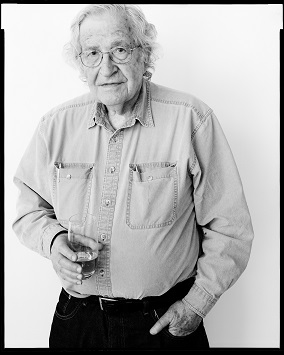
| QUESTION: Businesses want to trade with the Soviet
Union, with Libya, with many communist and socialist countries. Do you
think, with the changes in technology and the creation of a genuine
world market, that there may be the beginnings of a conflict between
straight business interests and the traditional American foreign
policy goals of controlling foreign countries?
CHOMSKY: That is a conflict that goes back to the origins of
imperialism. Take say, the early 1920s. There were plenty of
businessmen who wanted to trade with the Russians, but the state
blocked it. In the early 1950s, there was a major split in the
business community about how to deal with China. There was a group
that just wanted to open up trade and commercial interchange and so
on, and there was another group that wanted to take a very harsh
posture and to drive them into the hands of the Russians, and
ultimately, overcome them. In fact, into the late 1960s, the State
Department planners still had the idea that maybe we could break up
China, we could restore the old order in China. This is the
distinction between what Mike Klare once called the "Traders" and the
"Prussians." Basically, you have the same goals, but there is a
question as to whether to achieve the goals by economic power or
whether to achieve them by violence.... It is a matter of tactics....
In the Middle East, for example, the goal has always been to maintain
control over oil. Not because we need it, [but] because it is one of
the ways we control our allies. By having control over the energy
system, you have a big effect on the whole world system. So the
question is, how do we do it? The two approaches are reflected very
clearly in the split between [William] Rogers and [Henry] Kissinger
around 1970. Rogers' position was that you do it by the method of the
Traders, so he was, for example, in favor of a negotiated settlement
of the Arab-Israeli conflict along the lines that had very broad
support at the time. Kissinger, on the other hand, thought you do it
by violence, so he wanted to maintain, in fact construct an Iranian,
Israeli, Saudi Arabian alliance which would pretty much control the
region by force.... With regard to every part of the world ... the
goals are the same. You want to insure domination. The fact that those
people will trade with you is not enough. Russia will trade with you
but you can't control their economic decisions. That is the
problem.... American corporations cannot control investment decisions
in the Soviet Union. They are going to go their own way. They are
independent of our domination. If they want to devote their resources
to domestic consumption, they will do it. They are not going to devote
them to export-oriented production because that is what we want. That
is the problem down to tiny, little countries. Anywhere from the
Soviet Union to Grenada, it is the same problem.
QUESTION: To what extent can the United States impose its will?
CHOMSKY: In the late 1940s the world system was extremely unusual
from a historical point of view. The United States literally had 50
percent of the world's wealth. There has never been a period in human
history when one country had such overwhelming domination from an
economic, political and military point of view. Well, that naturally
had to erode and it has eroded and now the world system is
considerably more complex. There are numerous centers of power, there
are rising industrial countries such as Brazil, there [is] increasing
independence among the raw materials producers all over the world and
that means that new groupings of powers can [form], which can
challenge the decisions made by the master of the world market and can
begin to move in their own direction....
QUESTION: But in what direction? Won't their choices be dictated by
their own economic interests?
CHOMSKY: 'Own economic interest' is a misleading term because
countries don't have economic interests, groups inside of them do and
those interests may differ.
QUESTION: Precisely, and ruling groups will be out to maximize
their profits.
CHOMSKY: Not necessarily. That assumes capitalist domination of
every country. But suppose you get a government that does what the
U.S. has always feared more than most anything at all-- directs
resources to domestic development? Here we don't have to speculate. We
can go back to high level, declassified documents, which are very
explicit about this topic.... Take Latin America for example. As far
as I know the most serious and important review of U.S.-Latin American
policy was in 1954, right after the Guatemalan democracy was
overthrown. NSC5432, which is U.S. policy with regard to Latin
America, [is a] long comprehensive and detailed study [that] gives an
analysis of what our general policy must be towards Latin America and
is very clear and explicit. It says the primary concern is what they
call "nationalistic regimes," which are responsive to the demands of
the masses of the population for an improvement in their low living
standards and for diversification of production. In contrast, we have
to organize export-oriented production and integration into the world
market, and not nationalism, not use of resources for domestic needs.
They are not allowed to devote their resources to say, subsistence
agriculture, but rather to export crops.... The way to do this [was
for us] to take control of the Latin American military. Now at the
time that meant fighting France and England, we had to eliminate
French and British training missions which still existed in Latin
America. They were of course our ... real competitors. [I]n the future
... the real enemies are going to be Europe, Japan and other
functioning economies, not the Russians....
QUESTION: What is the economic interest now in Central America?
CHOMSKY: The economic interest is, first of all, resources and
resource extraction.
QUESTION: But the resources to be extracted in Central America are
minimal on a world scale.
CHOMSKY: Yes, but that is not what counts. General Motors does not
decide to give up its franchise in Tucson because that is a small
percentage of its income. They fight to keep their franchise in Tucson
and we fight to keep our franchise in Central America. They may not be
right, but they think Central America and the Caribbean is a potential
East Asia. The only [area] of the colonial world that has developed is
the Japanese area and there is a reason for that. Imperial powers are
brutal, but brutal in different ways. Japanese imperialism was very
brutal but in a developmentalist way. So while we were robbing our
colonies, Japan was building its colonies in the pre-second world war
period and there was significant industrial development in Taiwan,
Korea, and so on....
QUESTION: What would be the harm in letting a country like
Nicaragua go its own course?
CHOMSKY: Here we come to another long standing concern of American
planners which has never been abandoned.... That is the rational
version of the domino theory. There are two versions of the domino
theory. One of them is crazy. That is the version that is used to
scare the public: 'They are going to land in San Francisco.' But there
is also a rational version. And the rational version is that there
could be a demonstration effect. If any country can fall into the
hands of nationalist leaders who devote resources to their own
populations, it could very well have a demonstration effect. It could
be a virus that will infect the region and even beyond.... What was
the concern about [Salvador] Allende? They are going to be able to get
the copper. It is the virus of Allende. [It] will send the wrong
message to Italy, not because Chile is going to conquer Italy, but
because you have a big communist party there, you have a big workers'
movement, which has never been destroyed despite many efforts, and if
they see that there is a possibility of developing democratic
socialism, it will inspire them to try the same thing. Before you know
[it], the whole system [will] erode. ... What they care about is that
you might begin to get what we have always feared, workers controlling
industry, for example, and separation from the U.S.-dominated
international market where the multinationals, which by now are much
beyond the United States, do run the world market and their
international institutions like the IMF and the World Bank control it
and the big powers like us exercise violence when necessary and so on.
That is, a complex integrated system functioning for the benefit of
elite groups, economically powerful groups in our system, and in the
major capitalist countries. And if this begins to erode there is a
real problem.... Radical democracy in the United States is a threat to
the conservative world order because it can spread. It can arouse the
'wrong ideas' among other people and pretty soon our system of power
and privilege will collapse. That threat still exists and it will
always exist. This idea is never abandoned because it is correct....
People often say, 'What do we care about Grenada?' You can't imagine a
place in the world of less economic significance than Grenada.
Nevertheless, as soon as [Maurice] Bishop took power, it caused
hysteria in Washington. They had to destroy Grenada. It was true of
Carter, it is true of Reagan. They immediately embargoed, cut off
support, started running big military manuevers all over the region to
try to drive them into the hands of the Russians and terrorize them
and then finally invaded. What do they care about Grenada? It has
100,000 people and some nutmeg. But the point is the weaker a country
is, the more insignificant it is, the more dangerous it is.... That is
why you get this hysteria about places like Grenada or Laos in the
1960s and other tiny little specks of dust -- because the
demonstration effect is greater when the country is weaker. And that
is very rational.
QUESTION: Does the increasing power of the world market mean that
U.S. corporate interests will no longer have to be concerned about
controlling countries politically?
CHOMSKY: I don't think so. There is a force toward integration of
the world market and so on. But there is a corresponding feature of
that: namely, the diversification of the international system which
allows groupings of powers to gain a capacity to pursue a different
path that they didn't have previously. And that is very threatening to
those who intend and expect to dominate the world system. There has
been concern about this kind of autonomy for years. Since the late
1940s there has been a concern among the smarter planners, people like
George Kennan, that eventually Japan would reconstitute itself as a
dominant force. So for example, in the late 1940s when most U.S.
planners were convinced on mainly racist grounds that Japan was never
going to be able to export anything but toys, smarter people like
Kennan, who had major power in shaping the post-war world, recognized
that eventually they could be a real competitor and therefore we had
to guarantee some method of control. The method he suggested, which
was in fact followed, was to control their energy resources. So Japan
was allowed to reindustrialize but not to develop petrochemical and
refining industries and so on. And in fact, part of our concern for
controlling Middle East oil has been to insure that that lever remains
in our hands. But the trouble is that is not happening anymore. Japan
is beginning to set up its own independence with the oil producers and
Europe might do the same thing. Here the issue is quite complex....
Japan separated itself from the world market and pursued its own
independent development and is the only what we call Third World
colonial country to have industrialized....
QUESTION: Isn't it possible though that at some point the market
itself may start to provide the service of undermining popular
movements without the need for more direct applications of force?
CHOMSKY: I think you can find areas where it is happening in the
United States itself. Through American history it has been necessary
repeatedly to use violence to prevent democracy from developing....
Labor unions are one of the classic ways in which isolated people who
lack individual resources can join together to enter the political
system. And that had to be blocked. That is one of the reasons we have
such a bloody labor history. After a while, the forces of the market
took over. So, in the United States you don't need censorship.
Censorship is carried out by corporate media who control through
market forces and shape news in their own interest.
QUESTION: To what do you attribute the move by the socialist
countries toward market organization internally and some limited
opening up of their economies to the world market?
CHOMSKY: These so-called socialist countries, which have absolutely
nothing to do with socialism, these kind of state bureaucracies
dominating them along the Leninist model, the exact antithesis of
socialism, they are highly inefficient. They are inefficient in
control of the public, they are inefficient in production and so on,
and the market in fact is an efficient way of allocating resources.
Markets don't have to be used for distributing benefits; that's where
the problem started arising. But in determining things like resource
allocation, a market is a rational system and so they will move toward
those systems in the effort to increase the viability of their own
elite groups. Now that is going to lead to internal tensions. Take,
for example, the Soviet Union. One of the benefits that the working
class has had from the limping Soviet economy is that they don't have
to work very hard. But if you start introducing incentives and market
forces you [have] to work and you have to suffer. That is why
industrialization was such a brutal process in the West. And it is not
so clear that the working classes will be willing to accept the
requisite suffering for the hope of ultimate consumption. Certainly in
the West it never happened very easily. It had to be done by force.
And you can't predict what will happen there, whether they can do it
by force, or whether they can bring it about without force. But
industrialization has been a brutal process and I think those problems
are going to arise very quickly as they shift to market techniques for
allocating resources and making production decisions.
QUESTION: Politically, how important is the way the media is
organized, the actual corporate structure -- who owns the newspapers,
how many newspapers there are in the given town, the way the TV
networks are owned and regulated?
CHOMSKY: It is very important. In the United States, you can't see
it very much because ... we are much more advanced in the departure
from meaningful democracy than other countries. But elsewhere, in
rather similar societies, you can see it. England is not a terribly
different kind of place than we are, but up until the 1960s, England
had a very lively and effective labor press. The Daily Herald in
England ... if I remember correctly [had] twice the subscriptions of
the London Times, the Financial Times and the Guardian put together in
the early 1960s, and in fact, the polls showed that it was more
intensively read and more eagerly read by its subscribers, but it was
a working class newspaper. It presented an alternative view of the
world. Now it doesn't exist. The working class newspapers have become
cheap tabloids, which are sex, sports, and so on, part of the
decerebration of the masses. This [did not] happen by force. The
police didn't come in and close them down. It happened by market
pressures. Newspapers are corporations that sell a product, namely
subscribers, to buyers, namely advertisers. So a newspaper or any
journal is basically a corporation selling a product to other
corporations. The way you sell them is by looking at the profile. If
you want to have resources in this system, you are going to have to
have advertiser support in capital. And that means for one thing you
are going to have to adhere to their view of the world, but it also
means that you are going to have to be oriented towards the wealthier
readers with the normal advertising profiles that all of these guys
run on. These factors are going to drive out an independent press. It
happened in the United States a long time ago. It happened in England
fairly recently and the effects are very striking.... When the Labour
Party runs in England, it is just demolished by the entire information
system. And that makes a difference. In part, this is based on the
nature of the corporate media.... However, in my view, it wouldn't
change very much even if they were more diversified....
QUESTION: Why wouldn't it?
CHOMSKY: Because the same social forces would essentially operate.
If there were, say, two newspapers or three newspapers in Boston
instead of one, there would probably not be that much difference. It
is some difference, you lose something, but, I must say that I don't
want to underestimate it. When you cross the borders you see a big
difference. Every time I go to Canada, for example, which is a very
similar country, or England, or Europe, there is access to national
media, national television, the press, and so on. That is unimaginable
in the United States.
QUESTION: You said that if the organization applied in the
workplace in capitalism were applied in the political sphere it would
be called fascist. What do you mean by that?
CHOMSKY: If you go back to an early period, take even the ideals of
the enlightenment that theoretically underlay the American revolution,
they were concerned with certain general human values -- the right of
human beings to control their lives and their own work, and in fact,
to control their creative work. So a leading idea of what we today
call conservatism, the enlightenment thought was that if a person
works under the command of others, what the person produces may be of
value or even beautiful, but the person's life is a human disgrace, it
is a form of slavery. The person is a machine [was] the way they put
it. And the ideals of the enlightenment worked to let people be human,
and human meant in control of the decisions that affect their own
lives, in particular, in control of their workplace. These discussions
were all [conducted] in a period prior to factories and prior to
corporate capitalism, so they [were] directed against slavery and the
feudal system and serfdom.... But the same ideas carry over to later
developments and it means that if we are really serious about
enlightenment ideals, we will try to turn the productive lives of
people into a democratic system that they control and where they make
the decisions and where they make them in community with others. That
is socialism, not what we call socialism or what the Russians call
socialism, but what it meant prior to the distortion that was
introduced by the anti-socialist forces of the 20th Century, including
capitalism and Marxism/Leninism, all of them very hostile to socialist
ideals.... At the core of it is the central part of most human beings'
lives, namely, their productive work and that means workers
controlling industry. Just about any workplace, whether it is an
office or a factory, or whatever, is a system where there is a flow of
command that is centralized at the top and goes straight down to the
bottom and there is nothing that goes in the other direction other
than some symbols that are introduced to make people feel good
sometimes. These are very traditional ideas. They have been forgotten.
What I have just been saying would not have surprised the major
thinkers of enlightenment, the people we now regard as classics.
QUESTION: There seems to be a convergence between the way the
capitalist managers and the managers in the socialist countries
organize the production in their factories. Is this because both have
made the same ideological choice or both have personal or class
interests in organizing it that way or is there also a tension with
the needs of efficiency and production?
CHOMSKY: There is no evidence that it has anything to do with
efficiency, and even if it did have anything to with efficiency, it
would be irrelevant.... The distribution of power and the course of
history was such that those groups who could gain their power and
privilege by exerting authority over the control of production did so.
We have various forms of state capitalism in the West and various
forms of military bureaucratic control in the East. They are all very
much opposed to socialism. In fact, there has been a kind of hoax
perpetrated on the world by the world's two leading propaganda systems
since 1917. The two major propaganda systems in the world are the
American one and all of its affiliates and the Soviet one. And they
both like to pretend that what exists in the Soviet Union is socialism
... and they do it for opposite reasons. In the West we do it because
we want to defame socialism by associating it with that dungeon over
there. And in the East they want to do it by making their dungeon look
a little better by associating it with the deservedly positive appeal
that the moral values of socialism have to working people everywhere.
QUESTION: Where has real socialism or something approaching it
actually been tried?
CHOMSKY: It has been tried here and there, but it has usually been
destroyed. In fact, it has often been destroyed by the joint activity
of the Soviet Union and the United States.... Spain is a good
example.... The western capitalist countries and the Soviet Union
combined to destroy the popular revolution in Spain. That was the main
commitment on all sides and it really wasn't until the large scale
popular revolution had been wiped out.... that they fell to fighting
among one another for the rest of the loot. And that's rather typical.
The Soviet Union would certainly not tolerate any socialist
development anywhere, nor would we. There [are] some similarities in
the societies. They are both class structured and societies with a
state management and a coordinator controlled industrial system. They
obviously differ too. They don't have private control over capital the
way we do, but in many respects the systems are similar in their
doctrinal systems. They are mainly similar in their belief that people
have to be subordinated to higher authority. It is [a] different
higher authority in the two cases but subordination is accepted on
both sides.
QUESTION: You have said that totalitarian states have to control
action but democracies have to control thought. Can you explain that
distinction?
CHOMSKY: Totalitarian states are really more behaviorists, since
they have the means of power. [They] don't want to exercise violence
because it is inefficient, but they want the threat to be there and to
be visible. In a country like ours, where the state has very limited
means of violence available to coerce the population, comparatively
speaking, it is much more important to control what people think. And
that is in fact why the United States developed so early such a
sophisticated systems as the public relations industry and the highly
ideological corporate media. That process is continuing, and its
effects are very complex.... There is a real split developing between
much of the population and the elites, including the liberal elites.
There has undoubtedly been a right turn among elites, so you get what
they call "neo-liberalism" and "neo-conservatism," which are dominant
among elite groups. But the population has not moved in that
direction. The population is moving in the opposite direction.
QUESTION: What will be the legacy of the so-called Reagan
Revolution?
CHOMSKY: In many ways, it has certain similarities to what was
called the Hitler revolution. Putting aside atrocities and massacres
and that sort of thing, just look at the mechanics of it. Hitler's
revolution was Keynesian economics -- pre-Keynes, of course --
revitalizing the economy through military spending, which worked. It
got Germany out of a huge depression, got people back to work, created
affluence. They had restored faith in the grandeur and the glory of
Germany, winning cheap victories over defenceless rivals, which gave
people a big shot in the arm and aroused patriotism and restored what
they called the traditional values -- home, family, devotion and so
on. That is all very familiar. In fact, these are the basic
ingredients of what are today called, ludicrously, "conservatism" in
the United States. You take the modern conservatives, the people
around Reagan, guys that are straight out of Orwell. Any conservative
would turn over in his grave to hear the way the word is used, but
these are people who believe in a very powerful state. That is not at
all surprising, that under Reagan you have all the phenomena of
lunatic Keynesianism -- massive expenditures, but expenditures not for
productive purposes, but for consumption and waste. Military
production, after all, is a waste production from an economic point of
view.... So what you have is a very substantial increase in state
expenditures. In fact, state expenditures [increased] under Reagan,
relative to GNP, faster than in any peacetime period in history. The
state intervenes massively in the economy, in the highly protected
economy that they constructed. That is what the military is, a
state-guaranteed market for high technology production. Looking at it
institutionally, it is ...somewhere between lunatic Keynesianism and
quasi-fascism -- a big, powerful state creating a protected market,
guaranteeing that the production that is done in advanced industry
will have a market because the state will buy it.... From the point of
view of the corporate manager, you couldn't imagine anything better.
It is a gift, a gift from the public for research and development and
for production in a period when you cannot sell things.... The
Reaganites have pushed that to an extreme. |