
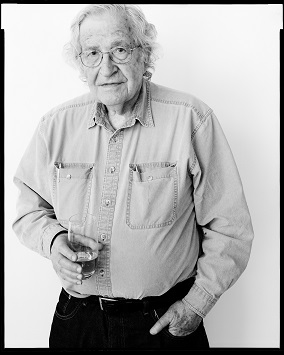
| CHOMSKY: I am asked "to address the subject of
U.S. defense responsibility for the rest of the world and why America
need not perpetuate this role." The question is unanswerable; there is
no such role. States use their power to defend "the national
interest," a mystification devised to conceal the special interests of
those with domestic power. Typically, this policy is disguised in
high-sounding rhetoric, which we dismiss with contempt when the
official enemy "defends freedom and socialism" by sending tanks to
Berlin, Budapest, Prague or Kabul, while solemnly reciting it when our
own state acts in a similar way. When the U.S. Air Force began the
systematic bombardment of rural South Vietnam in 1962, it was
defending those who were concerned over the "domino effect" of a
successful nationalist-Communist revolution that might be emulated
elsewhere. The aggression was masked as defense against "internal
aggression" by Vietnamese, indeed South Vietnamese. In 1947, Truman
announced that the U.S. would "support free people who are resisting
attempted subjugation by armed minorities or outside pressures,"
specifically the Greek royalist elites and Nazi collaborators restored
to power by the British army, by then unable to repress the rebellion
caused largely by British-backed terrorism. The U.S. proceeded to
defend the Greeks from "internal aggression" by supervising a program
of massive repression, tens of thousands of political prisoners and
exiles, political executions, re-education camps, forced population
removal, etc., exactly as any rational person reading the Truman
doctrine would have predicted. In this case too what was feared was
the domino effect. When the U.S. backed an invasion force in Guatemala
in 1954, overthrowing a mildly reformist democratic government and
installing a regime whose descendants still adminsister a huge reign
of terror, it was defending "the national interest" but nothing else.
The same is true of the destruction of the peasant society of northern
Laos, the arming of mass murderers in Indonesia and El Salvador, and
on and on.
In each case, the propaganda system invokes the threat of the
superpower enemy, exactly as the U.S.S.R. does. The cold war has been
highly functional for the superpowers, providing each with a framework
for carrying out its designs within the reach of its power. Hence its
persistence, despite the threat of mutual annihilation.
The world, however, is not what it once was. The relative decline
of Soviet and American power brings forth new and increasingly
assertive rivals. The EEC [European Economic Community] is moving
slowly towards a more independent role, which may engage it in
conflict with the U.S. in the Middle East and elsewhere. Similarly,
Japan. Before long, pursuit of "the national interest" may require new
programs, new forms of violence and terror, and new rhetoric.
From Spring 1978:
QUESTION: Is corporate responsibility a dead issue?
CHOMSKY: I'm afraid that I cannot discuss the question as put,
becuase I do not accept some of its presuppositions, specifically with
regard to the legitimacy of corporate power. Suppose, for example,
that I were to ask, with regard to some political oligarchy, whether
or how such centralized power might be exercised in a more "socially
responsible" way. The point is that such concentration of power is
illegitimate in the first place; and what is more, whatever doctrine
anyone proposes, it will be used for the benefit of those who wield
it, primarily. Apart from random exceptions, they will act in a
socially responsible way -- as benevolent despots -- when social
strife, disorder, protest, etc., induce them to do so for their own
benefit. The situation is not materially different when we turn to the
economic domain. I see no more justification for concentration of
private power here than in the political domain, or any reason to
expect it to be differently employed.
In a true capitalist society, if such an object were to exist,
socially responsible behavior would be penalized quickly in that
competitors, lacking such social responsibility, would supplant anyone
so misguided as to be concerned with something other than private
benefit. In a real capitalist society, with only limited competition
and substantial state control, as is and has always been required to
safeguard social existence in the face of the destructive forces of
private capitalism, it is possible for those who have concentrated
power in their hands to be more or less benevolent in its use. But the
central questions seem to me to be the ones that I have just
mentioned, which are not addressed, but rather begged in this inquiry. |