
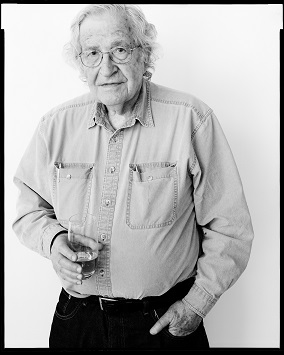
| QUESTION: Do your views about Man hint at some
kind of sympathy with a man like [R. D.] Laing who sees many mystical
elements in Man, that are maybe too random to be encompassed by a
finite science?
CHOMSKY: I would look at it differently, I think. I would just take
it for granted that a human being is a biological organism like any
other. It's a biological organism with a very unique intellectual
capacity that we are only barely beginning to understand. I think our
intellectual capacities are very highly structured. They are our
biological specialization. These biological structures enable us to
construct extremely rich, very penetrating systems, scientific
theories if you like. Some of them are common sense. Some of them are
articulated, which allows us to understand things rather deeply, far
beyond any evidence that's available to us. However, these same
principles which give such enormous range to our system of
understanding also limit its scope. These two facts are very closely
linked together. Any sort of principles that enable you to construct a
rich theory on the basis of limited data, also is likely to limit the
class of possible theories that you can attain. Now it may very well
be among the theories that we are able to attain by our biological
endowment there is included the theory of mind, or it may be among the
theories that we are not able to attain is included the theory of
mind. In that case, it will appear that human beings have mystical,
unintelligible properties because we as biological organisms will not
have within our range (which is obviously a finite range) the theory
which would, in fact, explain it. There's nothing inconsistent about
that. We are biological organisms. We are capable of constructing
certain systems and understanding certain scientific theories. It's an
open question whether those scientific theories happen to include the
true theory of some domain that happens to interest us. It may or it
may not. If it does not, that domain will appear to be mystical. It
will only be a higher organism or a differently endowed organism that
will understand it. But I think that's about all that can be said.
QUESTION: So, you think it is finite? Professor [Michel] Jouvet
told me that he thought psychology is so finite it's about reached the
end of the road. Presumably you see a time when it will have reached
the end of the road.
CHOMSKY: I think human intelligence will reach the end of the road
except for details. We'll always be able to learn more details, more
specific facts. I think it's quite possible, at some point, we will
have exhausted our intellectual capacities in some domain. And, I
suppose, at every stage of history that seemed to have happened, it
turned out to be false. I think one could build a kind of case, a
mildly persuasive case, that we have reached a stage not in psychology
but in many other domains. A very striking fact about
twentieth-century modernism is the move in one area after another, in
art, in poetry, in music, in certain parts of science, into a kind of
unintelligibility. I think there's no period in the brief history of
Western civilization in which the creative achievements of artists
were so remote from the common consciousness and understanding of
non-artists. I think it's conceivable that this does indicate a
reaching the limit or approaching the limit in certain domains of
intellectual and creative achievement.
QUESTION: Is that true of psychology?
CHOMSKY: Frankly, I don't think it's true in any sense of
psychology. Psychology has barely come into existence. It's just
beginning to ask some of the questions that might lead to a future
science. But someday it will happen -- precisely because we are
biological organisms with fixed capacities that provide both the range
and, ultimately, the limit of our understanding. ...
QUESTION: Ever since your work became so influential, there's been
a tendency to try and construct a grammar of non-linguistic kinds of
human interaction. Is it likely that the model of language will turn
out not to be a unique model?
CHOMSKY: Well, it depends. I think myself -- and this is
speculating -- we don't have the results or the knowledge at this
point. But I think it's very likely that the grammar of the system of
language does reflect a special faculty of the mind. I think it would
be surprising if there were very striking or strong analogies between
our innate capacities to acquire linguistic systems and our innate
capacities to acquire an understanding of social reality or the
physical world. There's no particular reason why they should be
modeled on the same set of principles. But, at a certain high enough
level of abstraction, the systems will of course observe similar
principles and be in some way interrelated. However, I think I
wouldn't suggest if someone is interested in social interaction that
they should try to apply the model of transformational grammar. But
what I'd do is approach the problem in the same manner which is
borrowed from the physical sciences -- namely, to ask, what is the
system, what is the system of belief that governs the behavior we are
observing? Let us discover the competence that underlies the behavior
of a person in a social situation if that is that the topic. And
having developed an understanding of that competence, that internal
system of beliefs and knowledge, then we have first to ask the
question, what is it that's learned? Let us discover as scientifically
as we can what we can about the system that's been acquired and call
it the grammar, if you like it. Then, having, to the extent that we
can, answered that question, we can sensibly raise the question of
learning for the first time. The question of learning is the question
of how that postulated system arises. On the basis of interaction with
the environment, the question about learning can't be asked except to
the extent that we already have some picture, some postulate, some
concept as to the acquiring of the system. So, in this respect, I
would think that any approach to psychology ought to follow the model
of linguistics or, I hasten to say, it's not the model of linguistics
but the model of any rational endeavor. And the fact that
psychologists regard that as strange and curious is just a comment on
how remote that kind of psychology is from rational endeavor and from
the sciences in particular.
QUESTION: Do you think that stems from the American preference for
studying actions rather than thought?
CHOMSKY: Well, now you've raised the question of why behaviorist
psychology has such an enormous vogue, particularly in the United
States. And I'm not sure what the answer to that is. I think, in part,
it had to do with the very erroneous idea that by keeping close to
observation of data, to manipulation, it was somehow being scientific.
That belief is a grotesque caricature and distortion of science but
there's no doubt that many people did have that belief. I suppose, if
you want to go deeper into the question, one would have to give a
sociological analysis of the use of American psychology for
manipulation, for advertising, for control. A large part of the vogue
for behaviorist psychology has to do with its ideological role.
Behaviorist psychology is pretty empty as an intellectual pursuit, in
my opinion. But it does have an important ideological role. For
example, it's considered not nice to treat human beings by the
techniques of the police state. It's not nice to coerce people or to
control them or to train machine guns on them. But, on the other hand,
if you have a mass of people you want to control and you can claim
you're not doing anything ugly like that but just applying the methods
of science which, as everyone knows, are neutral and good and
benevolent and achieve the same result, that's much more palatable.
Much more acceptable. So one finds, let's say, in total institutions,
in institutions in which masses of people are placed subject to
external controls, like prisons, schools and mental hospitals, not
quite even that behaviorist psychology is in vogue but that it
provides support. It may even sharpen and refine the methods which are
known intuitively to anyone who has to control masses of people. It
provides a kind of palatable ideology for the application of these
techniques of coercion.
QUESTION: [Behaviorist B. F.] Skinner, in fact, says that one of
the reasons why he feels badly misunderstood is that people think he
advocates greater controls. What he's been trying to do is to show
people the way they were and could be controlled so they could guard
against it. Is that fair do you think? Or does it go against the whole
trend of his thought as you see it?
CHOMSKY: I think one has to distinguish what Skinner himself may be
trying to do from something quite different -- namely, the question of
why it has such appeal. These may be very different things. As to what
he may be trying to do, I can't say. I don't have any idea of what he
may be trying to do. I've looked at his work pretty carefully and I
have never been able to discover or tried to impute to him any motives
in particular. I don't know what they might be. It seems to me that
when he gets away from the investigation of partial reinforcement --
when he does things like one finds in Beyond Freedom and Dignity
-- it's basically trivial and wouldn't be taken seriously by anyone if
it weren't for the fact that it fills a certain role for those who are
accepting the system. Now, the role it fills for them may be very
different from anything he intended. So, my point is when one gives
anything like a close analysis to the system Skinner proposes -- and
I'm not talking now of his detailed studies of conditioning and
reinforcement, they are what they are, but I am talking about what he
calls his extrapolations in which he's showing people how they are
controlled, what the system of controls is, and trying to build up a
social philosophy -- well, that second Skinner, as far as I can see,
is almost entirely empty. You cannot find a substantive thesis that's
even worth discussing, let alone refuting. And therefore no serious
person would pay the slightest attention to it on the basis of its
actual intellectual content. Yet people do pay enormous attention to
it and it's enormously influential. The reasons may have nothing to do
with content or with what Skinner's intentions may be, which I know
nothing about. All I'm saying is that the appeal and the acceptance
has to do with other matters: namely, that the system, though quite
vacuous, does provide a kind of aura of acceptability for techniques
of control and coercion that are very naturally sought in situations
where people have to be controlled, coerced and guided. Now I'm not
imputing to Skinner that intent. That's my point....
QUESTION: Professor [David] McClelland believes that many of the
people who went into psychology did so in reaction to a very strict
religious upbringing. Was that so in your case?
CHOMSKY: No, quite the contrary in fact. I was very much involved
in radical politics. Involved is a funny word. I was never part of an
organized movement. I was very much a loner in that respect. That was
my main interest in life by the time I was thirteen or so. I had
convinced myself that all of the organized movements, namely, the
Communist Party, the Trotskyites, were quite reactionary basically.
And, at a kind of fourteen-year-old level, I had worked myself into a
left-wing Marxist or Marxist-anarchist position which was critical of
any authoritarian tendency and regarded them as, basically,
reactionaries of some sort who had taken on a kind of socialist
terminology. And I had no particular place to go with this belief till
I met [linguist Zellig] Harris. And I met him... he was a very acute
social critic. He's never written about it but a lot of people have
been influenced by him politically. Surprising people, who passed
through his influence at some formative stage in their lives. And I
was one. I met him at a time when I was going to drop out of college,
which seemed a stupid waste of time. I had no interest in anything I
was doing in college. I was planning at that point -- it was 1947 --
to go off to the Middle East and to work on an Arab-Jewish
working-class movement of a sort that I dreamed at that time, whether
it existed or not, and I'd live in a kibbutz which, incidentally, I
later did. Though I had entered college with a great deal of
enthusiasm, by the time I'd had two years, I'd had all the enthusiasm
knocked out of me. Every course I took convinced me it was completely
boring, and not for me. It wasn't till I met Harris that I found
anything intellectually stimulating, though my contact with him was
originally through radical politics. So that's the actual
background... |