
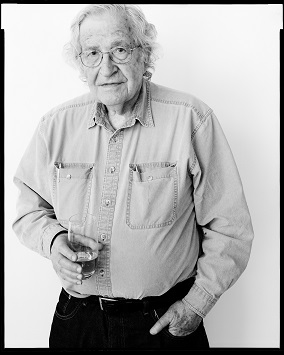
| QUESTION: You've just returned from a series of
talks ... There were the by now customary huge turnouts and standing
ovations and the like. But I sense you feel some disquiet. What's that
about?
CHOMSKY: To tell you the honest truth, when I see a huge mob, which
is pretty common these days, I have a mixture of feelings. Partly, I'm
sort of depressed about it, for a lot of reasons. For one thing,
there's just too much personalization. It doesn't make any sense. It's
worrisome. The other thing is that the ratio of passive participation
to active engagement is way too high. These were well-arranged talks.
For example, they did what a lot of people don't do and ought to do.
Every place I went there were a dozen tables outside with every
conceivable organization having leaflets and handouts and sign-up
sheets and telling what they're up to. So if people want to do
anything, there are easy answers to what you can do in your own
community. The question that comes up over and over again, and I don't
really have an answer still -- really, I don't know any other people
who have answers to them -- is, "It's terrible, awful, getting worse.
What do we do? Tell me the answer." The trouble is, there has not in
history ever been any answer other than, "Get to work on it."
There are a thousand different ways to get to work on it. For one
thing, there's no "it." There's lots of different things. You can
think of long-term goals and visions you have in mind, but even if
that's what you're focused on, you're going to have to take steps
towards them. The steps can be in all kinds of directions, from caring
about starving children in Central America or Africa, to working on
the rights of working people here, to worrying about the fact that the
environment's in serious danger. There's no one thing that's the right
thing to do. It depends on what your interests are and what's going on
and what the problems are, and so on. And you have to deal with them.
There's very little that anybody can do about these things alone.
Occasionally somebody can, but it's marginal. Mainly you work with
other people to try to develop ideas and learn more about it and
figure out appropriate tactics for the situation in question and deal
with them and try to develop more support. That's the way everything
happens, whether it's small changes or huge changes.
If there is a magic answer, I don't know it. But it sounds to me as
if the tone of the questions and part of the disparity between
listening and acting suggests -- I'm sure this is unfair -- "Tell me
something that's going to work pretty soon or else I'm not going to
bother, because I've got other things to do." Nothing is going to work
pretty soon, at least if it's worth doing, nor has that ever been the
case.
To get back to the point, even in talks like these, the organizers
told me they did get a fair amount of apparent engagement. People
would ask, Can I join your group? or What can I do? or Do you have
some suggestions? If that works, okay, it's fine. But usually there's
a kind of chasm between the scale of the audience, and even its
immediate reaction, and the follow-up. That's depressing.
QUESTION: You continue to be in tremendous demand for these
speaking engagements. Are you considering stopping?
CHOMSKY: I would be delighted to stop. For me it's not a great joy,
frankly. I do it because I like to do it. You meet wonderful people
and they're doing terrific things. It's the most important thing I can
imagine doing. But if the world would go away, I'd be happy to stop.
What ought to be happening is that a lot of younger people ought to be
coming along and doing all these things. If that happens, fine. I'm
glad to drift off into the background. That's fine by me. But it's not
happening much. That's another thing that I worry about. There's a
real invisibility of left intellectuals who might get involved. I'm
not talking about people who want to come by and say, "Okay, I'm your
leader. Follow me. I'll run your affairs." There's always plenty of
those people around. But the kind of people who are just always doing
things, like whether it was workers' education or being in the streets
or being around where there's something they can contribute, helping
organizing -- that's always been part of the vocation of intellectuals
from [Bertrand] Russell and [John] Dewey on to people whose names you
never heard of but who are doing important things. There's a visible
gap there today, for all kinds of reasons. A number of people involved
in these things have been talking about it. I'm sure you've heard of
others.
QUESTION: I wouldn't entirely agree. There are some voices out
there, like Holly Sklar, Winona LaDuke, and others that represent a
younger generation.
CHOMSKY: It's not zero. But I think it's nothing like the scale of
what it ought to be or indeed has been in the past. Maybe it was that
way in the past for not great reasons. A lot of those people were
around the periphery of, say, the Communist Party, which had its own
serious problems. But whatever the reasons, I think there's a very
detectable fact. There's plenty of left intellectuals. They're just
doing other things. Most of those things are not related to, are
sometimes even subversive to these kinds of activities.
QUESTION: A talk you gave in Martha's Garden in late August on
corporate power was broadcast on C-SPAN a couple of weeks ago. What's
been the response to that?
CHOMSKY: The usual. There's a huge flood of letters that I'm trying
to answer, slowly. Many of them are mixed. Many of them are very
engaged, very concerned. People say, "It's terrible. I'm glad
somebody's talking about it. I think the same way. What can I do?"
very often. There's a strange fringe. A fair number of people
interpret me as saying things that are very remote from what I mean.
I'll get a very enthusiastic letter saying, This is great, I'm so glad
to hear it, marvelous and wonderful, thanks, etc. I'd like to share
with you what I've done about this. Then comes some document which is
in my view often off the wall, but anyway completely unrelated to
anything I'm talking about. So somewhere we're not connecting. I think
I even sort of know why. There's a strange cultural phenomenon going
on. It's connected with this enormous growth of cultism,
irrationality, disassociation, separateness, and isolation. All of
this is going together. I think another aspect is the way the
population is reacting to what's happening to them. By margins that
are now so overwhelming that it's even front page news, people are
strenuously opposed to everything that's going on and are frightened
and angry and reacting like punch-drunk fighters. They're just too
alone, both in their personal lives and associations and also
intellectually, without anything to grasp. They don't know how to
respond except in irrational ways. In some ways it has sort of the
tone of a devastated peasant society after a plague swept it or an
army went through and ruined everything. People have just dissolved
into inability to respond.
It's kind of dramatic when you take, say, the opposite extreme in
the hemisphere: Haiti. Here's the poorest country in the hemisphere.
It's suffered enormous terror. People live in complete misery. I've
seen a lot of Third World poverty, but it's pretty hard to match what
you find in the marketplaces in Port-au-Prince, let alone the hills.
Here you have the worst conceivable situation, unimaginably horrible
conditions. Poor people, people in the slums, peasants in the hills,
managed to create out of their own activity a very lively, vibrant
civil society with grassroots movements and associations and unions
and ideas and commitment and hope and enthusiasm and so on, which was
astonishing in scale, so much so that without any resources, they were
able to take over the political system. Of course, it's Haiti, so the
next thing that comes is the hammer on your head -- which we [the
U.S.] sort of help to wield, but that's another story. However, even
after it all, apparently, it still survives. That's under the worst
imaginable conditions.
Then you come to the U.S., the best imaginable conditions, and
people simply haven't a clue as to how to respond. The idea that we
have to go to Haiti to teach them about democracy ought to have
everyone in stitches. We ought to go there and learn something
about democracy. People are asking the question here, What do I do? Go
ask some illiterate Haitian peasant. They seem to know what to do.
That's what you should do.... |