
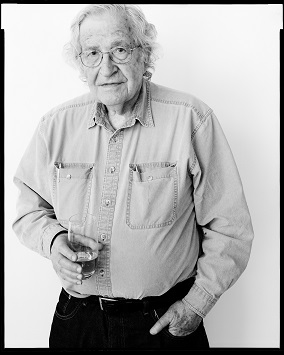
| 1928–, educator and linguist, b. Philadelphia. Chomsky, who has taught
at the Massachusetts Institute of Technology since 1955, developed a
theory of transformational (sometimes called generative or
transformational-generative) grammar that revolutionized the
scientific study of language. He first set out his abstract analysis
of language in his doctoral dissertation (1955) and Syntactic
Structures (1957). Instead of starting with minimal sounds, as the
structural linguists had done, Chomsky began with the rudimentary or
primitive sentence; from this base he developed his argument that
innumerable syntactic combinations can be generated by means of a
complex series of rules. According to transformational grammar,
every intelligible sentence conforms not only to grammatical rules
peculiar to its particular language, but also to “deep structures,” a
universal grammar underlying all languages and corresponding to an
innate capacity of the human brain. Chomsky and other linguists who
built on his work formulated transformational rules, which transform a
sentence with a given grammatical structure (e.g., “John saw Mary”)
into a sentence with a different grammatical structure but the same
essential meaning (“Mary was seen by John”). Transformational
linguistics has been influential in psycholinguistics, particularly in
the study of language acquisition by children. In the 1990s Chomsky
formulated a “Minimalist Program” in an attempt to simplify the
symbolic representations of the language facility.
Chomsky is a prolific author whose principal linguistic works after
Syntactic Structures include Current Issues in Linguistic
Theory (1964), The Sound Pattern of English (with Morris
Halle, 1968), Language and Mind (1972), Studies on Semantics
in Generative Grammar (1972), and Knowledge of Language
(1986). In addition, he has wide-ranging political interests. He was
an early and outspoken critic of U.S. involvement in the Vietnam War
and has written extensively on many political issues from a generally
left-wing point of view. Among his political writings are American
Power and the New Mandarins (1969), Peace in the Middle East?
(1974), Some Concepts and Consequences of the Theory of Government
and Binding (1982) [this is actually a book on linguistics, not politics --www.chomsky.info], Manufacturing Consent (with E. S.
Herman, 1988), Profit over People (1998), and Rogue States
(2000). Chomsky’s controversial bestseller 9-11 (2002) is an
analysis of the World Trade Center attack that, while denouncing the
atrocity of the event, traces its origins to the actions and power of
the United States, which he calls “a leading terrorist state.”
See biography by R. F. Barsky (1997); interviews with D. Barsamian
(1992, 1994, 1996, and 2001); studies by F. D’Agostino (1985), C. P.
Otero (1988 and 1998), R. Salkie (1990), M. Achbar, ed. (1994), M. Rai
(1995), V. J. Cook (1996), P. Wilkin (1997), J. McGilvray (1999), N.
V. Smith (1999), A. Edgley (2000), and H. Lasnik (2000);
Manufacturing Consent: Noam Chomsky and the Media (film by P.
Wintonick and M. Achbar, 1992) and Power and Terror: Noam Chomsky
in Our Times (documentary film dir. by J. Junkerman, 2002). |